CiCC - Memory - Working Memory
CiCC – Memory – Working Memory
Working memory = refers to the system that are assumed to be necessary in order to keep things in mind while performing complex tasks such as comprehension, thinking and learning.
Atkinson and Shifrin modal model of memory
consisting of multiple memory stores: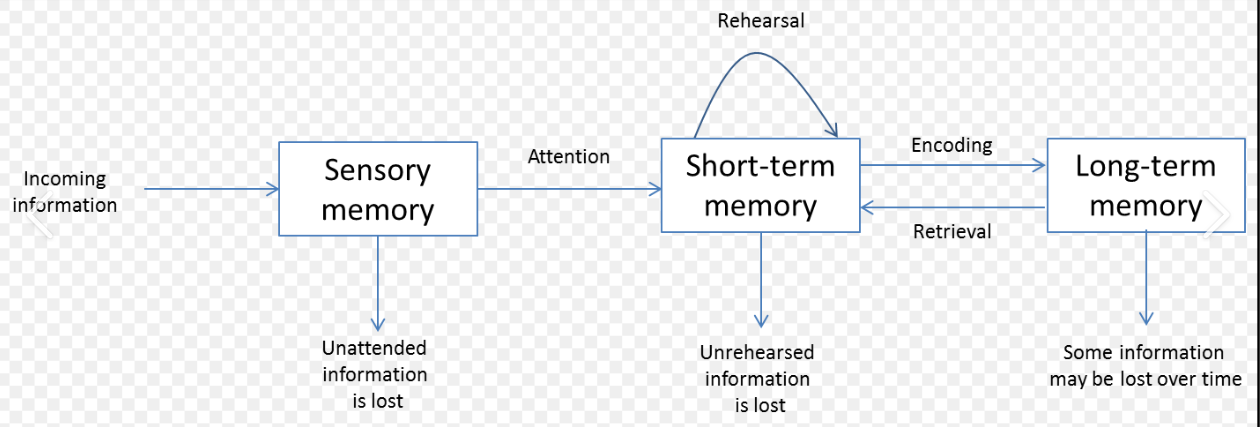
Problems with the model:
Only one short term memory store (how can you do two things at a time?)
Patients with damage to the STM still could comprehend and problem solve
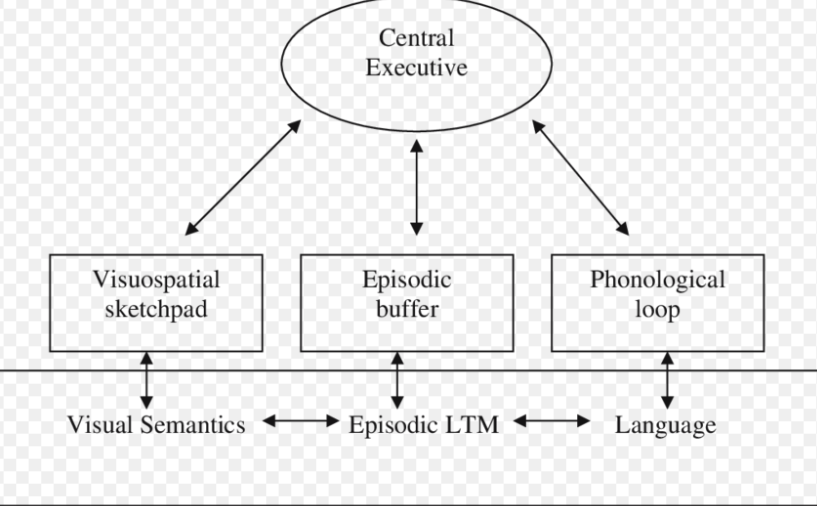 Baddeley’s working memory model
Phonological Loop:
This stores auditory information.
Capacity: 6-7 items
Amount said in 1.5 seconds. 🡨To remember words we use sub-vocal repetition (repeating it back to ourselves)
Visuospatial Sketchpad
Stores Visual information
Acts as:
“Mind’s Eye” – sequence of visually guided actions
Capacity: 6-7 Items
Problems with WMM
People can repeat back meaningful sentences ***
It has also been found that while recall after delay was highly impaired, Immediate prose recall was normal in amnesic patients (model does not account for this)
Episodic Buffer
Limited capacity system that integrates information from different sources. Holds “episodes” of information. Plays an important role in ***
There is evidence for the reactivation of episodic information. Episodic information activates widespread, specific areas of the brain.
Newer Perspective
Hierarchical Process View
***
Lerner scanned people listening to different conditions and looked for brain regions showing increased activity among all individuals (and found it) which supports the hierarchical process view in that one large part of information must be processed before the next*** (ongoing processing)
Since Working Memory is such a big concept there is unlikely to be one single accurate model