Conduction and Convection
Conduction = the process where vibrating particles transfer energy to neighbouring particles.
- Energy transferred to an object by heating is transferred to the thermal store of the object. This energy is shared across the kinetic energy stores of the particles in the object.
- The particles in the part of the object being heated vibrate more and collide with each other. These collisions cause energy to be transferred between the kinetic energy stores of particles. This is conduction.
- This process continues throughout the object until the energy is transferred to the other side of the object. It is then usually transferred to the thermal energy store of the surroundings.
- Thermal conductivity is a measure of how quickly energy is transferred through a material in this way. Materials with a high thermal conductivity transfer energy between their particles quickly.
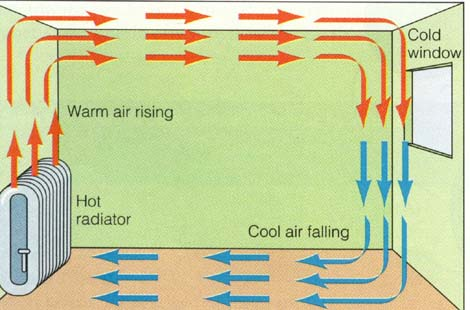
Convection = where energetic particles move away from hotter to cooler regions.
- Convection happens in gases and liquids. Unlike in solids, the particles are able to move, so they move faster and the space between particles increases. This causes the density of the region being heated to decrease.
- Because liquids and gases can flow, the warmer and less dense region will rise above the denser, cooler regions. If there’s a constant heat source, a convection current can be created.