Legal Philosophy Final
Richard Posner — The Law and Economics Movement
FINAL Study Guide Answers
1. How does Posner say that the scope of economics has expanded?
Posner argues that economics has expanded beyond traditional market transactions into nonmarket areas such as law, politics, family, crime, education, religion, discrimination, and social behavior more broadly. Economics is not defined by markets or money but by a methodological approach—rational choice, incentives, and constraints—sometimes described as economic imperialism.
2. What are some areas of law in which the use of economics is not controversial?
Economics is widely accepted in areas regulating explicit markets, including:
Antitrust law
Public utilities and common carriers
Corporate law and securities regulation
Bankruptcy and commercial law
Taxation
These areas already involve prices, incentives, and tradeoffs, so economic analysis appears technical rather than ideological.
3. What are the three basic premises of the economic analysis of law?
Individuals act as rational maximizers of their satisfaction, even in nonmarket decisions.
Legal rules function as prices, imposing costs or subsidies that shape behavior.
Common law tends toward efficiency, often producing Pareto or Kaldor-Hicks efficient outcomes, whether consciously or not.
These premises are positive (descriptive), not normative.
4. What does Posner mean by a “pricing mechanism”?
A pricing mechanism is the way legal rules impose implicit prices through liability, damages, penalties, or immunity. Even without money, law alters incentives by raising or lowering the “cost” of certain actions, allocating risk much like a market.
5. Explain fencing-out vs. fencing-in.
Fencing out: Farmers must fence crops to recover damages from wandering cattle. Efficient where cattle are numerous and crops are scarce.
Fencing in: Ranchers must fence cattle to avoid liability. Efficient where crops are abundant and cattle fewer.
Legal rules vary by region because economic conditions differ, consistent with Coasean logic about transaction costs.
6. What is the difference between ex ante and ex post regulation?
Ex ante regulation prevents harm before it occurs (e.g., censorship, licensing).
Ex post regulation punishes harm after it occurs (e.g., defamation suits).
Posner argues ex post regulation is more efficient when harm is rare and wrongdoers can pay damages; ex ante regulation is justified when harm is likely or actors are judgment-proof.
7. What are the inefficiencies of strict limits on suing for defamation?
Strict limits force victims to bear concentrated, uninsurable costs, producing:
Deadweight loss due to risk aversion
Lower-quality government as public service becomes less attractive
Adverse selection toward risk-preferring officials
This indirect subsidy to the press may be inefficient overall.
8. Why is the public/private figure distinction economically sensible?
Information about public figures produces greater external benefits. Public figures also have media access to repair reputations, reducing reliance on lawsuits. Private figures lack these advantages, justifying stronger legal protection.
9. How does Posner relate freedom of speech to external benefits?
Speech—especially political and scientific speech—produces external benefits that cannot be fully captured by property rights. This explains:
Strong protection for political/scientific speech
Moderate protection for art (copyright exists)
Weaker protection for commercial speech
No protection for threats or obscenity
The hierarchy tracks external benefits.
10. Why does economic theory predict women spend more time in church?
Women face lower opportunity costs from foregone earnings, making religious participation less costly. Posner uses this as a descriptive model of behavior under constraints, not a moral endorsement of gender roles.
11. Explain Posner’s school prayer argument.
Public education is subsidized because it produces external benefits. Public school prayer would be justified only if it:
Produces external benefits
Creates cost savings
Is voluntarily funded
Because courts do not require proof of these, school prayer would amount to an unjustified public subsidy of religion.
12. What is a “large judicially sanctioned public subsidy of religion”?
The property-tax exemption for churches, which allows them to receive public services without paying for them, functions as a substantial subsidy that courts permit without requiring proof of external benefits.
13. Why is accommodating fringe religions a good idea?
Accommodation prevents dominant religions from being implicitly favored by general laws. It promotes religious diversity and avoids monopoly-like effects, increasing “product variety” in the religious marketplace.
14. How did the Supreme Court increase demand for religion?
By:
Removing religious instruction from public institutions
Undermining traditional moral regulation
Forcing religion into the private sphere
Government and religion function as substitutes; as government retreats, demand for private religious organizations increases.
15. What evidence does Posner give that Court decisions helped religion?
Rapid growth of evangelical Christianity in the U.S.
The U.S. remains far more religious than Western Europe, where state-supported churches are common
Posner admits this evidence is suggestive, not conclusive.
16. How does Gary Becker approach the family? (lecture)
Becker treats the family as a rational decision-making unit, analyzing marriage, fertility, divorce, and household labor using:
Cost-benefit analysis
Opportunity costs
Comparative advantage
The family is modeled like a firm maximizing surplus.
Minow, Martha
Minow — “When Difference Has Its Home”
Minow — When Difference Has Its Home
Study Guide Answers
1. What are the facts of the Cleburne case? (102)
The City of Cleburne, Texas denied a building permit for a group home for mentally retarded adults. A zoning ordinance required a special permit for “hospitals for the insane or feeble minded,” which could be granted only with signatures from nearby property owners. Neighbors objected, blocking construction
2. Why are group homes needed? What is their purpose? (102)
Group homes are needed because many mentally disabled adults cannot live independently and because cost and psychological well-being favor congregate housing. Group homes are the most effective means of integrating mentally retarded persons into residential communities rather than isolating them in institutions
3. Why did the plaintiffs argue the permit denial and zoning scheme were unconstitutional? (102)
Plaintiffs argued the ordinance discriminated against the mentally retarded in violation of the Equal Protection Clause by imposing special burdens not imposed on other group residences, effectively excluding them from the community
4. What did the federal district and circuit courts say? (102–103)
District court: Upheld the ordinance under rational basis review, citing neighborhood safety and density concerns.
Fifth Circuit: Reversed, holding mental retardation to be a quasi-suspect classification deserving intermediate scrutiny due to historical mistreatment and political powerlessness
5. When does the Court apply the lowest level of scrutiny? (FN 9)
The Court applies rational basis review when no suspect class or fundamental right is involved. The government action need only be rationally related to a legitimate state interest
6. Summarize Justice White’s majority opinion. (103–104)
Justice White rejected quasi-suspect status for the mentally retarded, holding that classifications based on mental retardation require only rational basis review. He emphasized that mental retardation is a real and relevant difference, and that legislative efforts already protect the group. However, the Court still invalidated the permit denial as irrationally motivated by prejudice and fear, not legitimate interests
7. What was the “remarkable twist”? (104)
Despite refusing heightened scrutiny, the Court struck down the ordinance as applied, finding it failed even rational basis review. This is unusual because rational basis is typically deferential
8. How did Justice Marshall criticize the majority? (104–105)
Marshall argued the majority:
Failed to examine stereotypes underlying the ordinance
Ignored the historical isolation of mentally retarded persons
Left open future discrimination
Used remedial legislation as an excuse to withdraw judicial protection
9. How are classifications viewed traditionally? (105)
Traditionally, classifications based on mental competence are treated as natural, immutable, and unproblematic, dividing society into “normal” and “abnormal” persons with different legal entitlements
10. What is the abnormal person’s approach?
This approach assumes difference is intrinsic to the person, justified by nature or capacity. “Abnormal” people are seen as inherently different and therefore properly subject to restraint, segregation, or denial of rights
11. When was the rights analysis approach developed? By whom? (107)
Rights analysis developed during the 1950s–1970s, through civil rights and civil liberties movements, led by lawyers, judges, and advocates challenging race, gender, and disability discrimination
12. What is the rights analysis approach? (107–108)
It holds that:
Rights belong to individuals as persons
Classifications must be scrutinized due to histories of prejudice
Differences must be proven, not assumed
Equal treatment is the norm unless justified by real differences
13. What complicates rights analysis? (108)
Rights analysis simultaneously demands equal treatment while also advocating special rights or accommodations, creating tension between sameness and difference
14. What are special rights? Why may they be problematic? (108)
Special rights are accommodations justified by group differences or past exclusion. They are problematic because they can reinforce inequality, lack precedent, and re-inscribe difference rather than eliminate it
15. What is the main problem with the rights analysis approach? (108)
It retains an unstated norm (the “normal” person) and treats difference as deviation, failing to question the social structures that define normalcy
16. What is the social relations approach? (110–111)
The social relations approach views difference as relational, not intrinsic. It focuses on how institutions, power, and relationships create and sustain difference
17. What does the social relations approach say about power? (111)
Power lies with those who name difference. Labeling others as different reflects institutional authority and entrenches inequality
18. “‘Difference’ is meaningful only as a comparison.” Explain. (111)
Difference exists only relative to a norm. A person is “different” only in relation to someone else, and the power to define the norm shapes meaning
19. Significance of Justice Stevens’ statement about a “rational member of this disadvantaged class”? (114–115)
Stevens imagines the perspective of the disadvantaged group itself, challenging assumptions of incapacity. This reflects a social-relations approach by centering the lived experience of those burdened by the law
20. What is Social Darwinism? (116)
Social Darwinism is the belief that inequality reflects natural selection. It justified exclusion, segregation, and even sterilization of the mentally retarded
21. What is deinstitutionalization? (117)
Deinstitutionalization is the movement away from large institutions toward community-based living, making group homes essential for integration and freedom
22. What is Marshall’s sliding scale of equal protection scrutiny? Relate to “men only” sign. (117–118)
Marshall argued scrutiny should vary based on context and harm, not rigid tiers. A “men only” sign may be acceptable on a bathroom door but unconstitutional on a courthouse door because context determines meaning and power
23. What is strict scrutiny? (lecture)
Strict scrutiny requires:
A compelling governmental interest
Narrow tailoring
Least restrictive means
It is used for suspect classifications (race) and fundamental rights.
24. What does Buck v. Bell teach about law and difference? (lecture)
Buck v. Bell shows how law can naturalize prejudice, treating difference as biological destiny and legitimizing coercive state power (forced sterilization).
Kennedy, Duncan
Kennedy — “Legal Education as Training for Hierarchy”
Duncan Kennedy — Legal Education as Training for Hierarchy
Legal Philosophy Reading Guide Answers
1. Without reading further, what do you think Kennedy’s “prophecies” will be? (54)
Kennedy’s “prophecies” are that law students will internalize hierarchy, accept inequality as natural and deserved, and eventually reproduce the very professional hierarchies they initially believed they could reform or escape. Students will come to consent to domination by seeing it as meritocratic and inevitable
2. Why is getting into law school considered a success by most people? (55)
Getting into law school symbolizes social mobility and professional legitimacy, especially for students whose families are not part of the professional elite. Regardless of ambivalence, admission signifies upward movement and status, making it broadly understood as “success”
3. How is law school a “Kafkalike riddle state”? (56)
Law school is a “Kafkalike riddle state” because students are subjected to opaque authority, unclear standards, and constant judgment without clear rules. Professors control outcomes while appearing inscrutable, producing anxiety, dependency, and self-doubt
4. Why are tougher teachers more popular among law students? (56–57)
Tough teachers are perceived as offering rigor, legitimacy, and preparation for the bar and legal practice. Though intimidating, they seem better anchored to “real” professional standards than more nurturing teachers, whose kindness is feared to undermine rigor
5. What does Kennedy mean by “double surrender”? (57)
“Double surrender” refers to students giving up:
Active participation and autonomy in the classroom, and
Critical engagement with the legal system’s content, accepting its rules as given and apolitical
6. What are the three parts of law school’s mystification process? (59–60)
Legal reasoning is presented as rigorous and neutral, inaccessible to laypeople
Skills are taught implicitly, making success appear innate rather than learned
Legal reasoning is separated from practice, reinforcing apprenticeship and hierarchy
7. What courses are taught in the first year? How does Kennedy describe them? (61)
First-year courses include Contracts, Torts, Property, Criminal Law, and Civil Procedure. Kennedy describes them as transmitting the ground rules of laissez-faire capitalism, taught as internally logical and largely insulated from policy critique
8. What is Kennedy’s critique of rights discourse? (62)
Kennedy argues that rights discourse is:
Internally inconsistent and manipulable
Individualistic and formal
Blind to structural inequality
It can justify almost any outcome and ultimately reinforces the status quo rather than enabling radical change
9. What are Kennedy’s recommendations for legal education? (63)
Kennedy advocates:
Explicit skills training
Frequent feedback instead of one final exam
Demystification of legal reasoning
Reducing hierarchical ranking
These reforms would equalize student capacity and expand real career choice
10. How do professors describe legal careers serving poor people? (64)
Professors portray such careers as morally admirable but intellectually dull, financially unstable, and professionally limiting, discouraging students from pursuing them despite their social value
11. What are the three ways law school incapacitates students? (64–65)
Teaching doctrine detached from practical skills
Creating dependency on large institutions
Instilling fear of risk and exaggerating difficulty of alternative practice
12. How are hierarchical relationships modeled in law schools? (66–68)
Law schools model hierarchy through:
Professor–student relations (mirroring partner–associate dynamics)
Treatment of secretaries and staff
Faculty hiring and tenure practices
Mentor relationships
These everyday interactions normalize domination and deference
13. How does Kennedy describe lawyerlike discourse? (69)
Lawyerlike discourse is cognitive, controlled, abstract, and dominant, suppressing emotion and cultural difference. Students must adopt this style to be taken seriously, regardless of personal identity
14. How does Kennedy describe himself? (73)
Kennedy identifies himself as an upper-middle-class white male and Harvard professor, acknowledging that his position gives him both insight into and complicity with hierarchy
15. How does the Critical Legal Studies Movement relate to the formalism/realism debate? (lecture)
CLS extends legal realism’s critique by arguing not only that law is indeterminate, but that legal doctrine actively legitimates hierarchy and power. CLS rejects both formalist neutrality and realist reformism, exposing law as political at its core.
Williams, Patricia
Patricia Williams — “The Pain of Word Bondage”
Study Guide Answers (Reading + PowerPoint Integrated)
1. What do Williams and her friend Peter have in common? What don’t they have in common? (146–147)
Williams and Peter share class position, professional identity, and legal training: both are lawyers, educated, articulate, and capable of navigating formal legal institutions.
They do not share racial positioning. As the PowerPoint emphasizes through the lease example, Peter experiences law as a realm of trust, reciprocity, and informal flexibility, while Williams experiences law as coercive, formal, and distrustful, shaped by racism and unequal power .
2. What does Williams mean by the phrase “tonalities of law”? (147)
Williams uses “tonalities of law” to describe how law operates through affective registers—trust, suspicion, distance, authority—rather than neutral rules alone.
The PowerPoint reinforces that legal language flattens complexity and creates “hypnotically powerful rhetorical truths,” shaping how people experience law emotionally and socially, especially across racial lines .
3. How is Williams seen by others? How does she want to be seen? (147)
Williams is seen through a lens of racialized suspicion, treated as less trustworthy and less autonomous despite her credentials.
She wants to be seen as a full legal subject—someone whose presence does not require justification and whose claims are taken seriously. The PowerPoint frames this as a critique of how legal language objectifies people and denies full recognition .
4. What is the difference between needs and rights according to Williams? (149)
Needs are expressive and morally compelling but lack enforceability.
Rights create structured expectations, promises, and reliance.
The PowerPoint emphasizes that African-American culture has powerfully articulated needs (e.g., poetry and blues), but that articulation alone did not produce protection or stability—only rights can do that .
5. What is the point of the story about Williams, her sister, and the color of the road? (149–150)
The story demonstrates how perception is socially constructed. Two people can experience the same reality differently based on context and history.
The PowerPoint uses this story to highlight Williams’s phenomenological method—law must be understood through lived experience, not abstract doctrine alone .
6. What is the CLS “disutility of rights” argument? (151)
CLS argues that rights are indeterminate, unstable, abstract, and distance people from one another. Rights generate counter-rules and reinforce hierarchy rather than dismantle it.
The PowerPoint adds that CLS sees rights as creating a rigid system where bargaining is never equal and property rights confer power .
7. Why has describing needs been a “dismal failure” for African-Americans? (151–152)
Describing needs has failed because it does not bind institutions. Needs can be ignored, sentimentalized, or dismissed.
The PowerPoint stresses that racism and poverty are public, structural problems, but law’s privatized language treats them as individual issues, making needs politically ineffective .
8. What do rights give those who have been historically disenfranchised? (153–154)
Rights give stability, visibility, and power. They convert suffering into enforceable claims and make injustice legible within the legal system.
As the PowerPoint puts it, rights empower and make visible, creating a platform for political and legal recognition .
9. Who is Austin Miller and how did he become fuel for Williams’ survival? (155)
Austin Miller was a prominent lawyer who purchased Williams’s great-great-grandmother as a slave and impregnated her.
The PowerPoint highlights this as an example of how legal language transformed a human being into chattel. Remembering this history becomes fuel for Williams’s insistence on reclaiming rights rather than abandoning them .
10. Why won’t the informal systems of CLS lead to better outcomes? (158–159)
Informal systems rely on trust, equality, and shared norms—conditions that historically excluded Black people.
The PowerPoint reinforces that without formal rights, marginalized groups remain vulnerable to arbitrary power and exclusion .
11. “Rights are to law what conscious commitments are to the psyche.” Explain. (159)
Just as conscious commitments prevent psychological regression, rights prevent legal systems from reverting to domination and denial.
The PowerPoint frames this as rights providing structure and accountability, forcing society to confront its professed values .
12. Why did Europeans refuse to recognize the legal status or rights of indigenous tribal peoples? (159)
Recognizing indigenous rights would have undermined colonial power, land acquisition, and economic exploitation.
The denial of rights functioned as a legal justification for domination and dispossession .
13. How does Christopher Stone see rights in “Should Trees Have Standing?” (160)
Stone views rights as expandable social constructs. Legal standing has historically grown to include entities once thought incapable of holding rights.
The PowerPoint uses Stone to show that rights evolve as society redefines moral and legal community .
14. How were African-Americans seen in the 1800s? (162)
African-Americans were seen as property rather than persons, denied standing and legal recognition.
The PowerPoint underscores this through Dred Scott v. Sandford (1857), where slavery operated as a structure of denial of generative independence .
15. How can African-Americans both distrust rights and believe in them “so much and so hard”? (163)
African-Americans distrust rights due to repeated betrayal, yet believe deeply in them because rights represent hope, dignity, and survival.
The PowerPoint emphasizes that America’s failures stem from failures of rights commitment, not from the idea of rights itself .
16. Contrast reification and resurrection. (163)
Reification freezes people into rigid legal abstractions.
Resurrection reclaims rights as living tools that restore humanity, memory, and agency.
The PowerPoint frames resurrection as Williams’s answer to CLS skepticism .
17. How are rights a marker of citizenship? (164)
Rights signal belonging and recognition within the political community.
To lack rights is to be excluded from citizenship; to claim them is to assert full membership. The PowerPoint stresses that rights make people visible to law and society .
Module 4
PART 4 — How Should the Constitution Be Interpreted?
Skills:
explain originalism • critique originalism • understand common-law constitutionalism
10/29 — Originalism Readings
5. Lawrence Solum, “Originalism” (Legal Theory Lexicon)
6. Antonin Scalia, “Common-law Courts in a Civil-Law System”
7. Sanford Levinson, “On Interpretation: The Adultery Clause”11/3 — Strauss Part I
8. David Strauss, The Living Constitution, pp. 1–4911/5 — Strauss Part II
9. David Strauss, The Living Constitution, pp. 51–139
Originalism: Solum, Lawrence
Originalism
5. Solum — “Originalism” (Legal Theory Lexicon)
Scalia — “Common-law
Justice Antonin Scalia
“Common-Law Courts in a Civil-Law System” — Study Guide Answers
1. Difference between common law and customary law? Relation to living constitutionalism? (79–80)
Customary law reflects the practices and norms of the people.
Common law, by contrast, is judge-made law, developed through judicial decisions and precedent.
Scalia emphasizes that common law ceased long ago to reflect social custom and instead reflects judicial reasoning and creativity.
This distinction underlies his criticism of living constitutionalism: treating the Constitution like common law allows judges to make law rather than interpret democratically enacted text.
2. Facts and holding of Hadley v. Baxendale. Was it intelligently decided? (80–82)
Facts: A mill shut down due to a broken crankshaft. The carrier delayed delivery of the replacement shaft. The mill owner sued for lost profits.
Holding: Only damages reasonably foreseeable at the time of contracting are recoverable.
Scalia says the case may have been wrongly decided on the facts, but was intelligently decided because it announced a sound legal rule. The point of common-law judging is rule-creation, not factual perfection.
3. Why is first-year law school “fun”? (83)
Because it lets students “play king”—they pretend to be common-law judges inventing optimal legal rules. The intellectual thrill comes from crafting doctrine, not applying democratically enacted law.
4. What does Scalia mean by democracy? (85)
Democracy means laws made by elected legislatures, not judges. Judicial lawmaking is tolerable in common law only because legislatures historically tolerated it—but it becomes illegitimate when judges rewrite statutes or the Constitution.
5. Why was codification popular in the early 19th century? (86)
Codification sought to:
Restrain judge-made law
Prevent ex post facto reasoning
Promote democratic accountability
Figures like David Dudley Field viewed common law as undemocratic and manipulable.
6. What are the private-law fields? (87)
Contracts, torts, property, trusts and estates, family law — areas traditionally governed by state common law, not statutes.
7. How does Scalia describe his role as a federal judge? (88–89)
Scalia says federal judges do not make common law. Their role is to interpret text—statutes, regulations, and the Constitution. Treating statutes like common law is judicial usurpation.
8. Subjective vs. objectified legislative intent; meant vs. said (92)
Subjective intent: what legislators privately meant.
Objectified intent: what a reasonable reader would understand from the enacted text.
Scalia argues law must mean what was said, not what was meant, or else law becomes tyrannical.
9. Church of the Holy Trinity v. U.S. — wrongly decided? Costs of opposite ruling? (93–95)
Scalia says it was wrongly decided because the Court ignored clear statutory text.
Costs of enforcing the statute as written:
Some foolish or unpopular outcomes
Political backlash
But these costs are preferable to judicial lawmaking.
10. What is legal obsolescence? (96)
The idea that statutes become outdated over time. Scalia rejects judicial updating of statutes; only legislatures may fix obsolete laws.
11. Strict constructionism vs. textualism (98)
Strict constructionism: narrow, literal reading.
Textualism: reasonable reading of text’s full meaning.
Scalia admits textualism’s boundaries are unclear—this is a weak point in his argument.
12. Scalia’s argument for formalism (99–100). Do you agree?
Scalia argues formalism:
Protects rule of law
Ensures predictability
Prevents arbitrary power
Whether one agrees depends on whether one values democratic legitimacy over flexibility.
13. Llewellyn’s point about canons (101)
Llewellyn argued every canon has a counter-canon.
Scalia responds: bad canons should be discarded, not used to justify judicial manipulation.
14. Legislative intent — Justice Jackson’s view (104–105)
Jackson mocked legislative intent as “psychoanalysis of Congress.” Scalia uses this to argue legislative history invites judicial invention.
15. Why does Scalia read The Federalist? (112)
To understand original constitutional meaning and the structural design of the Constitution, not evolving values.
16. Can judges bracket their intuitions? (113)
Scalia admits it is difficult, but insists textualism is the best constraint available. Living constitutionalism invites unconstrained judgment.
17. Why doesn’t Scalia cite a source for the flexibility argument? (114–115)
Because it is a common, rhetorical argument, not a principled one. Scalia treats it as intellectually unserious.
18. Page 115 list: Do any violate individual rights?
Scalia lists legislative limits (e.g., banning school prayer). Whether they violate rights depends on one’s theory of rights; Scalia suggests many are policy choices, not rights violations.
19. Why does Scalia focus on property and gun rights? (116)
Because they are explicitly textual rights. He distrusts implied rights not clearly stated in the Constitution.
20. Should children be forced to testify against alleged abusers? (117)
Scalia suggests procedural rights must be honored, even when outcomes are painful. Fair process outweighs emotional appeal.
21. Is living constitutionalism “the end of the Bill of Rights”? (120)
Scalia argues yes: if rights mean whatever judges think they should mean, then no right has stable content, and constitutional limits disappear.
✅ Bottom line
Yes — this is a complete, doctrinally accurate set of answers, aligned with:
Scalia’s textualism
Separation-of-powers concerns
His critique of judicial discretion
Levinson — “On Interpretation:
7. Levinson — “On Interpretation: Adultery Clause”
Strauss,David
David Strauss — The Living Constitution
Study Guide Answers (pp. 1–49 + later chapters referenced)
1. How does Strauss characterize the common law? (p. 3)
Strauss characterizes the common law as an evolutionary system built through precedent, analogy, and incremental change. Judges do not start from scratch; they reason from existing decisions, adapting them to new circumstances. The authority of common law comes from continuity and accumulated judgment, not from fixed commands.
2. What are some of the difficulties of the freedom of speech clause? (p. 8)
The Free Speech Clause is written in extremely general terms (“Congress shall make no law…”), but real cases require drawing lines—between protected and unprotected speech, speech and conduct, dissent and danger. The text alone cannot resolve issues like hate speech, national security, or symbolic expression.
3. What would have to be given up to maintain a consistent interpretation of originalism? (pp. 12–18)
To be consistent, originalism would require giving up:
Modern understandings of equality (e.g., sex discrimination)
Broad free speech protections
Many rights not recognized at the Founding
Strauss argues that strict originalism would force courts to abandon settled precedents and moral progress.
4. How are appeals to history manipulable?
Appeals to history are manipulable because historical records are incomplete, ambiguous, and selective. Judges can choose which historical sources to emphasize, allowing history to be used strategically rather than objectively.
5. Describe the problem of translation. (pp. 21–24)
The problem of translation arises when judges try to apply 18th-century concepts to modern conditions. Even if we know what the Framers meant, translating those meanings into today’s world requires judgment and discretion, undermining claims of objectivity.
6. What is Jefferson’s objection? (p. 24)
Jefferson objected to one generation binding future generations. He believed each generation should have the right to govern itself, making rigid originalism inconsistent with democratic self-rule.
7. How can an originalism that appeals to principle be dangerous? (p. 27)
Appealing to abstract principles (like “liberty”) allows judges to smuggle in modern values while claiming historical legitimacy. This disguises judicial discretion as historical fidelity.
8. What are the three reasons that originalism remains appealing? (pp. 29–31)
Originalism remains appealing because:
It appears to constrain judges
It claims democratic legitimacy
It offers certainty and predictability
Strauss argues these benefits are largely illusory.
9. What does Strauss mean when he says constitutional text is “ceremonial”? (pp. 33–34)
In most judicial opinions, the constitutional text functions symbolically. Judges cite it to legitimize decisions, but the real work is done by precedent, doctrine, and reasoning, not textual analysis.
10. How do precedents evolve? (p. 36)
Precedents evolve gradually through distinguishing, narrowing, extending, or overruling past cases. Change is incremental rather than revolutionary.
11. Compare Strauss to the debate between Austin and Hart. (pp. 36–37)
Like Hart, Strauss rejects rigid rule-following and emphasizes interpretation, discretion, and social practices. Austin’s command theory resembles strict originalism; Hart’s rule of recognition parallels Strauss’s common law approach.
12. How do precedents narrow the permissible scope of opinions? (pp. 39–40)
Precedents constrain judges by limiting acceptable arguments. Even when judges disagree, they must operate within an established framework of doctrine.
13. How do attitudes differ from algorithms? (pp. 40–42)
Algorithms produce fixed outputs from fixed inputs. Legal attitudes involve judgment, experience, and values, allowing flexibility and adaptation over time.
14. What are the four reasons the common law approach is preferable to originalism? (pp. 43–45)
It adapts to social change
It respects precedent
It promotes stability without rigidity
It aligns with how courts actually decide cases
15. How is the U.S. constitutional system undemocratic? (pp. 47–49)
It empowers unelected judges, entrenches past decisions, and makes constitutional change extremely difficult—allowing minority rule over majority preferences.
16. What are the central principles of First Amendment interpretation? (pp. 53–55)
Distrust of government censorship
Protection of dissent
Fear of abuse of power
Preference for open debate
17. Discuss seditious libel and the First Amendment. (pp. 59–61)
Seditious libel laws punished criticism of government. Strauss shows how their rejection reflects evolving understandings of democracy and free expression.
18. Why is Schenck v. United States important? (p. 63)
Schenck introduced the “clear and present danger” test, marking an early attempt to balance speech and security.
19. How did the living Constitution evolve in the 1930s? (p. 67)
The Court abandoned Lochner-era limits on economic regulation, responding to the New Deal and economic crisis without constitutional amendment.
20. What is the categorical approach to speech? (pp. 69–70)
It classifies types of speech (e.g., obscenity, political speech) and assigns levels of protection rather than balancing interests case by case.
21. Dennis v. United States vs. Abrams v. United States
Dennis used a balancing test allowing suppression of dangerous speech; Holmes in Abrams advocated strong protection unless harm was imminent.
22. What is the point of MacPherson v. Buick Motor Co.? (pp. 80–85)
It illustrates how common law evolves without legislative change, expanding liability beyond privity.
23. What is privity-of-contract? (p. 81)
The doctrine that only parties to a contract can sue for its breach.
24. Evolution leading to Brown v. Board of Education (pp. 85–92)
Gradual erosion of segregation doctrine through precedents emphasizing equality and real-world effects.
25. Due Process Clause and Roe v. Wade (pp. 93–94)
Substantive due process was used to protect privacy and bodily autonomy.
26. Common law argument for reproductive freedom (p. 94)
Longstanding traditions of privacy, autonomy, and bodily integrity support reproductive rights.
27. Why do we sometimes defer to the past? (p. 100)
For stability, predictability, and respect for accumulated wisdom.
28. Issues where text is followed exactly (p. 103)
Procedural rules (age requirements, presidential terms, Senate structure).
29. Lessons of incorporation doctrine (pp. 108–109)
Rights evolved unevenly and pragmatically, not mechanically.
30. “Text matters most for the least important questions.” (p. 110)
Text resolves technical details; major moral questions require interpretation.
31. Specific where valuable, general where valuable (p. 112)
Specificity ensures clarity; generality allows growth.
32. Changed practices despite unchanged text (pp. 120–125)
Federal power, race equality, speech protections.
33. Changes despite rejected amendments (pp. 125–126)
Anti-segregation norms; expansion of federal power.
34. Adopted but evaded amendments (pp. 126–132)
Reconstruction Amendments undermined by Jim Crow.
35. Amendments ratifying existing changes (pp. 132–136)
19th Amendment and women’s suffrage.
36. Amendments restoring after aberrations (pp. 136–139)
Post-Civil War amendments; post-Watergate reforms.
37. How First Amendment evolution illustrates common law theory
Speech doctrine developed through case-by-case refinement, not textual change—perfectly illustrating Strauss’s living Constitution.
Module 5:
PART 5 — The Nature and Importance of Rights
Know how to:
explain Hohfeld’s analytic framework of rights
differentiate choice theory vs benefit theory
explain rights-based vs duty-based moral theories
Readings (in order):
10. Wenar — “Rights” (Stanford Encyclopedia)
11. Hart — “Are There Any Natural Rights?”
12. Dworkin — “Taking Rights Seriously”
13. Mill — On Liberty (excerpt)
Wenar
Leif Wenar — “Rights” (Stanford Encyclopedia of Philosophy)
Study Guide Answers
1. What are the four “Hohfeldian incidents”?
The four Hohfeldian incidents are:
Privileges
Claims
Powers
Immunities
They are the basic “atoms” that combine to form complex (“molecular”) rights.
2. What are privileges (or liberties)? (pp. 4–5)
A privilege exists when a person has no duty not to act.
If A has a privilege to φ, A is permitted to φ without violating any duty.
3. What are claims? (pp. 5–6)
A claim-right exists when one person has a right that another person perform (or refrain from) some action.
If A has a claim that B φ, then B has a duty owed to A to φ.
4. What are powers? (pp. 6–7)
A power is the ability to alter normative relations—that is, to create, modify, or extinguish rights and duties (e.g., promising, waiving, contracting).
5. What are immunities? (pp. 7–8)
An immunity exists when others lack the power to change one’s legal or normative situation.
Immunities protect people from having rights taken away or altered.
6. How do powers and immunities relate to Hart’s secondary rules? (p. 6)
Powers and immunities correspond to Hart’s secondary rules, which govern how primary rules (duties and permissions) are created, modified, or removed.
7. Which Hohfeldian incidents explain the First Amendment right to free speech?
Primarily:
Privileges (no duty not to speak)
Claims (others have duties not to interfere)
Immunities (government lacks power to restrict speech)
8. What are the opposites of the four Hohfeldian incidents? (p. 8)
Claim ↔ No-claim
Privilege ↔ Duty
Power ↔ Disability
Immunity ↔ Liability
9. What are the correlatives of the four Hohfeldian incidents? (p. 8)
Claim ↔ Duty
Privilege ↔ No-claim
Power ↔ Liability
Immunity ↔ Disability
10. In the molecular structure of property rights, what are first-order and second-order rights?
First-order rights: privileges to use property and claims against others’ interference
Second-order rights: powers to transfer, waive, or abandon property, and immunities against others altering those rights
11. Difference between active and passive rights? (p. 10)
Active rights: privileges and powers (concern one’s own actions)
Passive rights: claims and immunities (concern others’ actions)
12. Difference between negative and positive rights? Why are some neither?
Negative rights: rights to non-interference
Positive rights: rights to provision or assistance
Some rights (privileges, powers, immunities) are neither because they do not require either interference or provision.
13. Disagreement between will theorists and interest theorists? (p. 15)
Will theory: rights give control over others’ duties
Interest theory: rights protect important interests of the right-holder
14. How do rights make one a “small-scale sovereign”? (p. 15)
Rights give individuals authority over a domain, allowing them to decide whether others may act or must refrain.
15. Strengths of the will theory? (p. 16)
Explains control and authority
Fits contract and property rights well
Captures the link between rights and autonomy
16. Weaknesses of the will theory? (p. 16)
Cannot explain unwaivable rights
Cannot explain rights of children, animals, or incompetents
Struggles with bare privileges
17. Strengths of the interest theory? (p. 17)
Explains unwaivable rights
Accounts for rights of incompetents
Connects rights to well-being
18. Weaknesses of the interest theory? (p. 17)
People can have interests without rights
Some rights are not grounded in the holder’s interests
Difficulty explaining authority-conferring rights
19. Why can’t historians determine when the concept of a right emerged? (p. 21)
Because basic normative structures (permissions, authority) exist in all societies; only the language of rights changes.
20. What does “right” mean in its older, objective sense? (p. 21)
“Right” meant what is just or fair, or what is due to someone given their role—not a subjective entitlement.
21. What ability does the holder of a power-right have? (p. 22)
The ability to change normative relations, such as creating duties or extinguishing rights.
22. “Immunity-rights parallel claim-rights one level up.” Explain. (p. 23)
Claims protect against others’ actions; immunities protect against others’ authority to change one’s rights.
23. What does Dworkin mean by rights as trumps? (pp. 24–25)
Rights override ordinary policy considerations and cannot be sacrificed merely for social utility.
24. Why does Waldron think there is a right to do wrong? (p. 30)
Because autonomy requires allowing individuals to choose wrongly without coercion.
25. Status vs. instrumental justifications of rights? (pp. 32–33)
Status: rights arise from dignity or moral standing
Instrumental: rights are tools to achieve good outcomes
26. Why do status justifications belong to natural rights traditions? (pp. 34–35)
They ground rights in human nature, not social benefit or convention.
27. Bentham’s criticism of natural rights? (p. 37)
Natural rights are “nonsense upon stilts” — unsupported moral assertions.
28. Basic criticism of instrumental justifications? (p. 38)
They make rights too fragile, dependent on shifting calculations of utility.
29. How does Marx criticize rights doctrine? (p. 42)
Rights promote individualism and conceal structural inequality.
30. How do communitarians criticize rights? (pp. 42–43)
Rights undermine community values and shared responsibilities.
31. Examples of non-individualistic accounts of rights? (pp. 43–44)
Group rights, collective rights, and rights grounded in social roles.
32. How does O’Neill criticize rights? (p. 45)
Rights discourse neglects duties, obligations, and the moral demands of justice.
Dworkin
12. Dworkin — “Taking Rights Seriously”
Ronald Dworkin — “Taking Rights Seriously”
Study Guide Answers
1. What does Dworkin mean when he says the Constitution “fuses legal and moral issues”? (p. 185)
Dworkin means that constitutional interpretation cannot be purely legal or factual. The Constitution incorporates moral principles (e.g., equality, liberty), so deciding constitutional cases necessarily requires moral judgment, not just mechanical rule-application.
2. What are two prominent questions left open by Dworkin’s earlier work? (p. 185)
Whether citizens have moral rights against the government even when the law disagrees
Whether there is a general duty to obey the law, even when the law is unjust
3. What can we insist on from government? (p. 186)
We can insist that government take rights seriously—that it act consistently with a coherent moral theory of rights and not sacrifice individual rights merely for social convenience or majority preference.
4. What principle do both conservatives and liberals agree upon? (p. 186)
Both agree that citizens have moral rights against the government—even though they disagree about what those rights are and when they apply.
5. What is the “monstrous contradiction”? (p. 187)
The monstrous contradiction is the claim that citizens have moral rights against the government but also an absolute duty to obey the law, even when the law violates those rights.
6. What are the different uses of the word “right”? (pp. 188–189)
Weak rights: what it is not wrong to do
Strong rights: claims that override collective goals
Legal rights vs. moral rights
Dworkin emphasizes that not all “rights” function as trumps.
7. What are some legal rights that are not moral rights against the government? (p. 191)
Procedural rights or statutory entitlements (e.g., tax deductions, filing deadlines) that exist by law but do not reflect fundamental moral claims against state power.
8. What is the general duty clause in the orthodox position? (p. 192)
The orthodox view holds that citizens have a general moral duty to obey the law, simply because it is lawfully enacted.
9. What is the first conservative counter-argument for a general duty to obey the law? (pp. 192–193)
That widespread disobedience would undermine social order and respect for law, harming society as a whole.
10. What is the second counter-argument? (p. 193)
That even unjust laws should be obeyed because obedience maintains institutional legitimacy, which benefits everyone in the long run.
11. Why is the “right of society to do what it wants” not a competing right? (p. 194)
Because society has interests, not rights. Rights belong to individuals and cannot be outweighed simply by aggregate preferences.
12. What is the “timid lady on the streets of Chicago” not entitled by right to have? (p. 195)
She is not entitled by right to have all risks removed from public life or to have speech suppressed simply because it makes her feel unsafe.
13. What is the third counter-argument? (p. 195)
That allowing exceptions to obedience would lead to selective law-breaking, weakening enforcement and encouraging chaos.
14. How does Dworkin view the First Amendment? (p. 197)
As a paradigmatic example of a right as a trump—it protects individuals from government interference even when suppression would promote public welfare.
15. Why does “balancing” seem appealing at first sight? (p. 198)
Because it appears reasonable to weigh individual interests against social costs and benefits in a pragmatic way.
16. How can one make sense of a fundamental right against the government? (pp. 198–199)
By understanding rights as constraints on government action, not just interests to be balanced. A right means the government lacks authority to act in certain ways.
17. Why is the balancing model wrong? (p. 199)
Because balancing treats rights as ordinary interests, which defeats their purpose. If rights can always be outweighed, they are not rights at all.
18. What does the second model do? (p. 200)
It defines rights narrowly but strongly: once a right is properly specified, it cannot be overridden by general welfare considerations.
19. What are the three grounds that can be used to limit the definition of a right? (p. 200)
Historical scope of the right
Conceptual limits (what the right actually protects)
Conflicts with other rights, not mere policy goals
🔑 Big Picture (Exam Tip)
Dworkin’s core claim here is:
Rights are trumps over collective goals, and taking them seriously means rejecting both blind obedience to law and utilitarian balancing.
This reading pairs extremely well with:
Williams (rights as protection against domination)
Strauss (contrast: common law evolution vs moral principle)
Hart vs Austin (rules vs moral judgment)
Module 6 — What is Justice
PART 6 — What is Justice?
Know how to:
differentiate distributive vs corrective justice
explain Rawls’s political conception of justice
explain consequentialist, retributive, and expressive punishment
Readings (in order):
14. Rawls — Justice as Fairness, pages 1–79
15. Rawls — Justice as Fairness, pages 80–134
16. Rawls — Justice as Fairness, pages 135–200
17. Feinberg — “The Expressive Function of Punishment”
14. Rawls — Justice as Fairness, pages 1–79
John Rawls — Justice as Fairness
Complete Study Guide (Pages 1–134 + Lecture)
PART I–II (pp. 1–79)
1. The four roles of political philosophy (pp. 1–5)
Rawls argues political philosophy has four roles:
Practical: help resolve deep political disagreement (e.g., liberty vs equality)
Orienting: help citizens understand their political institutions and their status as citizens
Reconciliatory: show how existing institutions can be understood as rational rather than arbitrary
Realistically utopian: explore what a just society could look like under feasible conditions
2. Rawls’ most fundamental idea of justice (p. 5)
The most fundamental idea is society as a fair system of cooperation between free and equal citizens over time.
3. What the principles of justice do (p. 7)
They specify:
Basic rights and duties
Fair terms of social cooperation
How benefits and burdens of cooperation are distributed
4. A well-ordered society (p. 8)
A well-ordered society is one where:
Everyone accepts the same political conception of justice
Institutions satisfy those principles
Citizens have an effective sense of justice
5. What a just basic structure does (p. 10)
It secures background justice by fairly organizing major institutions (constitution, economy, family) that shape life chances.
6. Comprehensive doctrine vs political conception (p. 12)
Comprehensive doctrines: moral/religious worldviews about all of life
Political conception: limited to political values and suitable for public justification in a pluralist society
7. The original position (pp. 14–18)
A hypothetical situation where representatives choose principles of justice:
Behind a veil of ignorance
With no knowledge of social position, talents, race, sex, or conception of the good
Designed to model fairness and equality
8. The two moral powers (pp. 18–19)
Citizens have:
The capacity for a sense of justice
The capacity for a conception of the good
9. Why a democratic society is not a community (p. 21)
Because of reasonable pluralism: citizens inevitably hold diverse moral and religious views.
10. Reasonable pluralism (p. 25)
The permanent fact that free societies produce deep but reasonable disagreement about values.
11. Public justification (p. 27)
Political principles must be justifiable to all citizens using shared political values — the “look-in-the-eye test.”
12. Overlapping consensus vs comprehensive doctrine (pp. 32–35)
Overlapping consensus: agreement on political principles despite moral disagreement
Comprehensive doctrine: enforced moral unity (unstable and illegitimate)
13. The two principles of justice (pp. 42–43)
Equal basic liberties for all
Social and economic inequalities must:
Be attached to offices open under fair equality of opportunity
Benefit the least advantaged (difference principle)
14. Priority of the first principle (p. 43)
Liberty can only be limited for the sake of liberty — never for economic efficiency.
15. The basic liberties (pp. 44–47)
Include:
Political participation
Freedom of thought and conscience
Freedom of speech and association
Rule of law protections
16. Why the difference principle applies to institutions (p. 51)
Because injustice arises from systemic rules, not isolated acts.
17. Rawls’ argument against Nozick (pp. 52–55)
Natural talents are morally arbitrary. Justice regulates the basic structure, not voluntary transactions alone.
18. How the basic structure affects persons (p. 55)
It shapes aspirations, self-respect, opportunities, and life prospects from birth.
19. Primary goods & the least advantaged (pp. 57–58)
Primary goods = things any rational person wants:
Rights, opportunities, income, wealth, self-respect
The least advantaged are those with the lowest share of these goods.
20. Objections Rawls considers (pp. 66–72)
Includes:
Incentive objections
Desert-based objections
Claims that inequality is harmless
21. Legitimate expectations vs moral desert (pp. 73–74)
People deserve outcomes only within fair institutions — desert presupposes justice.
22. Why social contract theory was rejected (lecture)
Seen as ahistorical, abstract, and unrealistic after the 18th century.
23. Justice and a well-ordered society (lecture)
Justice enables stability through mutual recognition and fairness.
24. The basic structure (lecture)
The major institutions that distribute rights and opportunities — Rawls’ primary subject of justice.
25. Rawls’ two principles and ordering (lecture)
Liberty > fair equality of opportunity > difference principle.
26. Original position and intuitive justice (lecture)
Models fairness by neutralizing morally arbitrary advantages.
PART III–V (pp. 80–134)
1. What Rawls is trying to do (summary)
Model fair agreement among free and equal citizens under conditions that exclude domination.
2. Public basis of justification (p. 81)
Shared political reasons citizens can endorse despite deep disagreement.
3. Moderate scarcity & Hart (p. 84)
Like Hart’s minimum content of natural law, Rawls assumes:
Scarcity
Rough equality
Need for cooperation
4. Original position as a device of representation (p. 86)
It represents fairness, not an actual historical contract.
5. Psychological tendencies excluded (p. 87)
No envy, spite, domination, or extreme altruism.
6. Public reason (pp. 89–91)
Citizens justify political power using reasons others could reasonably accept.
7. Political society vs association (p. 94)
Political society is non-voluntary; associations are voluntary.
8. First comparison (pp. 95–96)
Two principles vs unrestricted utilitarianism.
9. Three conditions of the original position (p. 98)
Rationality
Equality
Veil of ignorance
10. Gambling with basic rights (p. 102)
Utilitarianism risks sacrificing liberty for aggregate welfare.
11. Priority of liberty (p. 111)
Basic liberties are not part of political bargaining.
12. Second comparison (pp. 119–120)
Difference principle vs restricted utility.
13. Three levels of publicity (p. 121)
Acceptance of principles
Institutional transparency
Psychological stability
14. Efficiency and inequality (p. 123)
Efficiency is acceptable only if inequalities benefit the least advantaged.
15. Stability (pp. 124–125)
A just society must generate its own moral support.
16. Why restricted utility is rejected (pp. 126–127)
Still allows rights violations for welfare gains.
17. What’s wrong with inequality itself (pp. 130–131)
It creates domination, servility, and loss of self-respect.
18–20. Rejected systems (pp. 136–138)
Laissez-faire capitalism: ignores fair opportunity
Welfare capitalism: preserves domination
State socialism: violates liberty
21. Property-owning democracy (pp. 139–140)
Disperses capital and power to preserve equal citizenship.
22. Civic humanism vs justice as fairness (pp. 142–144)
Civic virtue cannot be enforced without violating freedom.
23. Constitutional vs procedural democracy (pp. 145–148)
Rights constrain majority rule.
24. Protecting fair political liberties (p. 149)
Campaign finance reform, limits on wealth concentration.
25. “No social world without loss” (p. 154)
Justice requires tragic trade-offs.
26. Just savings principle (p. 159)
Each generation owes fair conditions to the next.
28. Overlapping consensus & stability (p. 184)
Stability comes from moral endorsement, not coercion.
29–31. Political vs comprehensive liberalism (pp. 186–191)
Justice as fairness is political, reasonable, not metaphysical.
32. Shared final ends (p. 199)
Mutual respect and fair cooperation.
33. Disappearance of envy & domination (p. 202)
Just institutions cultivate cooperative virtues.
34. Why both capitalism & socialism fail (lecture)
Both violate reciprocity and equal citizenship.
35. Nozick’s critique (lecture)
Justice = voluntary transfer + acquisition.
Rawls’ reply: talents and starting positions are morally arbitrary.
FINAL THEME (Professor Signal 🚨)
We have a responsibility to help others reach fair equality of opportunity because justice is not about what people deserve, but about what free and equal citizens could reasonably accept.
This is the moral spine of Rawls’ theory.
Tab 24
Exam ESSAY question:
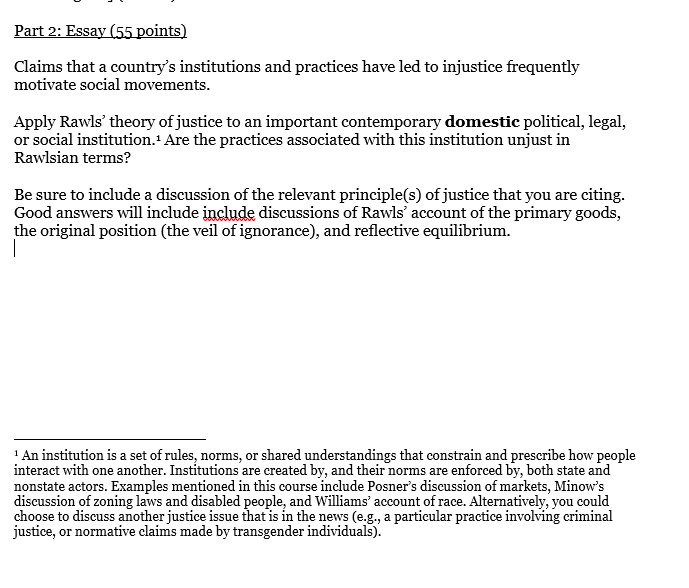
Mass incarceration