Fossils
Fossil: Any preserved remain, imprint or trace left of a previously living organism. E.g. bones, teeth, footprints, faeces, burrows, egg shells
fossils show the sequence of development in plant and animal species and establishes evolutionary links between species/shows common ancestry
provides evidence of which organisms lived on Earth in the past
provides examples of organisms which may now be extinct
provides examples of transitional organisms between species
The Fossil record
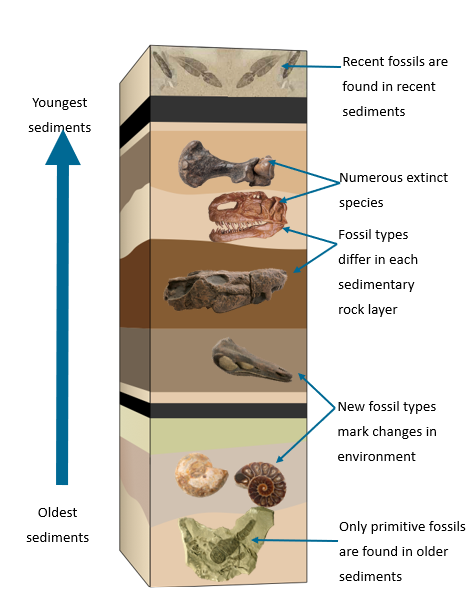
Layers of sedimentary rock are arranged in the order in which they were deposited, with the most recent layers nearer the surface (law of superposition)
The interpretation of rock layers containing fossils allows us to arrange the fossils in chronological order, but does not give their absolute date
Fossil Formation
Very few organisms form fossils and because of this the fossil record over time is often complete
Conditions for good fossil formation
Rapid burial helps in the formation of fossils at time of death. E.g. drifting sand, mud, volcanic ash enhance fossil formation.
Rapid burial removes oxygen therefore reducing decomposition.
Rapid burial results in less chance of scavengers destroying it.
Specific sediment features are required for fossilisation such as no or lack of oxygen/alkaline soils.
Alkaline soils produce the best fossil as the minerals in the bones are not dissolved
New minerals (from the soil) are deposited in the pores of the bones, replacing the organic matter that makes up the bone
Bone becomes petrified, but details of structure are preserve
Hard Exoskeleton or Bone
Organisms made of hard exoskeleton or bone have less chance of being decomposed or eaten increasing chance of fossilisation
Fossil is left undisturbed for a long period of time
When left undisturbed there is less chance of it being destroyed by motion/erosion/moving water/wind
Poor Conditions for Fossil Formation
Scavengers
Micro-organisms that decay the fossil
Destruction of the fossil by volcanic eruption, earthquakes, folding or faulting of the earth
Weathering and erosion of fossil
Human or animal activity
Other Reasons the Fossil Record is Incomplete
Fossils may not be recognised by humans
Humans may not be looking in the right place for the fossils
Layers of rock containing fossils may not be exposed at the surface - difficult to find deeply buried fossils
Fossil Dating
Relative dating: comparisons made between the age of fossils, e.g. fossil A is older than fossil B. Methods for relative dating include:
Stratigraphy
Fossils form in layers of sediment. The rules of superposition states that deeper sediment layers are older
This generalisation requires you to take into account the folding, faulting and erosion of sediment layers
Sometimes folding/faulting/earth movements may bring lower strata to a higher position. Erosion may cause higher strata to collapse into lower strata. Animals/human may bury bones into lower strata
Index fossils
Index fossils that are used to determine the age of the strata in which they are found in.
When you know the age of the strata you know the age of other fossils found within that same strata layer
A useful index fossil must be:
Distinctive so easily recognisable
Abundant (fossilised regularly) to be easily found
Have a wide geographical distribution to allow dating worldwide/a range of locations
Have a short/limited range through time to identify the period of their existence
Absolute dating: determining the actual age of the fossil in years, e.g. fossil A is 22,000 years old. Methods for absolute dating include:
Carbon- 14 dating
Carbon-14 is a radioactive isotope produced by cosmic radiation changing nitrogen into carbon in the upper atmosphere
Carbon-14 is absorbed by plants through photosynthesis and is passed through the food chain
Carbon-14 gradually breaks down to nitrogen
The rate at which it forms is equal to the rate at which it decays. Amount of C-14 in atmosphere is constant, and amount in a living organism remains constant.
At death, amount of C-14 begins to decline. For carbon dating the ration of C-12 to C-14 is measured
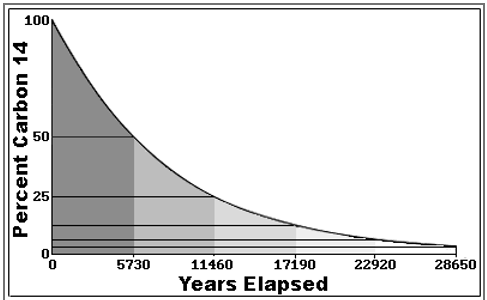
Half-life of C-14 is 5730 years. By finding the number of half lives the actual age can be calculated
C-14 dating only used for organic fossils that are less than 70,000 years old because the carbon levels would be too low
Potassium- Argon dating
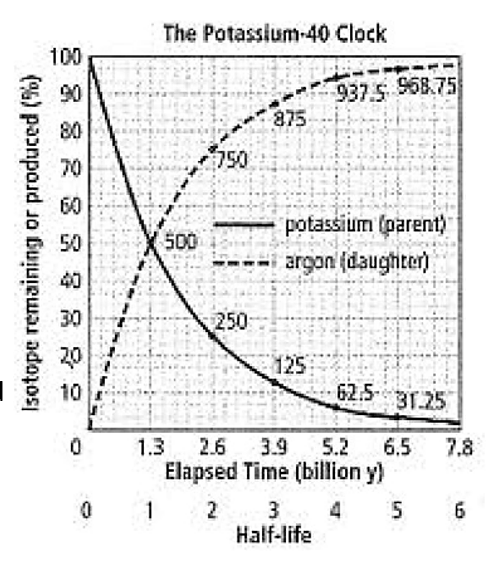
Radioactive potassium (K40) decays into calcium and argon
Decay takes place at a slow rate, the half-life of K40 is about 1.2 billion years
Young (new) volcanic rock has lots of K and little Ca/Ar whereas old rock has lots of Ca/Ar and little K
Only useful for old rocks over 200,000 years old as it has a long half-life
The fossil must be the same age as rock → fossil covered by volcanic eruption
Artefact: Any object made by a human