Interactive General Chemistry 2.0 - Chapter 7: Gases
Page 1: Gas Fundamentals and Moles
Gases expand to fill the entire volume of their container, with macroscopic behavior governed by pressure (), volume (), temperature (), and amount ().
A gas particle is an individual moving atom or molecule (e.g., one diatomic molecule of counts as a single particle).
Mole definition: .
Molar mass () is expressed in , relating mass and amount via .
Page 2: Gas Variables and Core Equations
Fundamental variables and primary units:
Pressure (): , , or
Volume (): or
Absolute temperature ():
Amount ():
Ideal gas constant:
Molar mass ():
Density:
Key relationships and formulas:
Temperature conversion:
Pressure conversion:
Before-and-after conditions:
Static ideal gas law:
Dalton's law of partial pressures:
Mole fraction:
Component partial pressure:
Graham's law:
Page 3: Pressure, Barometers, and Kinetic Molecular Theory
Pressure is defined as force per unit area () resulting from collisions of gas particles with container walls.
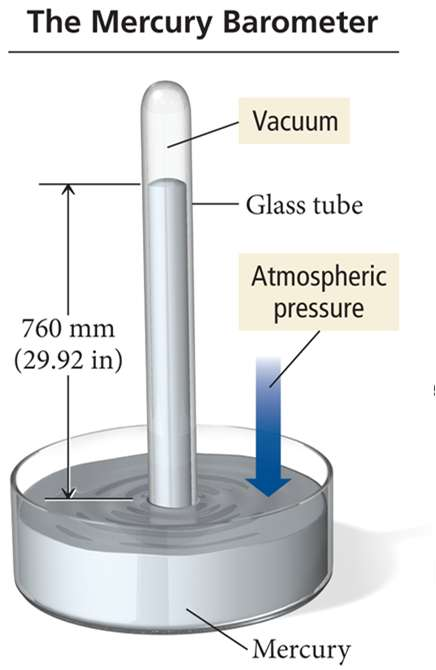
A mercury barometer balances atmospheric pressure pushing on an open reservoir against the weight of a mercury column in a closed glass tube:
Five assumptions of Kinetic Molecular Theory (KMT):
Gases consist of particles in continuous, random motion.
The volume of individual gas particles is negligible relative to the total container volume.
Collisions between particles and with walls are perfectly elastic (total kinetic energy is conserved).
Intermolecular forces of attraction and repulsion are negligible.
Average kinetic energy of gas particles depends exclusively on absolute temperature ( in Kelvin).
At an identical temperature, all ideal gases possess the same average kinetic energy regardless of chemical identity; lighter particles move faster on average.
Page 4: Molecular Speed Distributions
The Maxwell-Boltzmann distribution plots the fraction of gas molecules as a function of particle speed ():
Starts at zero, peaks at the most probable speed, and displays an asymmetric tail toward higher speeds.
The total area under the normalized curve represents the entire sample of particles and remains constant.

Temperature effect: Increasing temperature shifts the distribution peak to the right, lowers the peak height, and broadens the curve.
Molar mass effect: At the same temperature, lighter gases display distributions shifted further to the right with broader spreads than heavier gases.
Relationship between speed, energy, and mass:
Kinetic energy:
Characteristic molecular speeds scale with ; doubling Kelvin temperature increases speed by a factor of .
Root-mean-square speed: , using and in .
Page 5: Variable Relationships and Equation Selection
Directional relationships among variables:
Volume and Pressure (Boyle's law): Inverse at constant (;

Temperature and Pressure (Amontons'/Gay-Lussac's law): Direct at constant (
Temperature and Volume (Charles's law): Direct at constant (;

Amount and Volume (Avogadro's law): Direct at constant (;

Amount and Pressure: Direct at constant (
Graphical signatures: Direct proportions graph as straight lines through the origin; inverse proportions ( vs. ) yield curves, while vs. yields a straight line.
Equation selection criterion:
Dynamic conditions (two states): , canceling any quantities that remain constant.
Static snapshot (one state):
Page 6: Unit Conversions and Gas Law Calculations
Mandatory unit rules:
Absolute temperature must always be converted to Kelvin ().
In combined before-and-after equations, pressure units and volume units must match on both sides.
In using , pressure must be in , volume in , amount in , and temperature in .
Common conversion factors:
Final temperature in Celsius:
Page 7: Ideal Gas Law, Density, and Molar Mass
Rearrangements of the ideal gas law:
Pressure:
Volume:
Moles:
Temperature:
Gas density ():
Calculated using a sample basis: find via , convert moles to mass (), and divide by .
Combined density formula:
Molar mass of an unknown gas ():
Find moles () via , then evaluate .
Combined molar mass formula:
Determination directly from density:
Page 8: Standard Conditions, Avogadro's Hypothesis, and Partial Pressures
Standard Temperature and Pressure (STP):
Defined as () and .
Molar volume of an ideal gas at STP: .
Avogadro's hypothesis: Equal volumes of any ideal gases at identical temperature and pressure contain identical numbers of particles (equal moles).
Dalton's law and gas mixtures:
Each component gas occupies the full container volume and exerts a partial pressure independent of other gases.
Total pressure:
Mole fraction: , with
Partial pressure from mole fraction:
Individual component application:
Page 9: Particle Diagrams and Collection of Gas Over Water
Interpretation of microscopic particle representations:
When comparing flasks with identical and , pressure is directly proportional to particle count.
Count individual gas particles/molecules (e.g., one molecule or one atom counts as one particle).
If volumes or temperatures differ, compare relative values of .

Collecting gases over water:
The displaced gas saturates with water vapor; the total measured pressure is the sum of dry gas pressure and vapor pressure of water ().
Dry gas pressure calculation:
must be isolated before using .

Page 10: Gas Stoichiometry and Effusion Fundamentals
Reaction stoichiometry with gases:
Balanced equation coefficients reflect mole ratios, not direct mass ratios.
Stoichiometric conversions follow: .
At constant and , total pressure change is directly proportional to the net change in gas moles ().
Effusion vs. diffusion:
Diffusion: The gradual spreading and mixing of gas molecules throughout a space.
Effusion: The escape of gas molecules through a microscopic opening into an evacuated space.
Page 11: Graham's Law and Real Gas Deviations
Graham's law relationships (at constant ):
Rate ratio:
Travel distance ratio (fixed time):
Effusion time ratio (fixed amount/distance):
Mean free path represents the average distance a particle travels between collisions, depending on particle size and number density.
Real vs. ideal gas behavior:
Ideal gases assume point-mass particles with zero volume and zero intermolecular attractions.
Real gases deviate significantly under conditions of low temperature (intermolecular attractions pull particles together) and high pressure (particle volume occupies a non-negligible fraction of container space).
Real gases behave most ideally at high temperature and low pressure.
