∗∗Chloroplasts∗∗arefoundinallorganismsthatcarryoutphotosynthesis. This means that they aren’t only found in plants. They are also found in algae, phytoplankton, and some bacteria.
Photosynthesis
∗∗Photosynthesis∗∗istheprocessofturninglightenergyfromtheSunintochemicalenergy, which can then be used by cells for energy. The formula for photosynthesis is:
This means that plants require both carbon dioxide (CO2) and water (H2O) in addition to light energy as reactants, or ingredients, for photosynthesis and produce glucose (C6H12O6) and oxygen (O2) as products. Theproduct∗∗glucose∗∗hasstoredenergy,whichcanthenbeusedbyanycell,notjustplantcells,topowercellactivities.
Photosynthesis has two sets of reactions: lightanddarkreactions. The light reactions require light, but the dark reactions do not. Darkreactionscanoccurinthepresenceoflight,butitisnotrequired.
Like the mitochondria, chloroplastshavetheirownDNA. It is thought that mitochondria and chloroplasts were once free-living, single-celled organisms that developed a relationship with early cells and eventually became part of the cell (see Endosymbiosis).
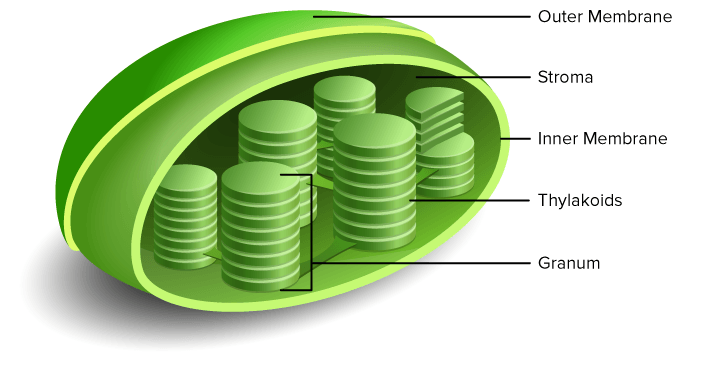
Chloroplastshaveaninnerandanoutermembrane, which is known as a bi-layer membrane. Mitochondria, cells, and the nucleus have a similar membrane. Inthemiddleofthechloroplastisaninter−membranespacethatincludesathickfluidcalled∗∗stroma∗∗. The stroma houses the chloroplast’s DNA, its ribosomes, sugars, enzymes, and thylakoids.
In the center of the chloroplasts are thylakoids, which areanetworkofinterconnectedsacsthatcontainphotosyntheticpigments. Photosynthesis occurs in the thylakoids. These sacs are arranged in stacks called grana (singular: granum).

 Edited: 05 October 2022