Traditions & Encounters: A Global Perspective on the Past - CH 4
Harappan Society
- - named after Harappa; was a chief city in the Indus valley civilizations
- Indus valley area was supported by fertile land that could be readily irrigated by the nearby water → ^^by 3000 B.C.E^^., small neolithic villages were able to grow into prosperous cities in this area
- It’s impossible to follow Harappan society's development for two reasons:
- much of Harappan society’s physical remains are inaccessible due to silt and water levels rising over the centuries
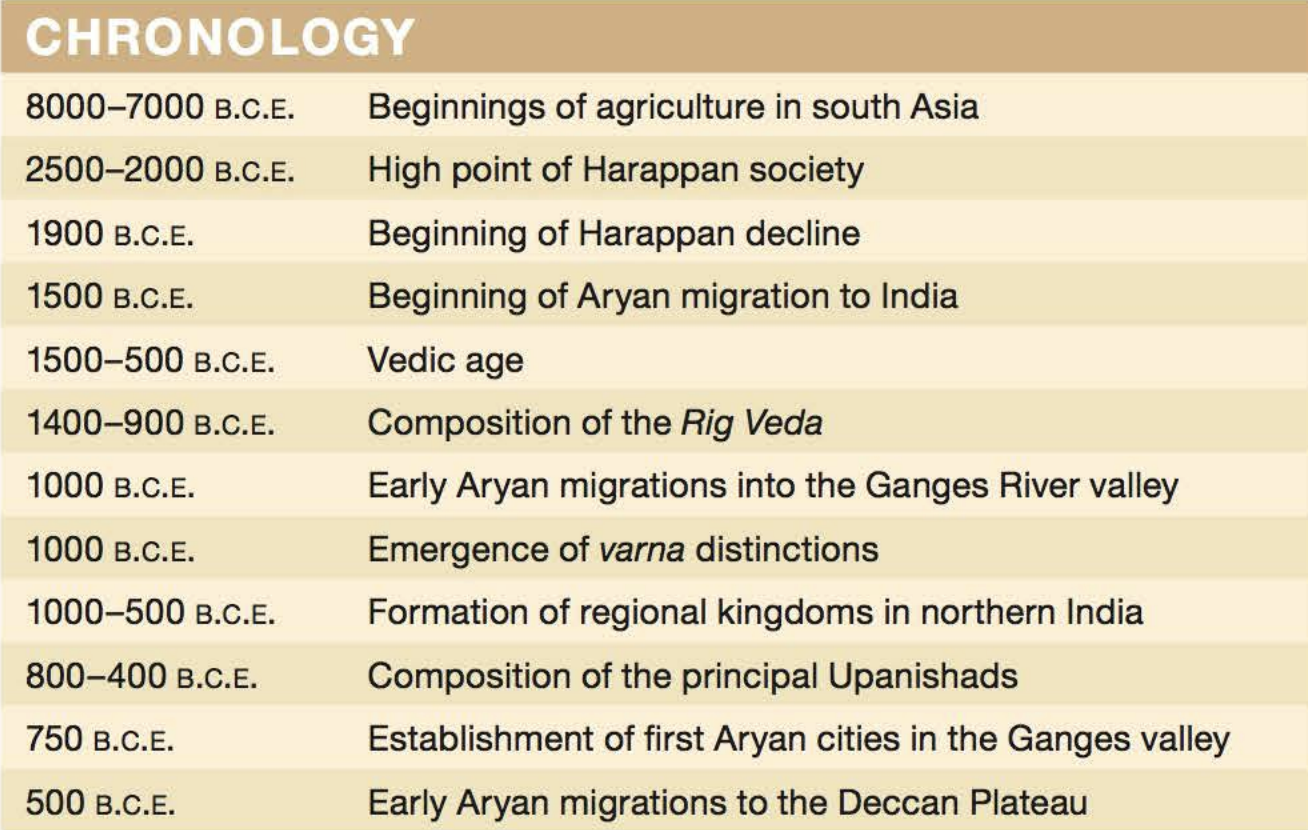
- earliest accessible remains are from ^^around 2500 B.C.E.^^
- there is a lack of deciphered written records → the Harappan writing system holds over four hundred symbols to represent sounds and words
- theories point out that the language could be related to Dravidian (language in southern India)
Foundations of Harappan Society
- - draws its water from rain and melted snow from the mountains (Hindu Kush & Himilayas) and deposits rich soil through lowlands and floodplains
- made agricultural society successful in northern India
- most vital crops and domesticated animals derived from Mesopotamia
- inhabitants here cultivated crops such as barley and wheat in September, then harvested in the spring
- also grew cotton ^^before 5000 B.C.E., started dying cloth in 2000 B.C.E.^^
- domesticated animals such as cattle, sheep, goats, and poultry
- first society to keep domesticated chicken flocks
- ^^Between 3000 B.C.E. - 2500 B.C.E.,^^ complex society dominated Indus River valley ^^until 1900 B.C.E.^^
- possible due to increased food growth and population growth
- The Indus Valley fed two major, large cities
- a handful of smaller cities subordinate to the aforementioned major cities
- There is no surviving evidence of the Harappan political system
- possible that Harappan cities were centers of political and economic interest in their respective regions
- Harappa was slightly smaller in population sie than the Mohenjo-daro, whose population were at least 35,000 strong
- there are about 1,500 Harappan settlements known to historians
- Harappa and Mohenjo-daro had fortified city walls, citadels, and granaries → suggested high importance areas, such as political centers or tax collection areas
- Mahenjo-Daro held large pool in its area, suggesting religious or ritualistic purpose
- Both cities set patterns that most cities around them would follow in terms of measurement systems, architectural styles, etc.
- standardization was possible due to the Indus River faciliating communication and trade throughout Harappan society
- Harappa depended on successful agricultural society, but also in trade (both domestic and foreign trade by nature)
- Harappa and Mohenjo-daro produced pottery, tools, and decor
- neighboring towns offered many metals such as gold, silver, copper, and led as well as gems and semiprecious stones
- ^^around 2300 B.C.E. - 1750 B.C.E^^., trade was established between Indus Valley region and Mesopotamians
- traded items such as copper, ivory, beads, semiprecious stones, wool, leather, and olive oil to name a handful of items
Harappan Society and Culture
- ^^from 2500 B.C.E. - 2000 B.C.E.^^, Harappa had a population of 40,000 strong with a steadily growing economic center
- many specialists maintained successful shops along Mohenjo-daro’s streets as well
- jewelers, artists, merchants, goldsmiths, potters, weaves, masons, architects, etc.
- Surplus of wealth in Harappan society allowed formation of social classes
- rulers held high authority from citadels dotted around Harappa and Mohenjo-daro
- areas of rich and poor were very apparent → commoners lived in apartment-like buildings (each in one room) with communal bathrooms and wells while the upper class had extensive, multiple-room houses with private bathrooms and wells
- statues, figurines, and illustrations upon seals reflected representational art and mark of higher status people
- Harappan people had intense concern for fertility
- Venerated pantheon associated with creation and procreation
- mother goddess
- horned fertility god
- trees and animals → associated with vitality
- some believe that Harappan deities are closest in comparison to Hundu pantheon
- ^^after 1900 B.C.E.^^, Harappan society declined
- ecological degredation was major factor in this
- deforestation
- soil erosion
- reduced rainfall
- these major climate and ecology-related changes reduced agricultural success
- most of Indus valley became desert after this point
- natural catastrophes such as earthquakes and periodic flooding also contributed to desertification
- cities soon became more and more abandoned ^^after 1700 B.C.E.,^^ to the point that the population drop could no longer sustain the once complex urban society
- even after decline, Harappan traditions influenced establishment of new societies
The Indo-European Migrations and Early Vedic India
- - “noble people,” nomadic and pastoral peoples who spoke Indo-European languages
- ^^by 1500 B.C.E.^^, traveled through Hindu Kush to establish herding & agricultural society throughout north of India
- - established people settled in India before the arrival of the Aryans
- ^^After 1500 B.C.E^^., Dravidian and Indo-European peoples joined and laid cultural foundation that would later impact Indian society to the modern day
The Aryans and India
- Aryans practiced limited agricultural techniques due to favoritism towards pastoral economy
- kept sheep, goats, horses, and cattle
- horses - valuable due to rarity and expense (had to import these)
- heavily depended on for transportation and war
- cattle - measure of wealth in Aryan society
- Aryans commonly ate dairy and beef in early culture, as they did not become sacred until centuries after their arrival
- the wealthy held large cattle herds
- early Aryans did not have a writing system, but depended on oral communication and memorization od their descendants
- countless poems and songs in , their sacred language
- was the less formal dialect of this used for everyday speech
- later evolved into several languages off northern India: Hindi, Bengali, Urdu, etc.
- - the earliest orally transmitted work of Aryans, which was a collective of hyms, songs, prayers, and rituals of their pantheon
- four Vedas total
- earliest and most renowned is the → 1,028 hymns to the Aryan gods
- ^^written between 1400 - 900 B.C.E.^^
- other three written ^^between 1400 - 600 B.C.E^^
- “veda” means ‘wisdom’ / ‘knowledge’
- → time between 1500 B.C.E. - 500 B.C.E. of Indian history
- The Vedas regerence frequent conflicts between Aryans and indigenous peoples of India, calling Aryans ‘,’ meaning ‘enemies’ / ‘subject peoples’
- Indra - Aryan war god & military hero, known for destructive nature
- suggests that Aryans and Dravidians clashed often, but that Aryans had mostly friendly relations with Dravidian peoples at first
- Aryans were subjected to frequent infighting, as they did not have a common, centralized government (had hundreds of chiefdoms instead)
- - Sanskrit term for a leader who governed in collaboration with a council of village elders
- herd raids were common and were seen as great offense since cattle equated to wealth in their society
- Aryan migrants spread east and south, established societies throughout Indian subcontinent
- in the early portion of the Vedic age, Aryan groups preferred to lay foundations in Punjab (upper Indus River valley along modern-day border of north India and Pakistan)
- ^^after 1000 B.C.E.,^^ settled in area between Himalayan foothills & Ganges River
- during this time, also able to create iron tools (i.e. axes, iron-tipped plows) that facilitated faster cultivation of land to support enlarging communities
- ^^by 750 B.C.E.,^^ Aryans were able to produce their first cities along the Ganges River valley
- ^^by 500 B.C.E.^^, Aryans migrated as far as northern Deccan, about 1.5 km south of Punjab
- As their communities became more prominent, Aryans replaced their tribal political system for an organized, formal institutional way of leading
- directed affairs within small states governed by citizen representatives
- ^^from 1000 - 500 B.C.E.^^, tribal chiefs worked to establish formal capitals and depended on professional administrators through this transition
- regional kingdoms were favored, did not build large imperial states like other cultures
- Aryans constructed a specific social order to distinguish status easily
- ^^around 1000 B.C.E.,^^ a hymn in the Rig Veda claims that the gods created four varnas (castes) during the beginning of the world
- brahmins and kshatriyas were most honorable humans that would lead societies worldwide
- jati -subcastes
- occupation determined this
- peoples working similar task in same area all belonged to the same subcaste, and their offspring inherited their parents’ caste
- jati members could intermarry and cared for one another, though there was still prestige or lack thereof among some of them due to some jati being higher in rank than others
- The caste system was not meant to be completely rigid, but was put in place to accomodate social change
- caste members could lose or improve status
- social mobility through castes resulted from group rather than individual efforts
- this was not easy, as it required new skillsets or work environments
- caste system enabled foreign individuals to integrate into Indian society
- Gender distinctions were enforced within varna and caste distinctions as well
- men → priests, warriors, tribal chiefs
- could inherit property (families could not do so without male heirs)
- enacted familial rituals to honor ancestors
- priveleged with formal education of Sanskrit
- women → domestic affairs
- did not learn Vedas
- had no formal education in Sanskrit
- - work that dealt with expected moral behavior, social relationships (sex and gender relationships)
- patriarchal system of Vedic society forced women under authority of men → Lawbook of Manu reflected patriarchal system set under Aryan influence
- insisted women be respected while at the same time insisting upon men to guide them
- fathers → husbands → sons
- outlined that women’s important affairs were to maintain the home and bear children
- - practice by which a widow would burn herself on the funeral pyre of her husband to join him in death
- thankfully, never became a popular or widely practiced custom in India
- illustrated full devotion and dependence of women to men
Religion in the Vedic Age
Aryan Religion
- Chief deity of the Rig Veda was Indra
- Indra - violent god who was accustomed to fighting and strong drink; a war god
- wielder of thunderbolts, led humans into battle
- associated with weather, especially with ain
- Varuna - sky god who oversaw moral behavior and preserved the universal order
- despised evil and punished the wicked
- House of Clay → dreary realm of punishment
- also had gods of the elements (fire), astrology (stars, sun, moon, sky(, health (and disease), time (dawn), and the underworld
- had ritual sacrificed in early Vedic times
- involved slaighter of specifically prepared livestock
- cattle, sheep, goats, horses
- priests chanted over sacrifices and ate soma (hallucinogenic that channeled divine inspiration)
- believed that this would provide divine support by pleasing the gods in this way
- proper honor to the pantheon required at least 5 sacrifices per day
- ^^around 800 B.C.E^^., shift in spiritual belief was produced → a sect of Aryans moved to the forests and contemplated mystical understanding of the Vedas, drawing from Dravidian peoples beliefs
- believed that souls experienced transmigration and reincarnation
- new birth, life cycles that occured consistently with the soul
The Blending of Aryan and Dravidian Values
- - (^^800-400 B.C.E.^^) body of works that represents practice of disciples gathering to discuss religious issues
- most well-known disciple, Gargi Vakaknavi → woman who drove out sage Yajnavalkya to exhaustion due to constant line of questioning
- took form of dialogues that explored meaning of the Vedas and etc.
- - the universal soul
- believed that all smaller lifeforms emerged from this larger soul
- believed that souls were born into physical world multiple times → the highest goal of the soul was to create permanent union with Brahman and escape such a cycle
- - the doctrine of the Upanishads that depicted that once death occured, individual souls would temporarily wait in the World of the Fathers, returning to earth after their new incarnation was assigned
- - doctrine that accounted for how souls were reincarnated and what they were reincarnated into
- morality measure that claimed that those who lived good lives would be given a more honorable rebirth in the next life, whereas those that lived miserable lives with bad deeds would experienve the opposite
- regardless of high or low morality, there would always be some sort of pain/suffering that accompanied the human existence
- - a deep, dreamless sleep that was accompanied with permanent freedom from the cycle of reincarnation
- yoga → utilized to practice on Brahman’s nature and its relationship to the human soul
- diligent efforts with spiritual practices such as this would make transition to Brahman easier and more peaceful
- Upanishad followers sought ultimate truth and knowledge
- influenced Indian thought about worldly nature and high morality standards
- taught respect of all living things, human or otherwise
- vegetarian diet highly common feature