4 LIPID METABOLISM
THE CLINICAL RELEVANCE OF ESTIMATING SERUM CHOLESTEROL AND TRIGLYCERIDE
Plasma/serum lipids have their origin from either exogenous or endogenous sources.
Food provides the exogenous source whiles synthesis in the liver and the intestine provide the endogenous source.
These are made of free fatty acids, cholesterol esters, triglycerides and phospholipids
FUNCTIONS OF LIPIDS
Cholesterol and phospholipids(lipid bilayer) are vital structural components of cellular membranes
Cholesterol is the precursor of steroid hormones and bile acids
Absorption of dietary lipid is essential for the absorption of fat-soluble vitamins.(ADEK)
LIPID PROFILE
Lipid profile is the measure of the various lipids found in the human blood
It is used as part of a cardiac risk assessment to help determine an individual's risk of heart disease and to help make decisions about what treatment may be best if there is borderline or high risk.
A LIPID PROFILE TYPICALLY INCLUDES:
Total cholesterol — this test measures all of the cholesterol in all the lipoprotein particles.
High-density lipoprotein cholesterol (HDL-C) — measures the cholesterol in HDL particles; often called "good cholesterol" because it removes excess cholesterol and carries it to the liver for removal.
Low-density lipoprotein cholesterol (LDL-C) — calculates the cholesterol in LDL particles; often called "bad cholesterol" because it deposits excess cholesterol in walls of blood vessels, which can contribute to atherosclerosis. Usually, the amount of LDL-C is calculated using the results of total cholesterol, HDL-C, and triglycerides.
Triglycerides — measures all the triglycerides in all the lipoprotein particles; most is in the very low-density lipoproteins (VLDL).
CLINICAL IMPLICATIONS AND SIGNIFICANCE
The estimation of lipids (serum cholesterol/Triglycerides) is considered to be significant in
Atherosclerosis and related Coronary heart diseases(angina & ischemic heart disease)
Various liver diseases. eg. Fatty liver disease, Hepatomegaly
Other variety of clinical features including corneal arcus, Achilles tendon thickening, xanthoma, xanthelasma and pancreatitis
SERUM ESTIMATION OF CHOLESTEROL & TRIGLYCERIDE
Aim
To estimate the total amount of cholesterol or Triglycerides in the blood.
PRINCIPLE (CHOLESTEROL)
Cholesterol is enzymatically oxidised by cholesterol oxidase after hydrolysis of its esters with a fungal lipase. Hydrogen peroxide thus released produces the oxidative coupling of phenol with 4-aminophenazone (4 AP) by means of a reaction catalysed by peroxidase (POD). The result is a red Quinonimine with a maximum absorption at 500-505nm. The principle is based on the following reaction system
Cholesterol esters lipase cholesterol + fatty acids
Cholesterol + O2 CHOD cholesten-3-one + H2O2
H2O2 + 4-AP + phenol POD 4-(p-benzoquinoneimine) + 4H2O
PRINCIPLE (TRIGLYCERIDE)
Sample triglycerides incubated with lipoprotein lipase (LPL), liberate glycerol and free fatty acids. Glycerol is converted to glycerol-3-phosphate (G3P) and adenosine-5-diphosphate (ADP) by glycerol kinase and ATP. Glycerol-3-phosphate (G3P) is then converted by glycerol phosphate dehydrogenase (GPDH) to dihydroxyacetone phosphate (DHAP) and hydrogen peroxide (H2O2). In the last reaction, hydrogen peroxide (H2O2) reacts with 4-aminophenazone (4-AP) and p-chlorophenol in presence of peroxidase (POD) to give a red coloured dye:
TG Lipase Glycerol + fatty acids
Glycerol + ATP GK Glycerol + Phosphate + ADP
Glycerol-3-phosphate + O2 GPDH Glycerol + Dihydroxyacetone Phosphate + H2O2
2H2O2 + 4AP + chlorophenol POD 4H2O2 + 4-P-benzoquinoneimine
The Friedewald equation enables plasma LDL cholesterol concentration to be calculated and is often used in clinical laboratories:
LDL cholesterol (mmol/L) =total cℎolesterol(mmol/L)−HDL cℎolesterol(mmol/L)−[triglyceride (mmol/L)]/2.2
VLDL=triglyceride (mg/dL)/5
This equation makes certain assumptions, namely that the patient is fasting and the plasma triglyceride concentration does not exceed 4.5 mmol/L (otherwise chylomicrons make the equation inaccurate).
PROCEDURE
To labelled test tube CH and TG
Pipette 2 ml of working reagent provided into the respective tubes.
Add 20 µl of sample prepared above into both test tubes. Mix well by shaking the test tube gently.
Incubate at room temperature for exactly 20 minutes.
Mix well and read the optical density/absorbance at 500nm.
You will be provided with a blank near the spectrophotometer.
ABSORBANCES FOR CHOL AND TRIG STANDARDS
CHO = 0.495
TRIG = 0.265
Standard Concentrations = 200mg/dl
Calculations:
A(Sample)/A(standard)x 200 (Standard conc.) = mg/dL cholesterol in the sample.
Conversion factor (cholesterol): mg/dL x 0.0258= mmol/L.
Conversion factor (TG): mg/dL x 0.0113= mmol/L.
questions;
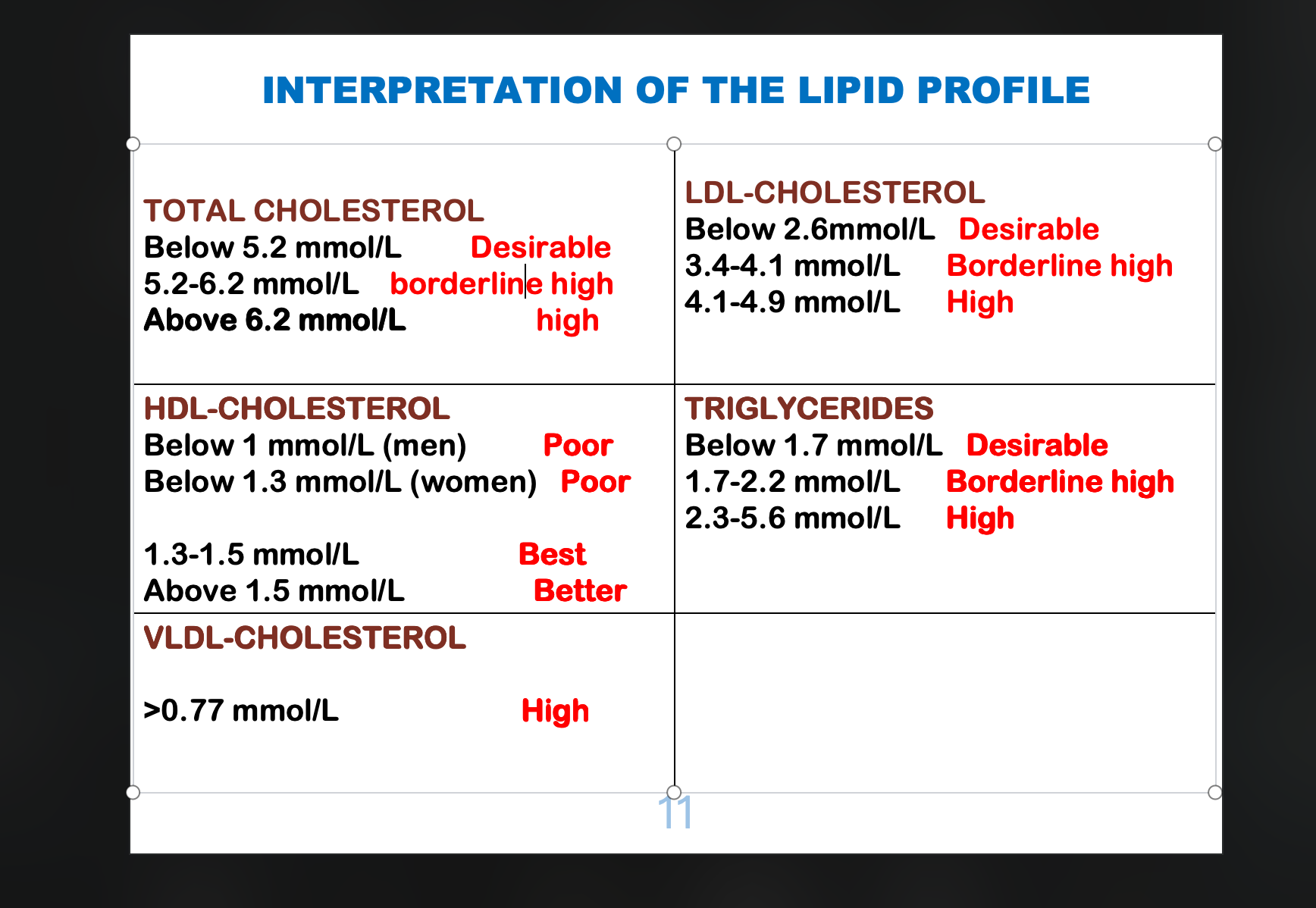
Your calculated concentrations from the above test form part of the lipid profile results of a patient who is undergoing a normal routine check-up at the KNUST Hospital. Hence Calculate the following parameters if HDL-CH = 1.4 mmol/L
VLDL
Non- HDL cholesterol
Cholesterol Ratio
LDL-CH
Comment and Interpret your result