Unit 1 Masterdoc
Ecosystems and Biomes
Ecology
Community: Different populations that share the same habitat.
Interspecific interactions: Interactions between species.
Competition: Different species compete for the same resources. (-\-)
Predation: One population eats another population. (Herbivory, +\-)
Symbiosis: Close and long-term interaction between species.
Parasitism: One species benefits at expense of the other. (+\-)
Mutualism: Both species benefit (+\+)
Commensalism: One species benefits while the other is indifferent (+\?)
Ecosystems and Biomes
Population: Members of a certain species that share the same area.
Biome: Community of plants and animals living in, adapted to, certain climate.
Ecosystem: All biotic and abiotic factors in the environment.
Land (terrestrial) biomes
Defined by temperature, moisture, climate, terrain, minerals
Tropical rainforests: Latitudes near the equator. Average temperatures and rainfall are high throughout the year. Warm, wet climate allows high biodiversity.
Temperature forests are found at latitudes between 30 and 60 degrees with well-defined seasons.
Temperature deciduous (seasonal) forests have cold, dry winters and hot, humid summers. Deciduous trees shed leaves each winter to conserve energy.
Temperature rainforests have mild, frost-free winters and rainfall that’s evenly distributed.
Coniferous forests (boreal forests, taigas) are found at latitudes 50 and 60 north. Short, warm, moist summers and long, cold, dry winters. Thin, needle-like leaves that do not shed. Seeds in cones.
Deserts mostly form at latitudes around 30. Rainfall is low and highly variable. Closer to equator has warmer temperatures. Plants conserve water in these arid environments.
Grasslands occur at any latitude. Seasonal drought, occasional fire, grazing by herbivores. Warmer grasslands have scattered trees called savannas. Milder grasslands with very few trees are called temperate grasslands, which include prairies and steppes.
Scrublands (chaparrals, woodlands) located in western coastal regions between 30 and 40 north and south. More rain than deserts and grasslands, less than forests. Shrubs and short trees.
Tundras are primarily in the arctic, and the most inhospitable. Cold and dry with short growing season and layer of permanently frozen soil called permafrost. Low in biodiversity.
Aquatic
Influenced by concentration of dissolved oxygen and nutrients.
Freshwater biomes: Little to no salt, including ponds, lakes, streams, rivers. Vital source of drinking water.
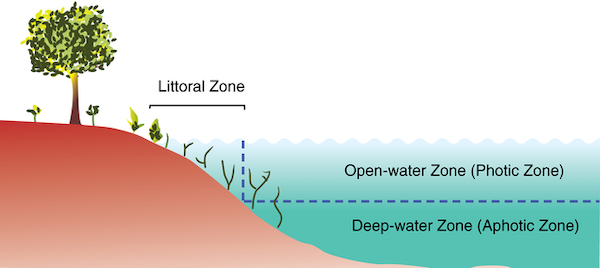
Littoral zone: Top, near-shore layer of a lake. Shallow with plentiful sunlight and nutrient inputs from the surrounding land. Supports wide variety of organisms.
Limnetic zone (open-water zone) is a lake’s sunlit surface layer where most photosynthesis takes place. It starts away from shore, just past the littoral zone, and extends the depth penetrated by sunlight. This zone supports phytoplankton and zooplankton, along with freshwater fish.
The profundal zone (or deep-water zone) is a lake’s deep, open-water layer, which is too dark for photosynthesis. The water in this zone is cooler and contains less dissolved oxygen than the shallower zones. This zone supports fish adapted to these cooler waters.
The benthic zone includes the soil and soil organisms that live at the bottom of a lake. This zone is inhabited mostly by decomposers and other organisms that feed on dead and decaying material, and can withstand a low-oxygen environment.
Streams and rivers are flowing bodies of water that drain the landscape, and are important agents of erosion. The flow of a typical stream or river can be characterized by three zones.
Streams and rivers start at the source zone, or headwaters, where water at high elevations collects from precipitation and snowmelt. This water is cold, fast moving, has lots of dissolved oxygen, and a low nutrient content. There are usually only a few plant species that grow near a river's source.
Headwaters merge together to form the transition zone of a river. Here, the river is wider, slower moving, has less dissolved oxygen, and carries more sediment than the source zone. The water is warmer and more nutrient-rich, so this zone tends to support a larger variety of plants and animals.
From the transition zone, a river meanders toward its mouth through a flat, wide floodplain zone. This zone forms because, occasionally, the bulk of water in the river becomes greater than the river channel itself, and water spills out onto the land forming wetlands and temporary lakes. The water in this zone usually contains more sediment and less dissolved oxygen than the transition zone. This zone's warm, nutrient-rich waters support the greatest variety of plants and animals.
Species
Generalists species: Can live in many different places, tolerate a variety of food types, and withstand a range of environmental conditions.
Specialist species: Niche species survive in only a narrow range of environmental conditions.