Beta Decay
What is it?
Beta particles (β) are high energy, high speed electrons (β-) or positrons (β+) that are ejected from the nucleus by some radionuclides during a form of radioactive decay called beta-decay.
Example Equation:
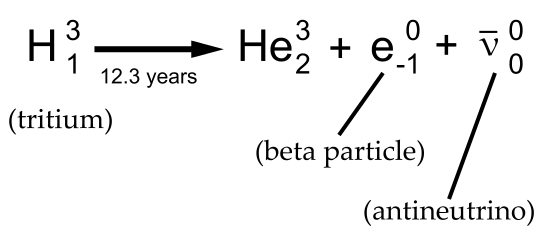
How does the atom’s mass change?
Technically, the atomic mass of an atom will change slightly in beta decay, but the mass number of the atom remains the same. In beta minus decay, a neutron is changed to a proton. As a neutron has slightly more mass than a proton, beta minus decay slightly decreases the mass of the atom.
How far can it travel in air?
Beta-particles, being less ionizing than alpha-particles, can travel through many centimeters or even meters or air and through millimeters of skin or tissue.
How can it be stopped?
Beta particles can be stopped, as the first answer says, can be stopped by a sheet of aluminium foil. But beta decay is a radioactive process, and thus cannot be stopped, as it is a spontaneous process.
Why is it dangerous?
Beta particles are capable of penetrating the skin and causing radiation damage, such as skin burns. As with alpha emitters, beta emitters are most hazardous when they are inhaled or swallowed or absorbed into the blood stream through wounds.
How is it useful?
Beta-emitting radioisotopes have also been extensively used in vascular brachytherapy and other brachytherapy applications.