Micronutrients (HL)
Micronutrients: things our body needs in smaller amounts to maintain health. These include vitamins and minerals
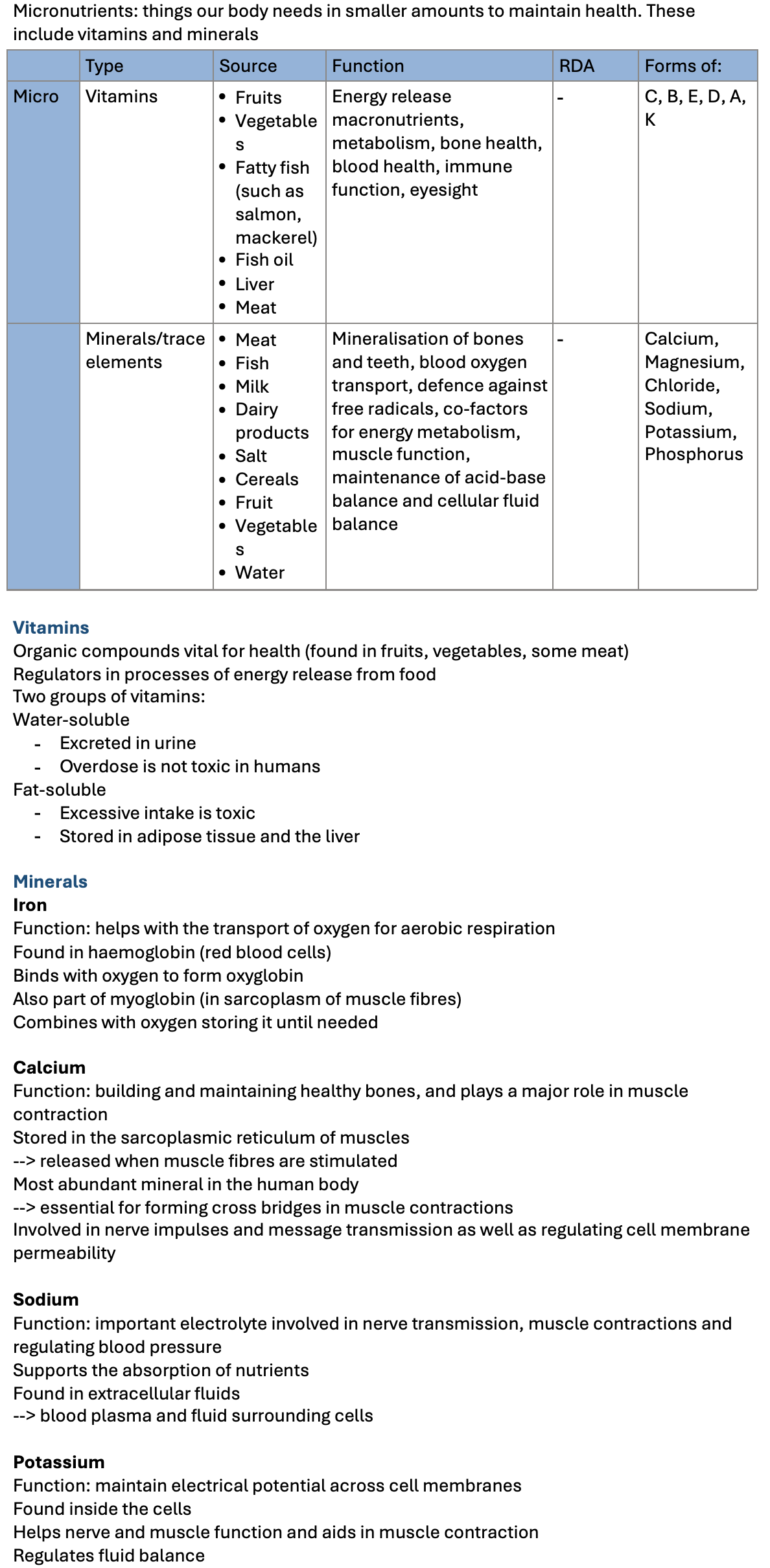
| Type | Source | Function | RDA | Forms of: |
Micro | Vitamins |
| Energy release macronutrients, metabolism, bone health, blood health, immune function, eyesight | C, B, E, D, A, K | |
| Minerals/trace elements |
| Mineralisation of bones and teeth, blood oxygen transport, defence against free radicals, co-factors for energy metabolism, muscle function, maintenance of acid-base balance and cellular fluid balance | Calcium, Magnesium, Chloride, Sodium, Potassium, Phosphorus |
Vitamins
Organic compounds vital for health (found in fruits, vegetables, some meat)
Regulators in processes of energy release from food
Two groups of vitamins:
Water-soluble
Excreted in urine
Overdose is not toxic in humans
Fat-soluble
Excessive intake is toxic
Stored in adipose tissue and the liver
Minerals
Iron
Function: helps with the transport of oxygen for aerobic respiration
Found in haemoglobin (red blood cells)
Binds with oxygen to form oxyglobin
Also part of myoglobin (in sarcoplasm of muscle fibres)
Combines with oxygen storing it until needed
Calcium
Function: building and maintaining healthy bones, and plays a major role in muscle contraction
Stored in the sarcoplasmic reticulum of muscles
--> released when muscle fibres are stimulated
Most abundant mineral in the human body
--> essential for forming cross bridges in muscle contractions
Involved in nerve impulses and message transmission as well as regulating cell membrane permeability
Sodium
Function: important electrolyte involved in nerve transmission, muscle contractions and regulating blood pressure
Supports the absorption of nutrients
Found in extracellular fluids
--> blood plasma and fluid surrounding cells
Potassium
Function: maintain electrical potential across cell membranes
Found inside the cells
Helps nerve and muscle function and aids in muscle contraction
Regulates fluid balance