BIO 112 Notes: Gymnosperms, Angiosperms, Monocots, and Dicots
Gymnosperm seeds
Gymnosperms have “==naked seeds”== because their seeds don’t exist within chambers such as fruits or nuts. They are conifers, cycads, and ginkgo plants.
\
Ginkgo trees
Gingko trees evolved during the Jurassic period 270 million years ago and haven’t changed much since then. They are commonly found in Japan.
- They are known as “living fossils” and were the ==first type of gymnosperm created.==
\
Gametophytes
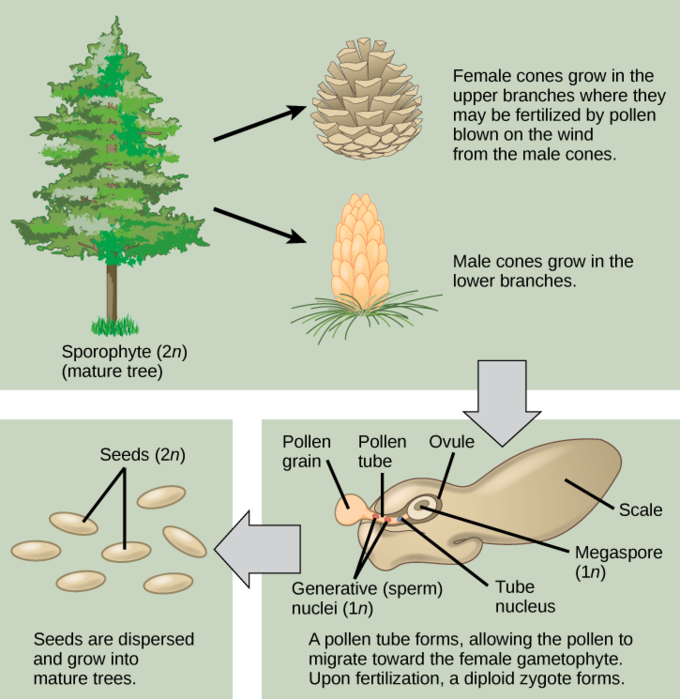
- Male gametophytes are created when the male cone of a gymnosperm undergoes meiosis to create ==pollen grains== or male gametophytes.
- Female gametophytes are created when the female cone of a gymnosperm undergoes meiosis. These are known as ovules.
\
Novel features of gymnosperm fertilization
Unlike most plants, gymnosperms often spread their seeds by ==wind instead of water==. This novel mechanism allowed the gymnosperms to ==abandon their need for water== and dominate land instead.
Fertilization by wind allowed gymnosperms a whole new advantage that changed the future of plants.
\
Primary methods of fertilization in Gymnosperms
Cycads and ginkgo trees have ==motile sperm==, which can swim to the egg in the ovule.
\ Meanwhile, conifers have sperm with no flagellum, causing an ==outgrowth called a pollen tube== to form where the pollen can travel to meet the female gametophyte.
How do Angiosperms differ from Gymnosperms?
==Angiosperms== are spermatophytes known as “==flowering plants.==” They have a broader diversity of flowers than gymnosperms but share the same basic build of a flower.
\ ==Gymnosperms== have ==naked seeds==, while ==angiosperms have fruits== that come in a variety of shapes.
\
What are all differences between Monocots and Dicots?
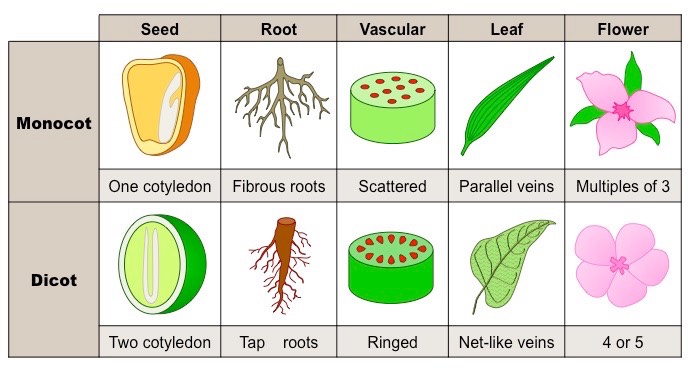
- Monocots only have ==one cotyledon==, while dicots have two.
- The ==leaves== of monocots are long and slender with parallel veins. Meanwhile, the leaves of dicots are broad with branched veins.
- ==Vascular bundles== are scattered throughout monocot leaves, but they are arranged in a ring within dicots.
- Monocots always have ==petals== in multiples of three, while dicots have multiples of four or five.
- Underground, monocots have fibrous ==roots== that splay out in many directions. However, dicots have a taproot system in which smaller roots branch from one main root.
- Finally, most monocots are ==herbaceous and have no woody stem==. On the other hand, dicots have woody stems, which allow their roots and stems to grow in all sizes and shapes.
\
In brief,
Monocots: 1 cotyledon, parallel veins, scattered vascular bundles, petals in multiples of 3, fibrous roots, herbaceous, no woody stem
Dicots: 2 cotyledons, branched veins, vascular bundles in a ring, petals in multiples of 4 or 5, taproot system, woody stems
\