1.2.3 Business Costs, Revenue, & Profit
Costs, Revenue, & Profits - Syllabus 1.2.3 (a)
Costs = Expenses that must be met when setting up and running a business.
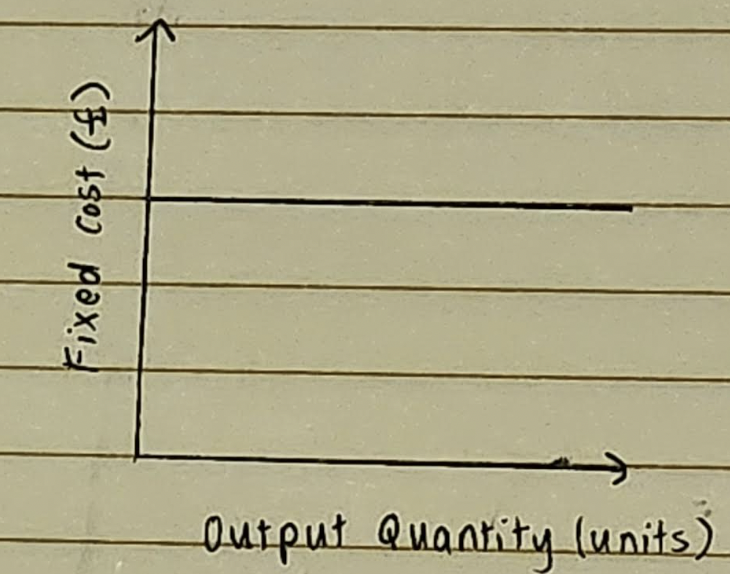
Total fixed costs (a.k.a. overheads) = Costs that stay constant regardless of output level.
E.g: Rent, advertising, interest payment, research/development costs, salaries, machinery, etc. These costs do not increase when output levels increase, if firms produce 0 output they must still pay fixed costs. Fixed costs are usually paid on a weekly, monthly, or yearly basis.
Graph (horizontal line):
Total variable costs = Costs that change when levels of output change.
E.g: Raw materials, delivery, packaging, etc. Variable costs are usually paid per item produced.
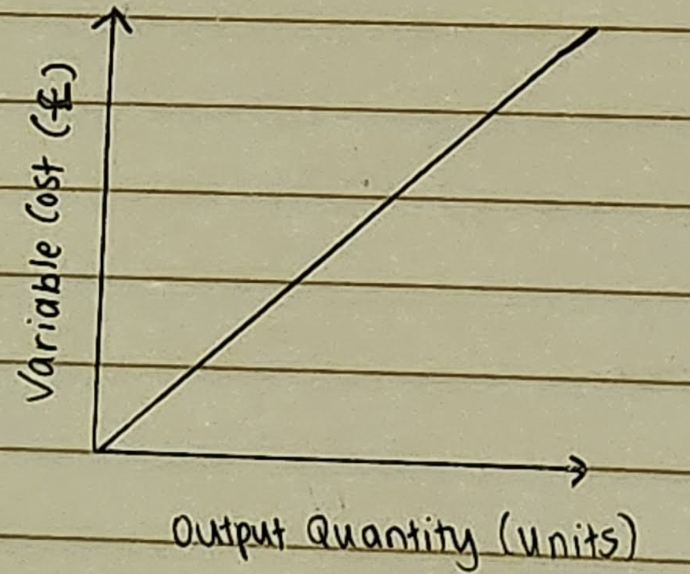
Number of output units ∝ Variable Cost
0 output → 0 variable cost
↓ output → ↓ variable cost
↑ output → ↑ variable cost
Graph (linear line that goes through origin):
Total variable costs formula = Variable cost per unit * Number of units produced
TVC = VC * Q
Total cost = Sum of total fixed costs and total variable costs.
Total cost formula = Total fixed costs + Total variable costs
TC = TFC + TVC
Average cost of production = Production cost of a single unit of output
Average cost formula = Total cost ➗ total output units produced
AC = TC ➗ Q
Total revenue = Total amount of money a firm receives from selling its outputs (i.e. sales of goods/services → revenue earned).
Total revenue formula = Price of each unit * Number of units sold
TR = P * Q
Average revenue formula = Total revenue ➗ total output units produced
Revenue affects decision making (e.g. amount spent on employee salaries or advertising); more revenue → more profit → more investments can be made.
Some firms only have 1 revenue source (e.g. gas, water, electricity firms, etc.) other firms have multiple revenue sources (e.g. MTR gets revenue from rent for stores’ premises and transport fees, music stores sell instruments and provide spaces for music classes, Ikea which sells furniture/stationary/food, etc.)
Profit = Difference between the total revenue and total costs, it’s the amount of money a firm earned after deducting all production costs.
Profit formula = Total revenue - total costs
Profit = TR - TC
TR - TC < 0 → Loss
TR - TC = 0 → No profit and no loss
TR - TC > 0 → Profit
Economies of Scale - Syllabus 1.2.3 (b)
Scale = Size of a business.
Economies of scale = Falling average cost due to expansion.
↑ production scale of firm → efficiencies generated → ↓ average production cost
Growth → ↑ production scale and ↑ output → variable cost per unit is constant (as variable cost/output units = constant ratio) but fixed cost per unit decreases because the fixed costs are distributed over more units → ↓ average production cost → economies of scale
Economies of scale include internal economies of scale and external economies of scale.
Internal economies of scale = Cost benefits an individual firm enjoys when it expands (a company cuts costs internally → internal economies of scale are unique to that particular firm). They originate within and are controlled by the firm due to changes in its functioning or production methods.
Purchasing economies:
Bulk buying = Buying goods in larger quantities → usually has cheaper average cost than buying in small(er) quantities.
Firm bulk buys → discounted price from a supplier because firm is buying in larger quantities → internal economies of scale.
Marketing economies:
Marketing = Activity/business of promoting and selling goods or services, including market research as well as advertising.
Larger firms lower unit cost of promotion and advertising as output increases.
E.g: Firms run own delivery vehicles → cheaper than paying distributor → ↓ average cost of transportation → internal economies of scale
E.g: Fixed marketing/promotion costs (like adverts) can be distributed over increased output for larger firms → ↓ average cost of promotion → internal economies of scale
Larger firms usually have more money and ease of access to effective marketing media markets so can employ more expensive but more effective product promotion (e.g. global TV adverts) → ↑ effectiveness → ↑ awareness of goods/services → ↑ demand and purchases → ↑ revenue and ↑ output → ↑ profit and fixed marketing cost divided over increased output → ↓ average cost for adverts → internal economies of scale
Technical economies:
Large factories/firms may invest more in specialized machinery, product development and/or technology → ↑ efficiency in production → ↑ output produced with same inputs or fixed costs → ↓ average unit cost for equipment/machinery → internal economies of scale.
Large factories/firms usually also have large-scaled machinery or production processes → ↑ efficiency and ↑ productivity → ↑ output produced with same inputs or fixed costs → ↓ average cost for equipment/machinery → internal economies of scale
Financial economies:
Creditworthiness = Extent to which a person/firm is considered suitable to receive financial credit, often based on their reliability in paying debts back in the past or their current financial situation (i.e. whether they have enough money now to repay debt on time).
Larger firms usually have an established customer base and many financial assets → ↑ creditworthiness → ↑ access to capital and ↑ access to favorable interest rates (e.g. banks are happier to lend large sums of money to large firms at lower interest rates) → cheaper access to money/capital → ↓ average cost → internal economies of scale.
Larger firms have a wider variety of money sources to choose from. E.g: large companies can raise funds/money/revenue by selling shares or assets but sole traders can’t → cheaper sources of finance can be accessed → ↓ average cost of finance → internal economies of scale.
Managerial economies:
Firms expand/grow → can employ specialist managers → ↑ specialization and division of labour → ↑ productivity and efficiency → ↑ output with same input → ↓ average cost of production → internal economies of scale.
Specialized staff may also be able to contribute to increase in demand through better adverts or promotions → ↑ revenue → ↑ profit
Risk-bearing economies:
Large firms are more likely to have wider product ranges and participate in a diverse variety of markets → ↓ business risk on average as large firms can spread their risks across multiple investors/products/markets → they can afford to make a loss in 1 market without having a large influence on their net revenue/profit or causing them to go bankrupt, because they are big enough to operate in other more profitable markets.
E.g: supermarkets extended their product ranges to include domestic goods, household durables, clothing, food, stationary, etc.
External economies of scale = Cost benefits all firms in an industry can enjoy when the industry expands. Industry grows → Helps decrease average cost for every firm in that industry.
More likely to occur if an industry is concentrated in a particular region.
Skilled labour:
Industry concentrated in 1 area → accumulation of labour with required skills and work experience →
↓ training costs when recruiting workers (because they’re already skilled enough or because it’s likely that local schools/colleges already provide required vocational courses) → ↓ average cost of training → external economies of scale
↑ productivity and efficiency → ↑ output with same input → ↓ average cost → external economies of scale
Infrastructure:
Industry concentrated in 1 area → Roads, railways, ports, buildings, transport systems, information systems, as well as other facilities/infrastructure will be tailored to that industry’s needs → access to ↑ quantity and ↑ quality of necessary resources, data, etc → ↓ transportation cost (no need to buy resources and deliver them to firm if they’re provided in the infrastructure) and ↓ equipment cost (if infrastructure provides the resources → no need to buy it additionally).
Access to suppliers:
Established/prestigious industry concentrated in 1 area → supplier firms attracted to set up nearby to supply larger firms with particular services at each production stage (e.g. specialist marketing, cleaning, banking, waste disposable, distribution, raw materials provision, maintenance) → ↓ transportation cost (no need to pay shipping/delivery fees, or delivery fees are cheaper, because resources and suppliers are in the firm’s vicinity) → all firms in the industry benefit form these services → external economies of scale.
Similar businesses in the area:
Industry concentrated in 1 area → similar businesses in area → firms can cooperate with one another for mutual gains → they can work together to share costs and benefits of research/development/technology → ↓ average cost → external economies of scale.
Diseconomies of Scale - Syllabus 1.2.3 (c)
Diseconomies of scale = Disadvantages experienced by a business as it grows, leading to a rise in unit costs. Business grows too much → becomes inefficient → rise in average unit costs.
Bureaucracy:
Bureaucracy = System of administration using large numbers of departments and officials.
Administration = Organizing/supervising the way an organization/firm functions.
Departments = Division/part of an organization.
Official = Someone with authority and leadership roles.
Large businesses rely on bureaucracy.
Too bureaucratic →
Too many resources used in administration → ↑ resource cost → ↑ average cost → diseconomies of scale.
Too much time wasted on tasks that don’t add value to the firm’s production/operations (e.g. writing reports, filling forms, etc.), decision-making is too slow, communication channels are too long → ↓ productivity and efficiency → ↓ output produced with same input → ↑ average costs → diseconomies of scale
Rigid rules and regulations in firms → stifles creativity as well as leads to negativity within the workforce.
Communication problems:
Large firm → many employees
Many international employees → language and/or cultural barriers, time differences, etc → communication challenges
Many people →
Harder to update/inform everyone
Messages may get confused or take too long to be conveyed to the right people
Difficult to maintain relationships with suppliers
Lack of control:
Coordinate = To organize people or things so they work well together.
Large firms → ↑ resources like staff, raw materials, machinery, etc → hard to coordinate to ensure everything is used efficiently
Large firms → demanding/difficult to organize → ↑ supervision and ↑ management needed → ↑ costs
Distance between senior staff (top management) and shop floor workers (employees at the bottom of the organization):
Large firms → Many layers of management between chair person at the top and shop floor workers in the factor →
Senior managers too far from workers at the bottom of the organization → unaware of their needs → relationships between workers and managers may worsen.
Lack of understanding between workers and higher level managers → Workers feel like they’re not treated as individuals in the workplace → Workers may become demotivated, overworked, and/or stressed but think their rewards are significantly less than rewards senior managers get.
Conflicts may happen between senior staff as well as shop floor workers → ↑ resources wasted to resolve these conflicts → ↑ average costs → diseconomies of scale.