Forces
With forces, they have magnitude and direction, being better represented as vectors. They are a push or pull, with some requiring contact, while others act at long distances.
Force requires at least two agents, even when one of the agents aren’t obvious.
Special unit: N
Forces in 2D
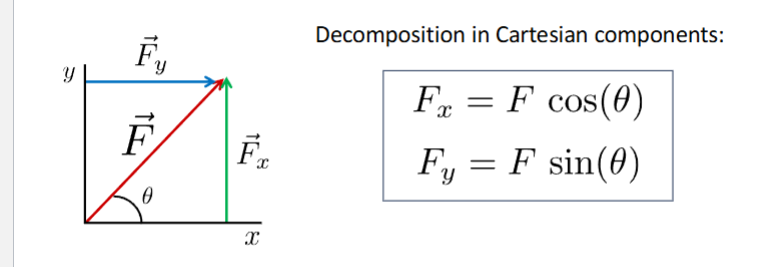
Similar to vectors, taking the property that you can decompose it into Cartesian components, with F for Fx and Fy, respectively.
Adding forces

With two separate forces, it would form a triangle, hence why the formula is
using K.// a summation from k
When adding forces, individual force vectors are arranged tip-to-tail to form a vector triangle or polygon. The total or net force is determined by the resultant vector connecting the starting point to the final endpoint, represented by the summation equation ∑F⃗k∑Fk. This resultant force determines the overall acceleration and direction in which the object will move.
Types of Forces

There is Normal Force, Weight Force, Friction Force, and Tension Force.

With weight force,
Weight force is the gravitational force exerted on an object, pulling it downward toward the center of a massive body like Earth. It is equal to the object's mass multiplied by the acceleration due to gravity, expressed as

With Normal Force, kind of think about it as the force exerted by a non-moving object. The relationship is always perpendicular and changes with the tilt of the object exerting such a force. (think pen on a wall; the wall is using normal force)
With normal force, without any input, the opposing force would be gravity, while with normal force, it can decrease or increase, depending on the input.
It’s a balancer, balancing between the weight and everything else, and if it doesn’t collapse, it is sending an equal amount of force back, like a friction force.

With Friction, the force is always opposite the direction of velocity.
Also, with the
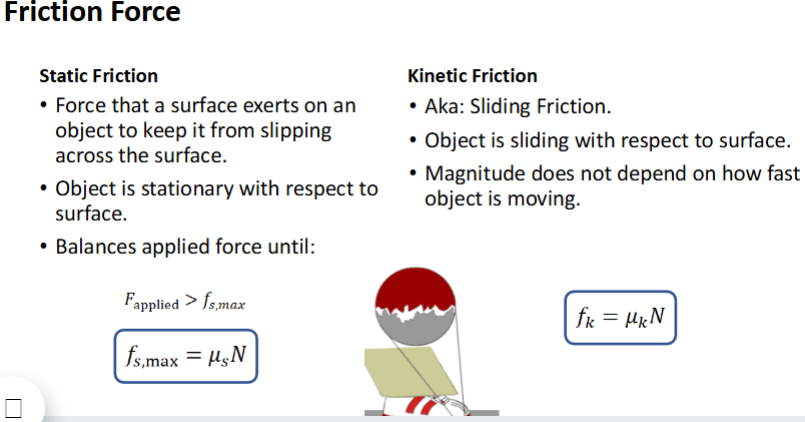
The two primary formulas for friction describe static friction and kinetic friction:
1. Static Friction (): This force acts on a stationary object to prevent it from starting to move. It is written as an inequality because static friction matches whatever force is applied up to a maximum threshold ().
2. Kinetic Friction (): This force acts on an object that is already sliding across a surface. It has a constant value determined by the coefficient of kinetic friction () and the normal force ().
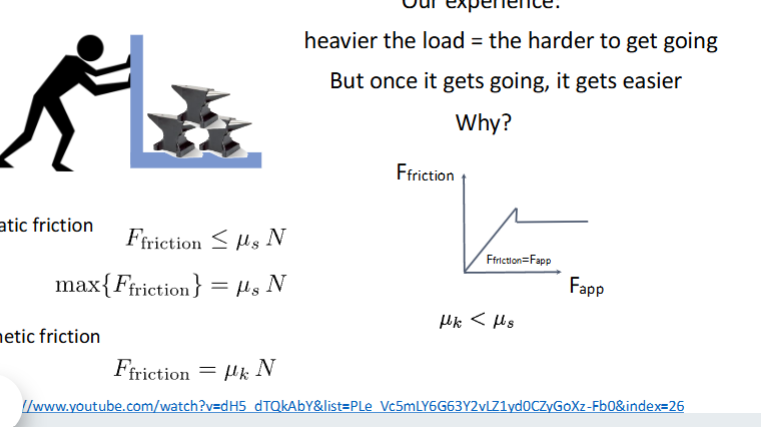
Main Difference: Static friction prevents the start of motion and varies in magnitude up to a maximum limit, whereas kinetic friction opposes ongoing sliding motion and stays constant. Additionally, the coefficient of static friction () is typically larger than the coefficient of kinetic friction ().
With friction, it depends on the force, since if it’s not moving, there needs to be another force acting in that direction.
With the net force is zero, the opposing force would be the exact same as the regular one, achieving 2-2=0, for instance, with F being 2 N, and F1, the opposing force being -2
There is a limit with static friction, since when a object moves, like with 10N, the Friction force would be less than, since it needs to be a net force greater than 0.
\
With friction, it is present between walking, between pulley and string, braking, and much more.
Instances of low friction being useful is hockey, with the puck gliding across the ground, since there is air between the puck and the ground.
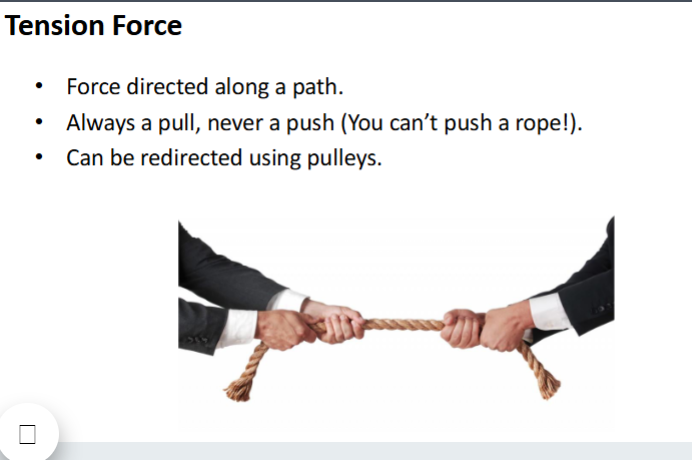
With tension force, the tension is in the string, which can change based on the object or the holder, but explores that more than the string itself. There is a separate thing that measures the compression.

Not really a symbol for it, fine with F(whatever force, w, r, n, t).
Also, with this force, the weight is the same/force, though on one side, it will be different, and it ranges based on the orientation of the string, though the total force is the same.
Think like 45 + 45 = 90, 60+ 30 = 90, just a property that changes depending on the string position/orientation.
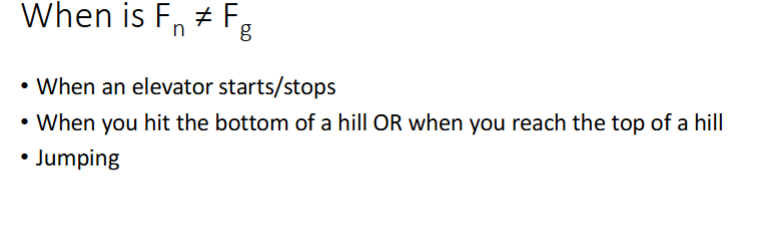
Basically, when you need to get above the normal force, to actually move up, like with jumping, you need more force than gravity to jump.
When a wheel is moving without slipping, it would be static friction, since that’s the frition holding it together in place, if that makes sense, if it slipped, then it would be kinetic.

Normal force is always present as long as their is a surface, and an objact on it, and weight force will be present as long as gravity exists.

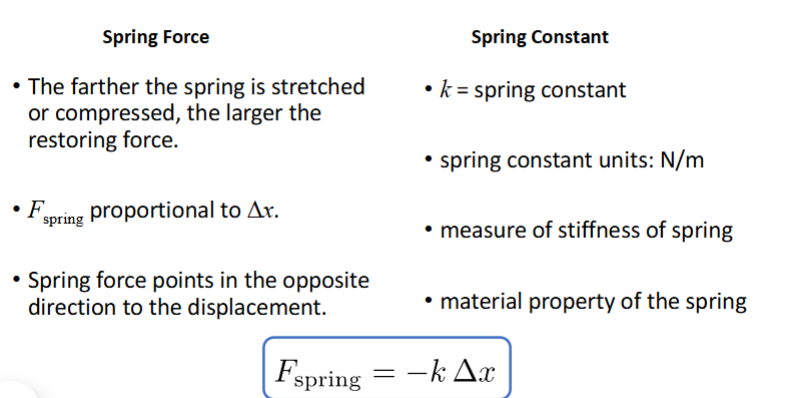
The difference between tension and spring force, is that spring force changes the length with force, while with tension, the length doesn’t change.
Spring force acts opposite to where the force is applied.

Spring force is a restoring force exerted by a stretched or compressed spring to return to its equilibrium position. Described by Hooke's Law (), the force is directly proportional to the spring's displacement and the spring constant . The negative sign signifies that the direction of the force
A larger k means more flexibility.
Newton’s first Law

With the first law, in mathematical form.

Strategy for Equilibrium problems
