Unit 5 (AP Calculus AB): Mean Value Theorem, Extreme Values, and Extrema on Closed Intervals
Mean Value Theorem
When you compute a derivative, you are finding an instantaneous rate of change, meaning the slope of the tangent line at a point. Many real problems start with an average rate of change over an interval, like average speed over a whole trip. The Mean Value Theorem (MVT) connects these ideas by guaranteeing that, under the right conditions, the instantaneous rate of change matches the average rate of change at least once on the interval.
What the Mean Value Theorem says
If a function is continuous on a closed interval and differentiable on the corresponding open interval, then there exists at least one interior point where the tangent slope equals the secant slope.
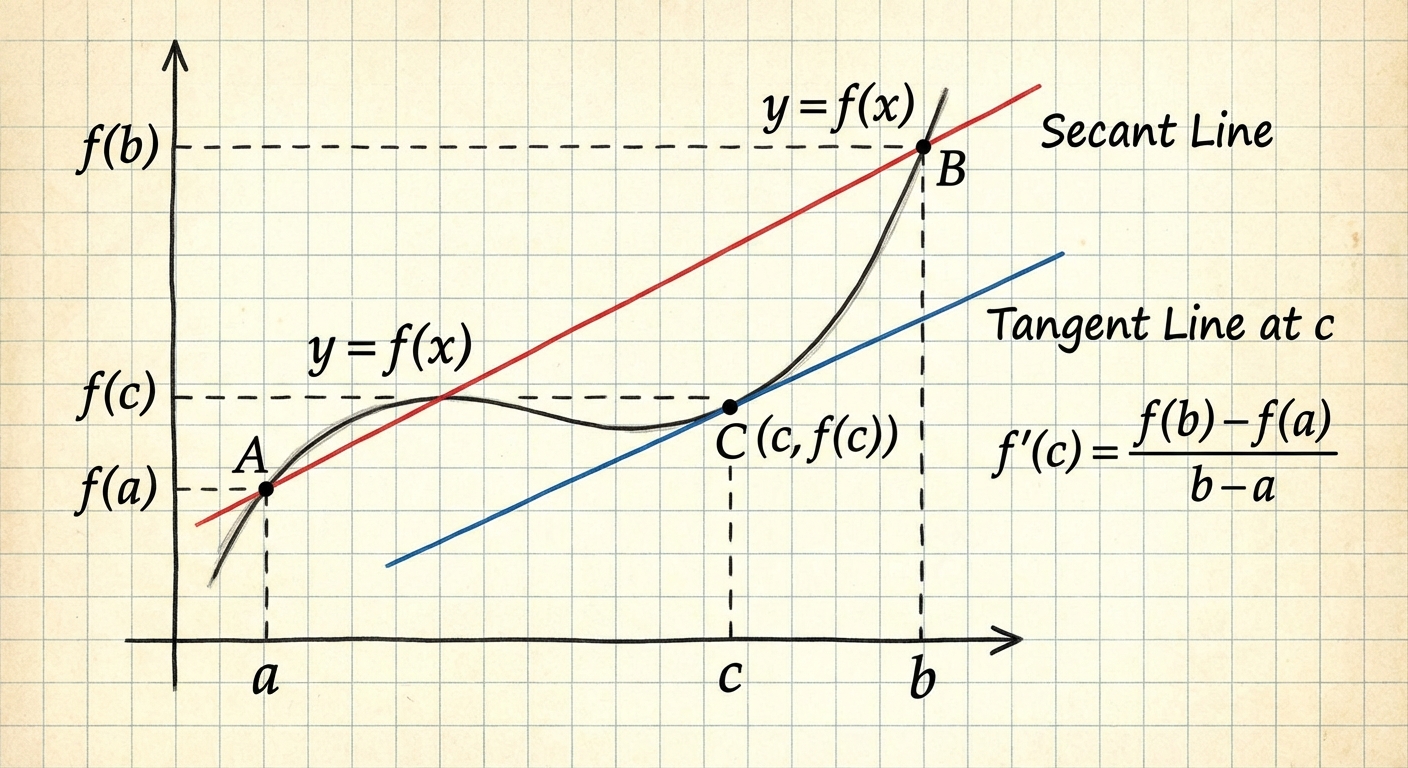
Mean Value Theorem (MVT). If %%LATEX0%% is continuous on %%LATEX1%% and differentiable on %%LATEX2%%, then there exists at least one number %%LATEX3%% in such that:
Interpretation:
- %%LATEX6%% is the slope of the secant line through %%LATEX7%% and %%LATEX8%%. This is the average rate of change on %%LATEX9%%.
- %%LATEX10%% is the slope of the tangent line at %%LATEX11%%. This is an instantaneous rate of change.
- The theorem guarantees at least one point where these slopes match.
Geometrically, if you draw the secant line from %%LATEX12%% to %%LATEX13%%, then somewhere in between, the graph has a tangent line parallel to that secant line.
Why it matters
MVT is a core “existence guarantee” tool in calculus. It is used to justify real-world statements (like the average speed idea), prove other results (including inequality facts and behavior of functions), and solve AP-style questions that ask you to show a particular derivative value occurs somewhere in an interval.
Conditions for MVT (and why they are not optional)
The two hypotheses are exactly what prevent counterexamples.
- Continuity on means the graph has no holes or jumps on the interval. If you could “teleport” from one value to another, you might skip the needed tangent slope.
- Differentiability on %%LATEX15%% means there are no corners, cusps (like the sharp point in %%LATEX16%%), or vertical tangents inside the interval. If the derivative does not exist at a point, the conclusion might not even make sense there.
If either condition fails, MVT may fail.
Special case: Rolle’s Theorem
Rolle’s Theorem is the MVT in the special case where the endpoints have equal function values.
If %%LATEX18%% and %%LATEX19%% is continuous on %%LATEX20%% and differentiable on %%LATEX21%%, then there exists %%LATEX22%% in %%LATEX23%% such that:
Geometrically, if you start and end at the same height and the function is smooth enough, you must have a horizontal tangent somewhere in between.
Notation you are expected to recognize
AP problems often mix derivative notation and rate-of-change language.
| Concept | Common notations | Meaning |
|---|---|---|
| Derivative | %%LATEX25%%, %%LATEX26%%, | Instantaneous rate of change |
| Average rate of change on an interval | Secant slope | |
| MVT guaranteed interior point | An input where slopes match |
Worked example 1: Find all points guaranteed by MVT
Let %%LATEX30%% on %%LATEX31%%.
- Check conditions: polynomials are continuous and differentiable everywhere, so MVT applies.
- Compute average rate of change:
- Compute derivative:
- Set equal to the average rate:
Conclusion: at %%LATEX37%%, the instantaneous slope equals the average slope from %%LATEX38%% to .
Worked example 2: Applying MVT on a polynomial
Problem: %%LATEX40%% on %%LATEX41%%. Find the value(s) of guaranteed by MVT.
- Check conditions: %%LATEX43%% is a polynomial, so it is continuous on %%LATEX44%% and differentiable on .
- Average rate of change:
- Derivative:
- Set derivative equal to the average rate:
- Check the interval requirement : only
is in .
Worked example 3: A typical “show that” MVT setup
Show that there exists a number %%LATEX55%% in %%LATEX56%% such that:
Choose a function so that its derivative produces a sine. A good choice is:
- %%LATEX59%% is continuous on %%LATEX60%% and differentiable on .
- By MVT, there exists such that:
Compute the right-hand side:
Compute the derivative:
So MVT gives:
Exam Focus
Typical question patterns:
- “Verify the hypotheses of the Mean Value Theorem on %%LATEX68%% and find all values of %%LATEX69%% that satisfy the conclusion.”
- “Show that there exists %%LATEX70%% in %%LATEX71%% such that %%LATEX72%%.” (You compute %%LATEX73%% as a secant slope.)
- Conceptual interpretation in context (position/velocity, temperature change, profit).
Common mistakes:
- Forgetting to check both continuity on %%LATEX74%% and differentiability on %%LATEX75%%. AP loves piecewise functions with corners/cusps or functions with asymptotes in the interval.
- Using the wrong slope: average rate of change must be .
- Solving for %%LATEX77%% but giving an endpoint value. MVT requires %%LATEX78%%, not %%LATEX79%% or %%LATEX80%%.
- Applying MVT to a function with a cusp (like %%LATEX81%%) or an asymptote inside the interval. A reliable FRQ habit is to explicitly write: “Since %%LATEX82%% is continuous on %%LATEX83%% and differentiable on %%LATEX84%%, MVT applies.”
Extreme Value Theorem
Calculus often asks two different kinds of questions about maxima and minima: (1) existence, meaning whether you are guaranteed to have absolute extrema, and (2) location, meaning where they happen. The Extreme Value Theorem (EVT) answers the existence question for a key situation.
What the Extreme Value Theorem says
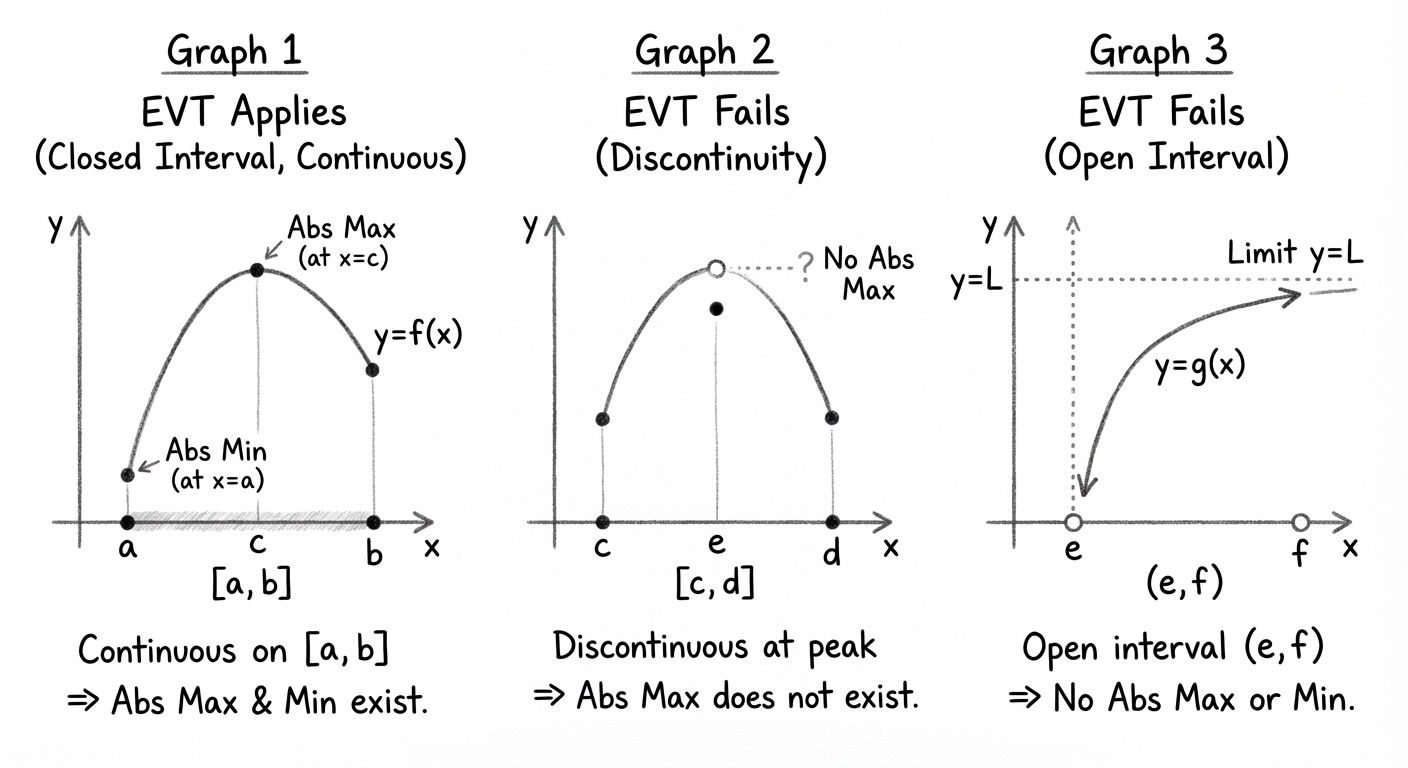
Extreme Value Theorem (EVT). If %%LATEX85%% is continuous on a closed interval %%LATEX86%%, then %%LATEX87%% attains both an absolute maximum value and an absolute minimum value on %%LATEX88%%.
The word “attains” is crucial: it means there are actual inputs where the max and min occur. In other words, there exist numbers %%LATEX89%% and %%LATEX90%% in such that:
Why it matters
EVT tells you when it makes sense to go looking for absolute extrema using calculus methods. It also explains why “closed interval” problems are so common on AP: endpoints are included, and EVT guarantees absolute extrema exist as long as the function is continuous.
In applications, EVT is the justification behind statements like:
- A continuous profit function over a fixed production range must achieve a highest and lowest profit somewhere in that range.
- A continuous temperature function over a day must reach a hottest and coldest moment.
Key nuances (what can go wrong if conditions fail)
Both conditions matter.
- Continuity is mandatory. If there is a hole or vertical asymptote, a maximum or minimum might not exist. For instance, a function could approach the value %%LATEX94%% but never equal %%LATEX95%%, so it would have a supremum but no maximum.
- Closed interval is mandatory. On an open interval like %%LATEX96%%, the function %%LATEX97%% has no absolute maximum (it gets arbitrarily close to %%LATEX98%% but never reaches it) and no absolute minimum (it gets arbitrarily close to %%LATEX99%% but never reaches it).
A common misconception is thinking “continuous” alone guarantees absolute extrema. It does not; you also need the interval to be closed and bounded.
Worked example: Using EVT conceptually
Consider %%LATEX100%% on %%LATEX101%%.
- The function is continuous on .
- Because the interval is closed and bounded, EVT guarantees an absolute maximum and absolute minimum exist.
Even without calculus, you can reason:
- Maximum occurs at the top of the semicircle: %%LATEX103%% gives %%LATEX104%%.
- Minimum occurs at the endpoints: %%LATEX105%% gives %%LATEX106%%.
EVT does not tell you where extrema occur; it guarantees they do occur.
Exam Focus
Typical question patterns:
- “Does %%LATEX107%% have an absolute maximum and minimum on %%LATEX108%%? Justify.”
- Conceptual multiple-choice: identify which hypotheses (continuity, closed interval) are needed.
- Free response: explain why an optimization problem is guaranteed to have a solution on a given domain.
Common mistakes:
- Claiming EVT applies on an open interval like .
- Ignoring discontinuities inside (piecewise graphs with jumps/holes, or asymptotes).
- Confusing EVT (guarantees existence) with methods that locate extrema (critical points and endpoints).
Finding Absolute and Relative Extrema
Once you know extrema exist (often via EVT), the next step is locating them. Derivatives help because extrema often happen where the derivative is zero or undefined.
Types of extrema (definitions)
An absolute (global) maximum of on a domain is the highest function value anywhere on that domain, and an absolute (global) minimum is the lowest.
A relative (local) maximum occurs at %%LATEX112%% where %%LATEX113%% is larger than nearby values (within some small open interval around %%LATEX114%%). A relative (local) minimum occurs at %%LATEX115%% where is smaller than nearby values.
Relative extrema are neighborhood statements, not whole-interval statements. A function can have many relative extrema but only one absolute maximum (or none, if the domain does not guarantee one).
Why derivatives locate relative extrema (Fermat’s Theorem)
If %%LATEX117%% is differentiable at an interior point %%LATEX118%% and has a relative maximum or minimum there, the tangent line cannot be slanted up or down; otherwise, moving slightly left or right would immediately increase or decrease the function. This idea is formalized as Fermat’s Theorem:
If %%LATEX119%% has a relative extremum at an interior point %%LATEX120%% and exists, then:
Critical points (critical numbers)
A critical point (more precisely, a critical number %%LATEX123%%) is an input %%LATEX124%% in the domain of such that either:
or
The “does not exist” case includes sharp turns/cusps and vertical tangents.
Important logic chain to keep straight:
- Relative extrema occur only at critical points.
- Not every critical point is an extremum.
A classic example is %%LATEX128%%, where %%LATEX129%% but is not a max or min (it is an inflection point).
How to classify relative extrema (First Derivative Test idea)
To decide whether a critical number is a relative maximum, relative minimum, or neither, examine the sign of on either side.
- If %%LATEX132%% changes from positive to negative at %%LATEX133%%, then %%LATEX134%% goes from increasing to decreasing, so %%LATEX135%% is a relative maximum.
- If %%LATEX136%% changes from negative to positive at %%LATEX137%%, then %%LATEX138%% goes from decreasing to increasing, so %%LATEX139%% is a relative minimum.
- If %%LATEX140%% does not change sign at %%LATEX141%%, then there is no relative extremum there.
This sign-change reasoning is often more reliable than memorized rules because it ties directly to the meaning of the derivative as slope.
Worked example: Find relative extrema
Let
- Compute derivative:
- Find critical numbers by solving :
So the critical numbers are
- Determine the sign of on intervals.
For %%LATEX150%% (test %%LATEX151%%):
So %%LATEX153%% is increasing on %%LATEX154%%.
For %%LATEX155%% (test %%LATEX156%%):
So %%LATEX158%% is decreasing on %%LATEX159%%.
For %%LATEX160%% (test %%LATEX161%%):
So %%LATEX163%% is increasing on %%LATEX164%%.
- Classify.
- At %%LATEX165%%, %%LATEX166%% changes from positive to negative, so is a relative maximum.
- At %%LATEX168%%, %%LATEX169%% changes from negative to positive, so is a relative minimum.
If you need the function values:
So the relative max value is %%LATEX173%% at %%LATEX174%%, and the relative min value is %%LATEX175%% at %%LATEX176%%.
Exam Focus
Typical question patterns:
- “Find the relative extrema of .” (Find critical points, then classify.)
- Given a graph of %%LATEX178%%, determine where %%LATEX179%% has relative maxima/minima based on sign changes.
- Interpret in context: where does a quantity reach a local high/low, and what does it mean?
Common mistakes:
- Stopping after solving and calling every solution a max/min without checking sign change.
- Forgetting that extrema can occur where %%LATEX181%% does not exist (corners, cusps, vertical tangents), as long as %%LATEX182%% exists.
- Mixing up the derivative sign logic: positive means increasing, negative means decreasing.
Candidates Test for Absolute Extrema
Relative extrema describe “nearby” behavior, but AP frequently asks for absolute extrema on a specific interval. The most dependable method for absolute extrema on a closed interval is the Candidates Test, also called the Closed Interval Method.
What the Candidates Test is
To find the absolute maximum and minimum of %%LATEX183%% on a closed interval %%LATEX184%%:
- Identify all critical numbers of %%LATEX185%% in %%LATEX186%% (where %%LATEX187%% or %%LATEX188%% does not exist).
- Evaluate %%LATEX189%% at each critical number in %%LATEX190%%.
- Evaluate %%LATEX191%% and %%LATEX192%%.
- Compare all candidate values: the largest is the absolute maximum value and the smallest is the absolute minimum value.
Why endpoints matter
A very common misconception is thinking “the maximum happens where the derivative is zero.” On a closed interval, an absolute maximum or minimum can occur at an interior critical point or at an endpoint. Endpoints often win when the function is increasing or decreasing on the entire interval (so there are no interior critical points).
Why the test works (connection to EVT)
The logic is a combination of two facts:
- EVT says: if %%LATEX193%% is continuous on %%LATEX194%%, absolute extrema exist.
- Calculus says: inside the interval, absolute extrema can only occur at critical numbers.
So, on a closed interval, checking endpoints and interior critical numbers guarantees you find the absolute max and min.
Worked example 1: Absolute extrema on a closed interval
Find the absolute maximum and minimum of
on
- Critical numbers in come from
So critical numbers are
Both are in the interval.
- Evaluate %%LATEX201%% at the candidates %%LATEX202%%:
- Compare values:
- Largest value is %%LATEX207%% (occurs at %%LATEX208%% and ).
- Smallest value is %%LATEX210%% (occurs at %%LATEX211%% and ).
So the absolute maximum value is %%LATEX213%% at %%LATEX214%% and %%LATEX215%%, and the absolute minimum value is %%LATEX216%% at %%LATEX217%% and %%LATEX218%%.
This is a good reminder that absolute extreme values can occur at multiple inputs.
Worked example 2: A function with a nondifferentiable critical point
Find the absolute extrema of
on
- The absolute value creates a corner at %%LATEX221%%, so %%LATEX222%% does not exist. That makes a critical number.
(You can also reason piecewise: for %%LATEX224%%, %%LATEX225%% so %%LATEX226%%; for %%LATEX227%%, %%LATEX228%% so %%LATEX229%%. The slope changes abruptly at .)
- Candidates are . Evaluate:
- Compare:
- Absolute minimum value is %%LATEX235%% (at %%LATEX236%% and ).
- Absolute maximum value is %%LATEX238%% (at %%LATEX239%%).
Notice the absolute minimum happens at a point where the derivative does not exist (a corner). If you only checked where , you would miss it.
Worked example 3: Candidates Test with a table
Problem: Find the absolute extrema of
on
- Differentiate:
- Find critical points by setting :
So
and
Both are inside .
- Evaluate candidates in a table:
| Candidate Type | ||
|---|---|---|
| Endpoint | ||
| Crit Point | ||
| Crit Point | ||
| Endpoint |
- Conclusion:
- Absolute maximum: %%LATEX260%% at %%LATEX261%%
- Absolute minimum: %%LATEX262%% at %%LATEX263%%
A realistic application framing
In optimization problems, you typically define a function (area, cost, revenue, distance) over a restricted domain. If the domain is a closed interval and the function is continuous, EVT guarantees a best and worst case exist, and the Candidates Test tells you exactly where to check: endpoints plus critical numbers.
Exam Focus
Typical question patterns:
- “Find the absolute maximum and minimum values of %%LATEX264%% on %%LATEX265%%.”
- “A function %%LATEX266%% is continuous on %%LATEX267%%. Find where attains its absolute extrema.”
- Applied optimization: define , justify EVT conditions, then use candidates to determine the optimum.
Common mistakes:
- Forgetting to test endpoints %%LATEX270%% and %%LATEX271%% on a closed interval.
- Finding critical numbers but evaluating %%LATEX272%% instead of %%LATEX273%% when comparing candidates.
- Including critical numbers not in the interval, or forgetting that a “critical number” must be in the domain of .
- Ignoring undefined derivatives: points where does not exist (corners/cusps/vertical tangents) are still critical points and can produce absolute extrema.
- Mixing up value vs. location: if asked for the “absolute maximum value,” give the %%LATEX276%%-value; if asked “where” it occurs, give the %%LATEX277%%-value(s).