Unit 8: Scales, Modes, and Musical Form
The Church Modes
Modes are alternative scales derived from the major scale pattern. In AP Music Theory, you must be able to identify these modes aurally and visually. There are two primary ways to conceptualize modes: Relative (rotations of a parent major scale) and Parallel (alterations to a tonic major or minor scale).
The 7 Diatonic Modes
A helpful mnemonic to remember the order of modes is: I Don't Play Loud Music At Lunch.
- Ionian (Major)
- Dorian (Minor-ish)
- Phrygian (Minor-ish)
- Lydian (Major-ish)
- Mixolydian (Major-ish)
- Aeolian (Natural Minor)
- Locrian (Diminished qualities)
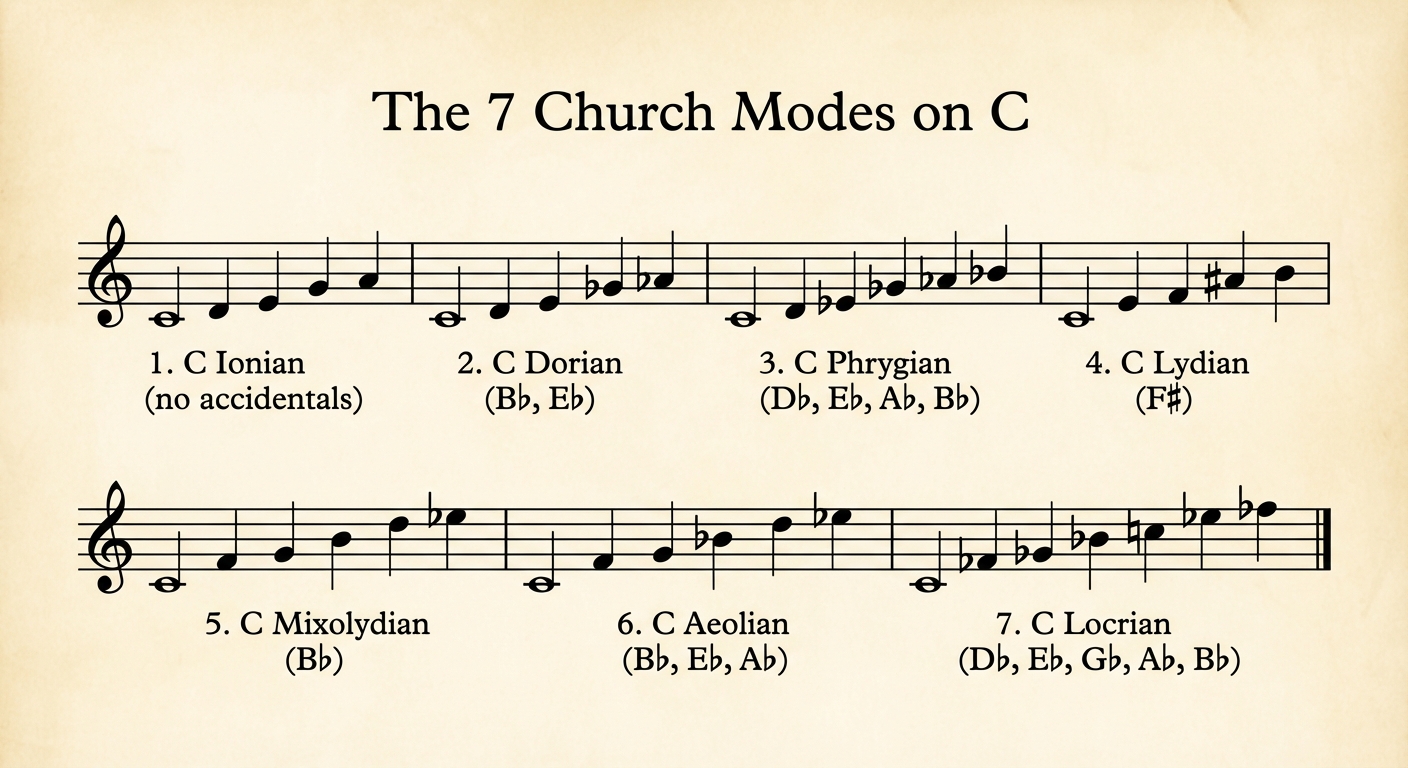
The Parallel Approach (Recommended)
Thinking in "Parallel" allows you to compare the mode directly to a major or minor scale starting on the same tonic. This is the fastest way to identify modes on the exam.
Major Modes family
These modes contain a Major 3rd. Compare them to Ionian (Major Scale).
- Ionian: The standard Major scale. No alterations.
- Lydian: Major scale with a raised 4th ($\sharp\hat{4}$).
- Mixolydian: Major scale with a lowered 7th ($\flat\hat{7}$).
Minor Modes Family
These modes contain a Minor 3rd. Compare them to Aeolian (Natural Minor Scale).
- Aeolian: The standard Natural Minor scale. No alterations.
- Dorian: Minor scale with a raised 6th ($\natural\hat{6}$ or $\sharp\hat{6}$).
- Distinction: It has the "Dorian 6th" which removes the minor interval between steps 5 and 6.
- Phrygian: Minor scale with a lowered 2nd ($\flat\hat{2}$).
- Distinction: Creates a distinctive half-step movement at the very beginning of the scale.
The Odd One Out
- Locrian: Starts like Phrygian ($\flat\hat{2}$) but also has a lowered 5th ($\flat\hat{5}$).
- Formula: $1 - \flat\hat{2} - \flat\hat{3} - \hat{4} - \flat\hat{5} - \flat\hat{6} - \flat\hat{7}$
- Scale Quality: This is the only mode with a diminished tonic triad.
The Relative Approach
This method views modes as "rotations" of a parent major scale (playing white keys on a piano).
| Mode | Scale Degree Start | Example (White Keys) |
|---|---|---|
| Ionian | 1 (Do) | C to C |
| Dorian | 2 (Re) | D to D |
| Phrygian | 3 (Mi) | E to E |
| Lydian | 4 (Fa) | F to F |
| Mixolydian | 5 (Sol) | G to G |
| Aeolian | 6 (La) | A to A |
| Locrian | 7 (Ti) | B to B |
Other Melodic Structures
Beyond standard major/minor and modes, you must recognize these specific scale formations.
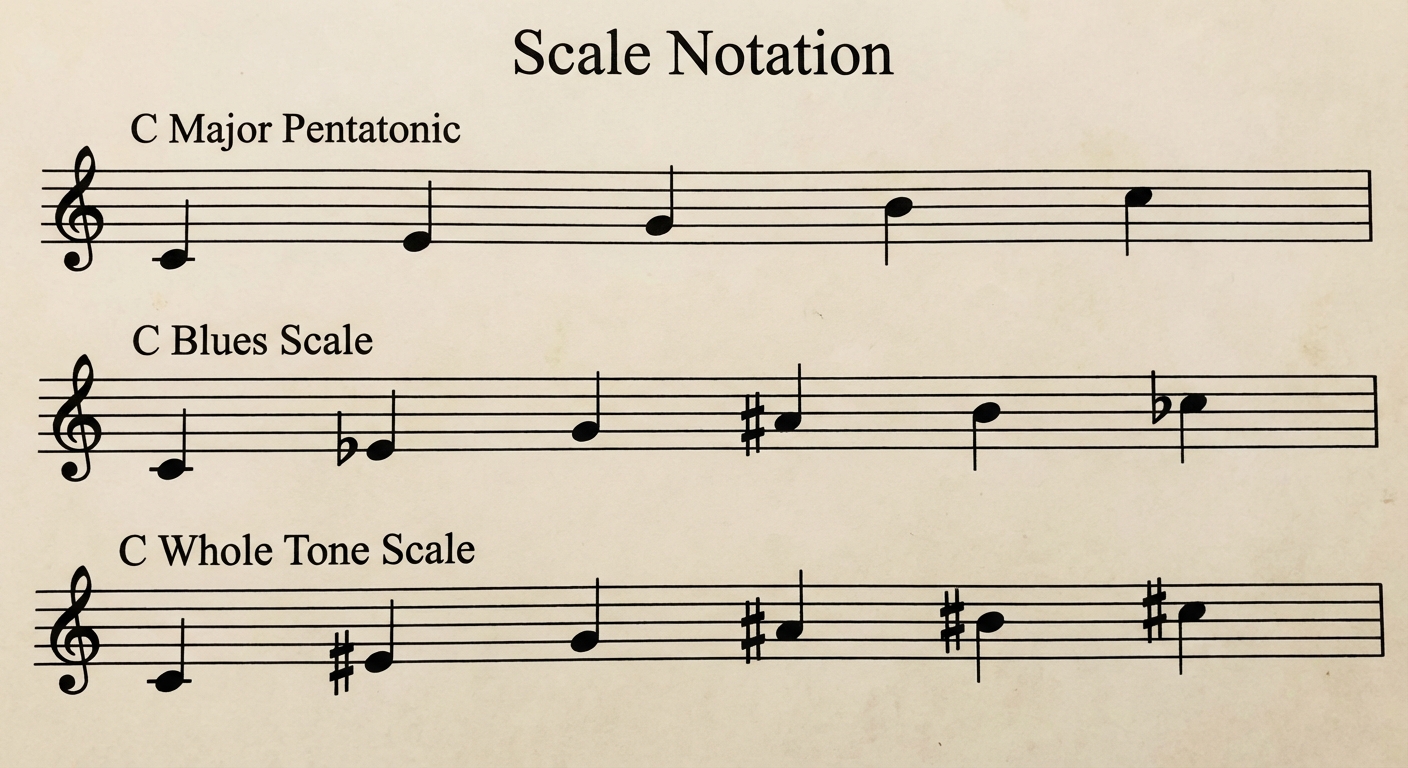
Pentatonic Scales
Scales consisting of only five tones (penta). They lack half-steps and generally avoid the tritone, making them sound consonant.
- Major Pentatonic: Scale degrees $1 - 2 - 3 - 5 - 6$. (Omits the 4th and 7th).
- Example in C: C D E G A
- Minor Pentatonic: Scale degrees $1 - \flat\hat{3} - 4 - 5 - \flat\hat{7}$. (Relative to major pentatonic starting on scale degree 6).
- Example in C: C Eb F G Bb
The Blues Scale
Used in jazz, blues, and rock. It is essentially a Minor Pentatonic scale with an added chromatic passing tone known as the "blue note."
- Formula: $1 - \flat\hat{3} - 4 - \sharp\hat{4}/\flat\hat{5} - 5 - \flat\hat{7}$.
- Hexatonic: Technically a six-note scale.
Whole-Tone Scale
A hexatonic (6-note) scale composed entirely of major seconds (whole steps).
- Effect: Dreamy, floating, lacks a tonal center because there are no half-steps or leading tones.
- Example: C D E F# G# A# (C)
Octatonic Scale
An 8-note scale that alternates between whole steps and half steps (Whole-Half-Whole-Half… or vice versa).
- Often associated with Diminished harmony.
Phrase Structure & Relationships
Analysis of form begins with the smallest unit of musical thought.
The Motif vs. The Phrase
- Motif: A short melodic or rhythmic fragment used to build a melody.
- Phrase: A complete musical thought that ends with a cadence. A phrase is roughly comparable to a sentence in language.
Chain of Phrases
Phrases often do not stand alone. They interact in pairs or groups.
- Phrase Chain: A series of unrelated phrases (e.g., $a - b - c$).
- Elision: When the cadence of one phrase serves as the beginning of the next phrase (overlap).
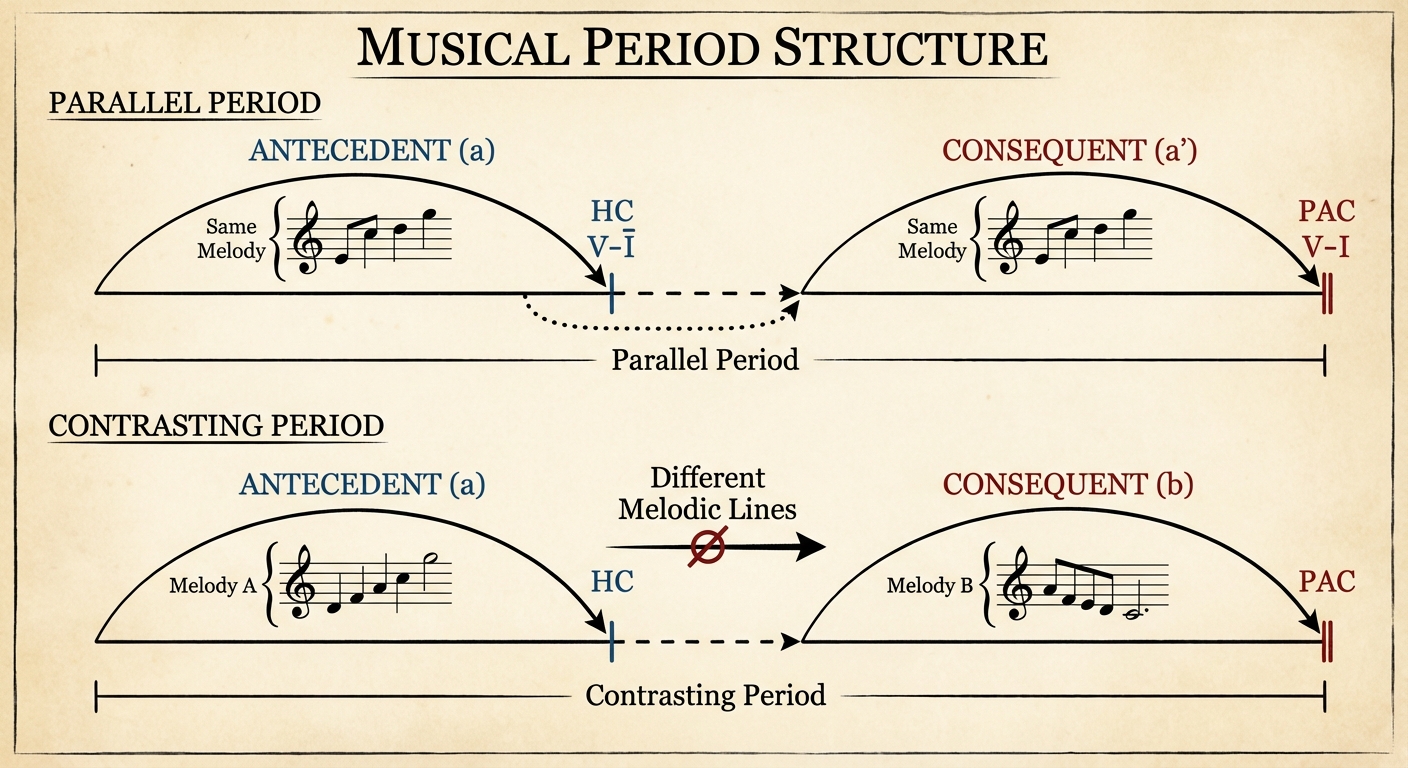
The Period
The Period is the most common structural unit in Classical era music. It primarily consists of two phrases acting in a "Question and Answer" relationship.
Essential Logic: Antecedent & Consequent
For a pair of phrases to form a period, the second phrase must end with a stronger cadence than the first.
- Antecedent Phrase (Question): The first phrase. Ends with a "weak" cadence (usually a Half Cadence or sometimes an Imperfect Authentic Cadence). It feels unfinished.
- Consequent Phrase (Answer): The second phrase. Ends with a "strong" cadence (usually a Perfect Authentic Cadence). It resolves the tension.
Types of Periods
We classify periods based on the melodic similarity between the two phrases.
1. Parallel Period ($a - a'$)
- The Antecedent and Consequent begin with the same (or highly similar) melody.
- The endings differ to accommodate the different cadences.
2. Contrasting Period ($a - b$)
- The Antecedent and Consequent have different melodic material.
3. Double Period
- A group of four phrases. The first two form the Antecedent (large-scale question) and the last two form the Consequent (large-scale answer).
- Cadence Rule: The only cadence that matters for the definition is the final one (phrase 4) compared to the midpoint (phrase 2). Phrase 4 must be stronger than phrase 2.
4. The Sentence
- Distinct from a period. It usually follows a $2 + 2 + 4$ measure structure.
- Presentation: A basic idea is stated, then repeated (often sequentially).
- Continuation: The music accelerates rhythmically or harmonically toward a cadence.
Large Structural Forms
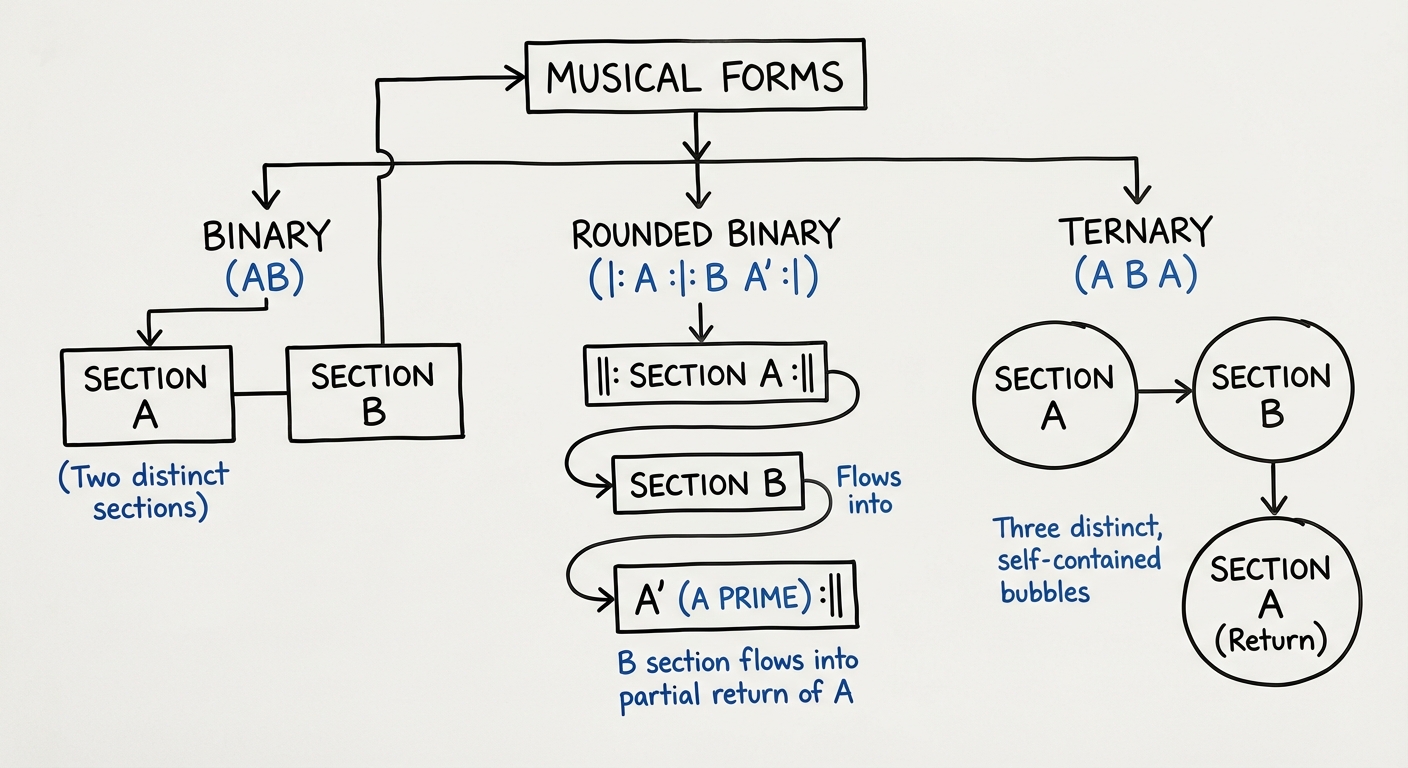
Binary Form (AB)
A two-part structure. Both parts are usually repeated ($|: A :| |: B :|$).
- Simple Binary: The A section moves to a new key (usually V or relative major); the B section has no distinct return of the opening A theme.
- Rounded Binary: The B section acts as a contrasting "digression," but ends with a return of the A section's melody (often shortened).
- Structure: $A - B - \frac{1}{2}A$
- Note: This is the precursor to Sonata form.
Ternary Form (ABA)
A three-part structure where the A section returns completely (Statement - Contrast - Return).
- Distinction from Rounded Binary: In Ternary, the B section is usually harmonically closed (ends in its own key) and creates a distinct "separate" section.
Other Forms
- Strophic (AAAA): Same music repeated for different verses of text (common in hymns and folk songs).
- Through-Composed: New music for each stanza; no repetition of large sections.
- Rondo: A principal theme (A) alternates with contrasting episodes.
- 5-part Rondo: $A - B - A - C - A$
- 7-part Rondo: $A - B - A - C - A - B - A$
- Sonata-Allegro Form: Explored in advanced analysis, but consists of Exposition, Development, and Recapitulation (a massive expansion of Rounded Binary).
Pop & Song Forms
Occasionally, the AP exam references terminology common in popular music analysis.
- Verse: Repeated music with different lyrics. Tells the story.
- Chorus: The main hook. Same music, same lyrics. Often thicker texture.
- Bridge: A contrasting section (usually new harmony/key) that connects a chorus back to a verse or final chorus. Provides relief/tension.
- Refrain: A single line repeated at the end of verses (distinct from a full Chorus section).
- Interlude: A strictly instrumental break between vocal sections.
Common Mistakes & Pitfalls
- Confusing Dorian and Aeolian:
- Mistake: Hearing a minor mode and assuming it is Aeolian.
- Fix: Listen specifically to scale degrees 6 and 7. If the 6th is raised (major 6th interval from tonic) but the 3rd is minor, it is Dorian.
- Identifying Intervals in Modes:
- Mistake: Assuming Phrygian has a raised note.
- Fix: Phrygian is defined by the lowered 2nd. It sounds "darker" than minor.
- Period vs. Phrase Group:
- Mistake: Calling any two phrases a "Period."
- Fix: Check the cadences. If phrase 2 ends on a Half Cadence (weaker than phrase 1 or equal), it is NOT a period. A period requires resolution at the end ($Weak \to Strong$).
- Rounded Binary vs. Ternary:
- Mistake: Confusing these two because they both have an ABA feel.
- Fix: Look at the repeats. Rounded Binary usually has repeat signs grouping the $BA'$ section together. Ternary sections are often more independent.