Skill Acquisition
SKILL CONTINUUMS:
Muscular involvement:
Fine- small muscle movements, accurate with control and direction (eg. Darts)
Gross- large muscle movements, power, stamina and strength (eg. Running)
Environmental:
Open- unstable/ changing externally paced environment, requires constant adjustment and decision making (eg. Cricket batter)
Closed- predictable/stable/ consistent self paced environment, habitual (eg. High jump)
Pacing:
Self paced- performer controls the start of movement, habitual (eg. Long jump)
Externally paced- performer stats based on the action of others, changing environment (eg. Basketball)
Continuity:
Discrete- clear beginning and end (eg. Football penalty)
Serial- linked series of discrete skills (eg. Floor routine)
Continuous- no clear beginning or end (eg. Cycling)
Complexity:
Simple- low perpetual load, less decision making (eg. Swimming)
Complex- high perpetual load, lots of decision making (eg. Cricket batter)
Organizational:
Low- contained subroutines requiring power, stamina and strength (eg. Swimming)
High- subroutines cannot be separated, use whole practice (eg. Cycling)
SKILL TRANSFER:
Positive transfer- earning one skill positives influences the learning of another
→ Teach similar skills together
→ Ensure skills are well learned
→ Positive reinforcement
→ Progressive practices
Negative transfer- learning of one skill inhibit the learning of another
→ May be a misunderstanding
→ Skills appear similar but are different
→ Conflicting skills coached together
Zero transfer- no impact by learning of one skill on another
Bilateral- from one side of the body to the other
To prevent this:
Draw attention to the differences
Thoroughly learn skill before moving on
Making key teaching points clear
Don’t overload the performer
GUIDANCE AND FEEDBACK:
Visual guidance- demonstrations or use of videos
Strengths: creates a mental image and is best for les complex skills
Weaknesses: can overload beginners and each in needs to be accurate
Verbal guidance- coach talking though the skill/ key terminology
Strengths: immediate feedback can be given and highlights key points
Weaknesses: can overload beginners causing them to loose concentration
Manual guidance- coaches use a ‘hands-on’ approach
Strengths: builds confidence and eliminates danger
Weaknesses: performer becomes dependant and creates an unrealistic kinaethesic
Mechanical guidance- use of equipment
Strengths: build confidence and ensures safety
Weaknesses: performer becomes dependent and creates an unrealistic kinaethesic
Intrinsic feedback- kinaethesic senses knows when a skill was executed good/ bad
Extrinsic feedback:
Knowledge of results focuses on the outcome
Knowledge of performance focuses on how well the reformer played
Positive feedback- information that praises a performance. Helps strength the S-R bond and motivation
Negative feedback- form of criticism and may be centred around poorer aspects of performance/ results
TYPES OF PRACTICE:
Massed practice- no rest interval and used when a coach wants to promote high levels of fitness
→ for simple and discrete skills
→ highly organized
→ self paced
Strengths: increases fitness and makes skill automatic
Weaknesses: demanding and there is no time for feedback
Variable practice- performing tasks in different situations which strengthens the ability to adapt the skill to a range of circumstances
→ used for open skills for beginners
Strengths: motivating and allows adaptation
Weaknesses: time consuming and demanding
Distributed practices- rest intervals are given for advice and feedback
→ used for beginners/ unfit individuals
→ used for complex, low organized, externally paced skills
Strengths:: allows recovery and feedback
Weaknesses: time consuming
METHODS OF PRACTICE:
Whole practice: repeating the whole series of actions. Can be performed over and over until perfected.
Whole-part-whole practice: action is performed as a full, then skills are broken down and practiced, then the whole action is performed again.
Progressive- part practice: learning several subroutines to form the whole movement.
STAGES OF LEARNING:
1st Phase: Cognitive
Beginners who are understanding the new sport/ skill.
Trial and error process.
Manual and mechanical guidance may be use.
Extrinsic and positive feedback used for encouragement.
2nd Phase: Associative
Practice phase of learning.
Information from feedback is used to correct errors.
Performer builds up mental framework.
Intrinsic feedback is used.
Verbal and visual guidance are used.
3rd Phase: Autonomous
Movements are effected to become automatic.
For experts who are concentrating on the finer details.
THE LEARNING PLATEAU:
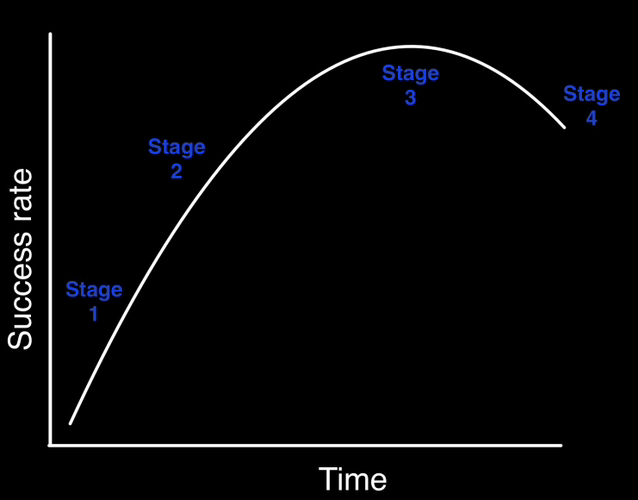
Stage 1- the novice working out the subroutines of the task. Improvements are rapid but uncoordinated.
Stage 2- rapid increase in ate of learning. Performance becomes fluid. This success provides reinforcement, motivation nd confidence.
Stage 3- learning plateau where there is little to no improvement. Could be a consequence of performer reaching their limit of ability, or becoming bored.
Stage 4- reduction in level of performance, due to fatigue or loss of motivation (drive reduction).
OBSERVATIONAL LEARNING:
Behavior is more likely to be repeated if it is reinforced with success
→ Attention: learner must be attracted to the demonstration
→ Retention: information should be broken down so it can be processed and stored
→ Motor reproduction: coach should make sure the performer has the necessary amount of power and coordination
→ Motivation: learner is more likely to continue the practice if motivate. Positive reinforcement should be used.
OPERANT CONDITIONING:
Positive reinforcement, mental rehearsal ad practicing the task as a whole will strengthen the S-R bond. This is a link between a stimulus and a certain response.