Paleontology GEOL120
What is Paleontology?
evolution of life over geological time
origin of life/evolution of modern organisms
relationships between the geosphere and biosphere
What is common to all living organisms?
Chemistry
ability to build themselves using energy/external elements
ability to duplicate themselves
common history/common ancestor

Evolution and Extinction
Evolution
Natural selection
Extinction: is a normal and important process
The Big 5
5 major extinction events have reshaped life on Earth.
Events are almost always a combination of multiple causes:
-sea level changes
-continental restructuring/plate tectonics
-Bolide (asteroid) impacts
-massive volcanic eruptions


Helps visualize paleodiversity through time. x-axis=time periods, y-axis=different families of fauna (think kingdom, phylum, class, order, family, genus, species)

What is a fossil?
Fossils are remains of past life
Usually found in sedimentary rocks
Transformation of organisms into fossils, or fossilization, is a comp[lex phenomenon

Hopefully the fossils dodge any tectonic activity, as they will get broken up
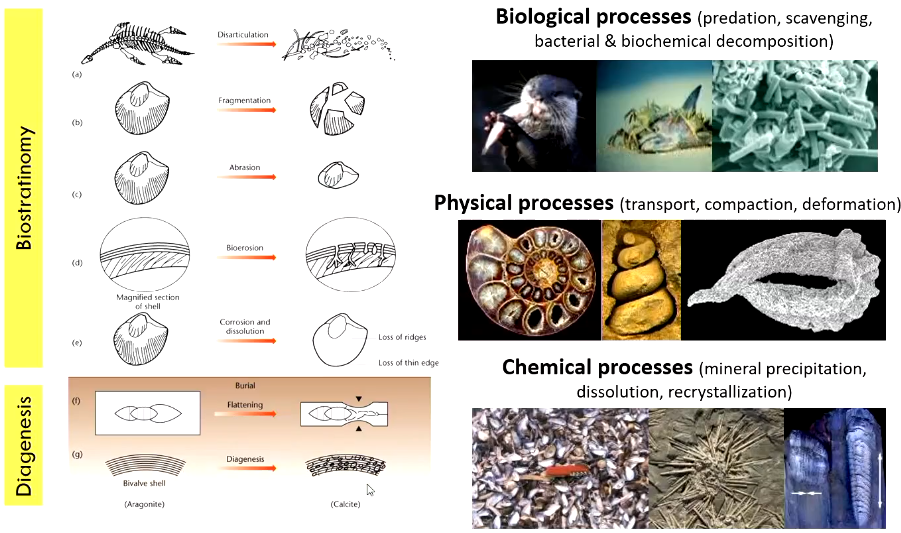
Taphonomy - fancy word for fossilization
Pre-burial - Biostratinomy
Post-burial - Diagenesis
Body fossils - Whole or part of their bodies
unaltered remains - preservation in toto, preservation of soft tissue
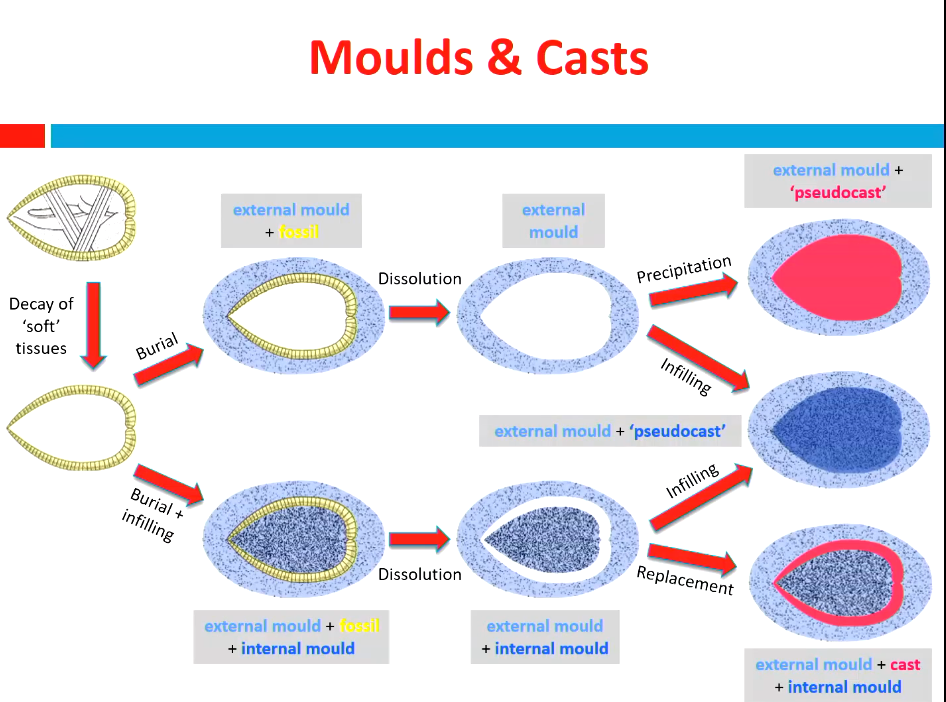
altered remains - carbonization, permineralization, replacement, moulds/casts
preservation in toto - part or entire organism fully preserved
frozen/mummified, only recent organisms (a few 10,000s of years), decay rapidly starts again if warmer or more humid conditions
amber, usually external envelope only, organic matter altered
Carbonization - after burial, volatile organic components disperse, leaving thin carbon-rich film, deducing low O2 environment. Typical for plants (coal), graptolites, soft-bodied arthropods.
With carbonization, think the fish fossil you have at home
Permineralization - (think of petrified wood) saturated solution (silica, CaCO3…) fills cavities of an organism. Mineral precipitation within these cavities. Original material composing hard parts may remain
People usually get confused between permineralization and replacement.
Replacement - Biomineralization tissue dissolves, leaving a void later filled with another mineral. Or replacement molecule-by-molecule
When the biomineralized parts of the fossil have been dissolved away and replaced mineral by mineral. Think of a crab shell getting dissolved, and then silica growing in the cavity and replacing the old shell.


Pyritization-
FeS2; Permineralization or coating or replacement
Usually induced by bacterial activity during the breakdown of the organism
Iron rich, O2 poor and organic matter poor sediment


Factors facilitating fossilization-
Preservation potential of tissues
depositional environment (low O2/low energy) aquatic, mostly marine environments (sea, lakes, deltas/rivers
Fossils don’t usually form in -
mountainous regions
high energy rivers
high energy marine environments
frozen environments
deserts
Where can fossils be found
sedimentary rocks, metasedimentary rocks (low P/T), some volcanic rocks (‘death mask’ from ash falls)
Preservation potential of tissues

Biomineralized minerals include -
calcium carbonate (silica), aragonite, calcite, calcium phosphate (apatite),
Trace fossils
Bioturbation -
Are fossils of tracks like footprints, they provide evidence for behavior; ecology, feeding, movement, speed, herding, hunting, etc.
They can be imprinted either on top of or underneath bedding
Coprolites -
Fossilized fecal matter
Form and Function
Functional morphology - The study of (paleo)biological form and its functional; nature
Form in paleontology - can be linked to behavior and role in an ecosystem
Biomechanics - Use of basic principles in physics and engineering to interpret the function of modern and ancient biological structures. e.g. trex was capable of pulverizing and digesting bones, reconstruct musculature and ‘contact areas’ to estimate bite force.
Distribution
For vertical distribution light is the main control
For horizontal distribution, primarily controlled by temperature (eg tropical, temperate and polar)
Other factors include: salinity, nature of the substrate and water turbulence

Paleoecology
study of ancient organisms in their environmental context
relies on interpreting modern ecosystems to interpret ancient ecosystems
paleoecology deals with: composition, structure, organization.
Ecospace
Visual representation of life modes. Classify marine animals into ecologic categories. Compare ecosystems over time.


Sea level rise and fall
We can use fossils to help us track seal level rise and fall over time.
Sea level fall = progradation of shoreline seaward, reef exposure
depending on speed of seal level rise, coral reefs may keep up, if sea level rise is too fast reefs can ‘drown’
Paleoclimate
Climate=average weather conditions over a long period of time (at least 10+ years)
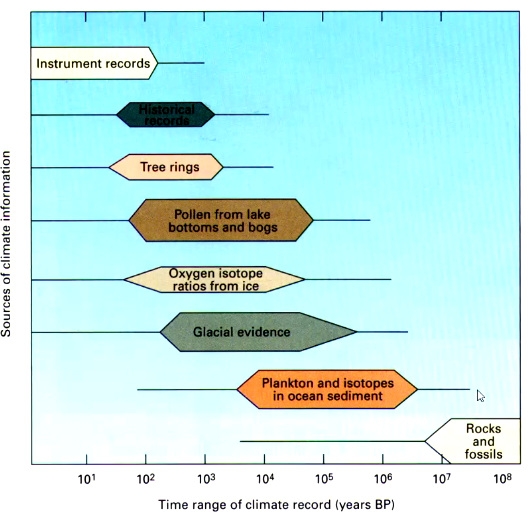
Climate varies across many different time scales
Proxies=preserved characteristics of the past that stand in for direct meteorological measurements
Stable isotopes
Unique tracers of biogeochemical processes
Record of past physical and biological processes
Fractionation causes change
Usually lighter isotope reacts, diffuses, evaporates faster than the heavier
Biological processes also fractionale stable isotopes


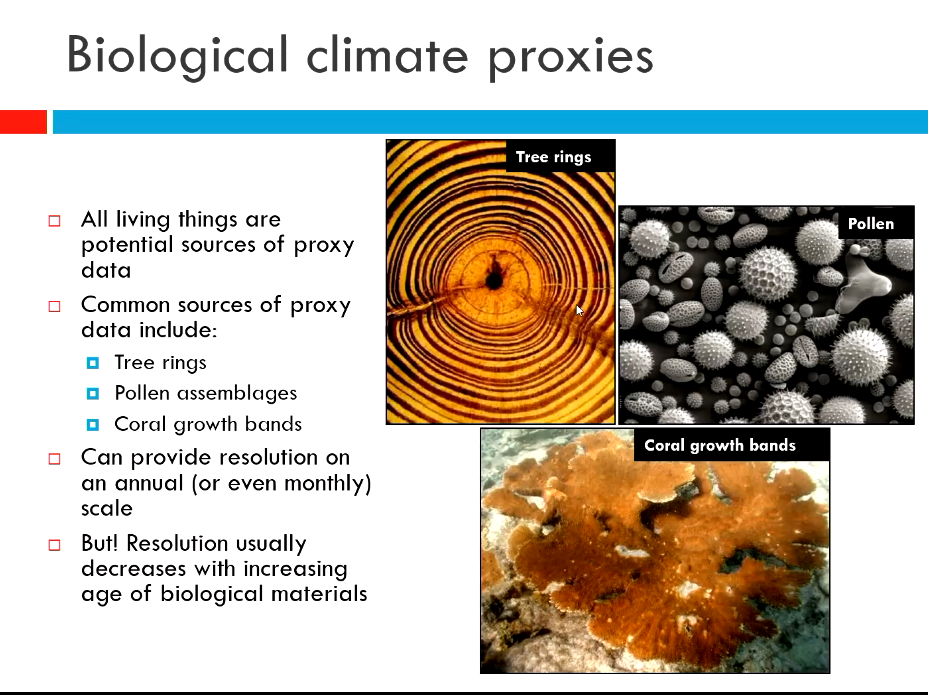

Biological proxies - corals
corals preserve a diverse array of paleoclimatic indicators
Provide very high resolution (up to monthly) data, but is limited to the past few thousand years
Paleobiogeography -
The study of where continents were located in the past using fossils. Or understanding the proximity of continents in the past.
If you find a correlation or similarity in fossil records between 2 different continents, then there is a good chance that they were adjacent to or even connected to each other in the past.
Biostratigraphy -
To subdivide sedimentary rocks into units (biozones) according to their fossil content.
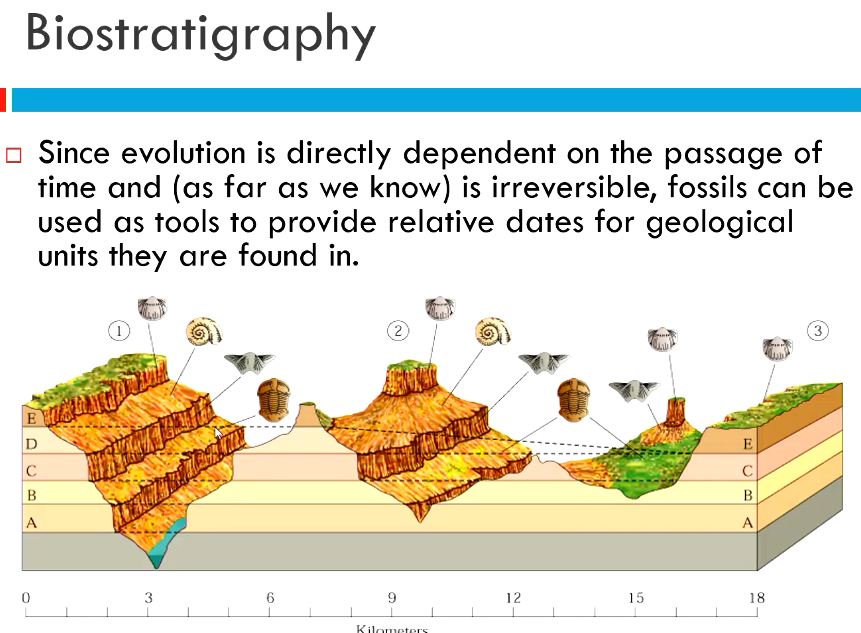
Biostratigraphy provides value to exploration and production through:
high-resolution correlations of bore holes and seismic sections
-precise dating of geological events
-paleoenvironmental analysis for characterizing reservoir, seal and source rocks (petroleum)
Biomarkers
Molecular or Chemical fossils. Organic compounds (primarily lipids) that have particular biosynthetic origins and can be preserved in sediments, sedimentary rocks and oils.
The most valuable biomarkers are taxonomically specific i.e. they can be assigned to a defined group of organisms, and are resistant to degradation.
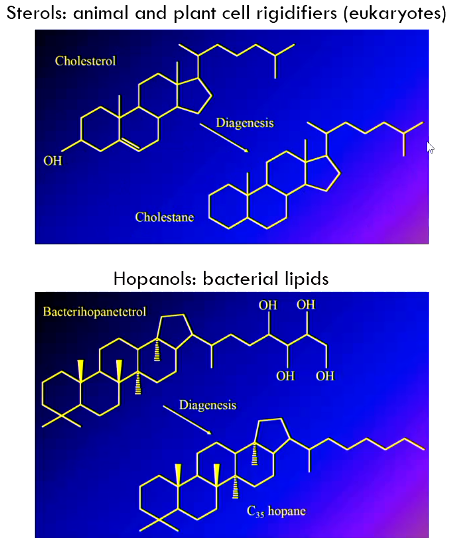
Biomarkers are important for the oil industry. They help tell what source rock generated the oil found.
Can help effectively explore for more oil
Oil correlation (using oil composition, biomarkers and stable isotopes)
Biomarkers are important for paleontology
Can show presence of broad categories of life without body or trace fossils.
Help to understand evolution on broad timescales.