Prosocial behaviours - week 10
Why do we help?
Social exchange Theory (Blau, 1964)
Social interactions as social transactions:
people exchange time and effort
weigh up rewards and costs.
External rewards: ‘tangible’, material, observable benefits
Examples:
Social approval/liking
Public image (e.g, corporate social responisbility)
Return on investment in future
Internal rewards
Increasing self-worth
Maintaining self-esteem
Enhancing self-presentation
Positive mood:
e.g., emotional support for partner correlates with giver’s mood (Gleason et al., 2003)
Internal rewards: ‘feel bad - do good’ (1) Kreb (1975)
Procedure:
Participants hear other’s distress which might trigger reactions like “others need help - I could help them”.
Findings:
Students reporting most physiological arousal most likely to help
Internal rewards: guilt reduction (2) McMillen (1971)
Procedure:
Students were told answers to a multiple-choice psychology.
½ cheaters vs ½ non-cheaters.
Students were asked to circulate a petition on an issue which was socially desirable or non-desirable.
Findings:
The greates degree of compliance was found in the trangress-socially desirable request group.
Emotions are somatic markers that drive behaviour.
Social norms: Reciprocity
The expectation that people will help those who have helped them.
We “invest” in others and expect something in return
Based on expected benefits of helping.
To receive without giving in return violates the ‘norm’
Receiving help without possibility to return can make receiver feel inferior and be a reason for not seeking help.
Social responsibility norm
We should help those who need help, regardless of future exchange.
Applies in cases where people are unable to return the help:
higher taxes in Northern Europe to fund welfare states.
Children in war.
Animals in distress.
Social responisbility norm
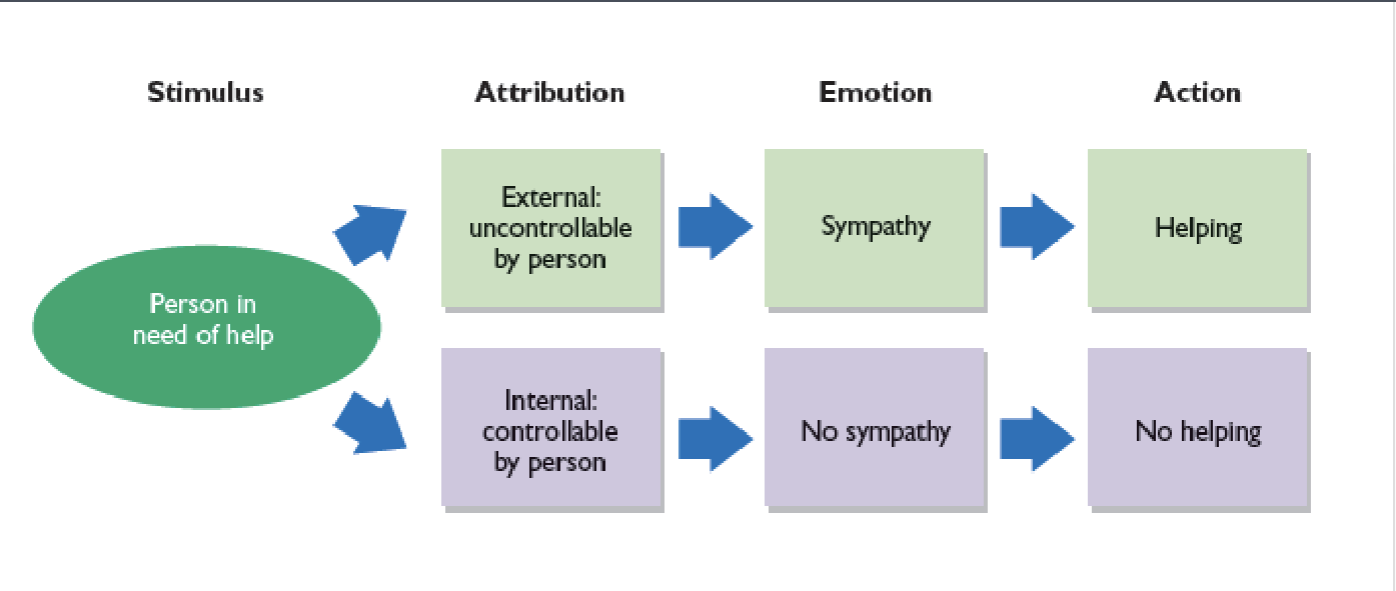
But … willingness to help is influenced by attribution of cause need for help:
External: (e.g.) natural disaster, illness
Internal: (e.g.) laziness, recklessness
Would you help? (Barnes, Ickes & Kidd, 1979)
Student A
Has attended all classes
Has tried to understand
Is not as good as you at taking notes in class
Can she borrow your notes?
Student B
Has missed a lot of classes
Offers little in tutorials (if she’s there…)
Is not as good as you at taking notes in class
Can she borrow your notes to revise from?
Evolutionary explanations: a paradox?
Genetic selfishness predisposes us towards selfless helping aka to enhance chances of genes passing on.
Kin protection: genes dispose us to care biological relative
Undermined by non-related caring?
Supported by ethnic ‘in-group- favouritism?
Empathy altruism hypothesis (Batson et aql. 1987)
Helping other without obvious benefit to ourselves or expectation of help in return.
Depending on the vicarious emotion we experience helping which is either egoistic or altruistic (Batson et al., 1987)
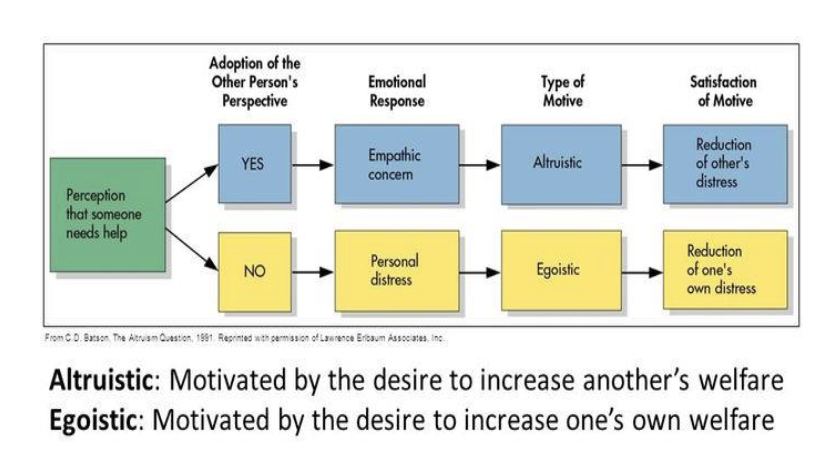
Truly altruistic?
Schaller & Ciadlini (1988):
Aim: show that empathy does not necessarily lead to helping.
Findings:
Feeling empathy for someone who suffers makes one sad and thus, help the sufferer.
If participants were given an alternative way to resolve sadness (e.g., listening to comedy tape), they were less likely to help.
Highlights the difficulty of distinguishing between egoistic and altruistic motivations.
The bystander
Numbers of bystander
Kitty Genovese case
Bystander effect: people more likely to help when alone than in comapny of others (Darley & Latané, 1968)
Latané & Dabbs, (1975)
Procedure: dropping pens or coins in elevator
Results:
1 other person: helped 40% of time
6 passangers: helped 20% of time
Diffusion of responsibility effect
The bystander effect
As number of bystanders increase, a gicen bystander is less likely to notice the incident, less likely to interpret the incident as an emergency and less likely to assume responsibility for acting. (Latané & Darley, 1968)
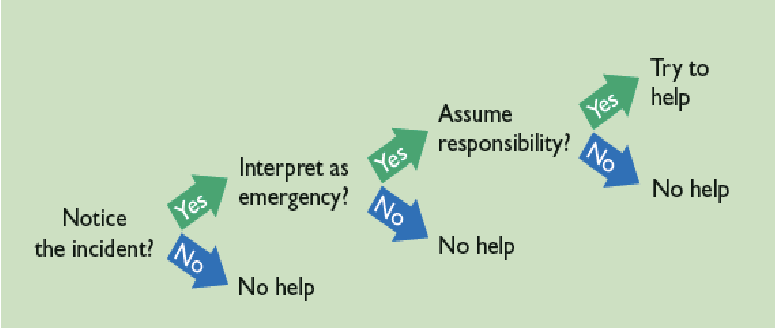
A. interpret rhe incident as an emergency…
Smoke pouring in room more likely to be reported by single person than by group: “others are calm, it cannot be an emergency” (Latané & Darley, 1968).
B. Assume responsibility…
Darley & Latane (1968): replication of Genovese case
Procedure:
Participants (n = 5) in seperate rooms hear woman cry for help (stimulated seizure)
Manipulation ensures particpants notice the emergency and interpret it as an emergency.
Findings:
85% helped if they believed there were no other listeners.
31% helped if they believed 4 others also heard the victim.
Seeing someone else help promotes helping
People more willing to donate blood if approached after observing a confederate consent to donate (Rushton & Campbell, 1977)
Drivers more likely to help female driver with flat tyre if they had earlier seen someone else do the same (Guéguen, & Jacob, 2011)
People more likely to charitable donate if they have just seen someone else donate (Bryant & Test, 1967)
Being similar
More likely to help people who are like us (Miller et al. 2001)
Similar face (DeBruine, 2002)
Same date of birth (Burger et al., 2004)
Similar clothing (Levine et al., 2005)
Clothing = marker of identity
Social Identity
Ingroup vs Outgroup
Social similarity
Social identity theory (Tajfel & Turner, 1979) an alternative to diffusion of responsibility as explanation for bystander effect (Levine et al., 2005)
People predisposed to help in-group members.
Who helps?
Personality traits?
No clear altruistic personality
Rescuers of Jews in Nazi Europe showed no obvious similarity in traits (Darley, 1995)
Empathy?
People who score high on positive emotionality, empathy and self-efficacy, more likely to be helpful (Bierhoff et al. 1991)
Gender
Eagly & Crowley (1986)
Overall little difference.
Potentially dangerous situations involving strangers: men more likely to help.
Situations involving volunteering for good causes, helping with experiments or children: women more likely to help.
Increasing helping behaviour?
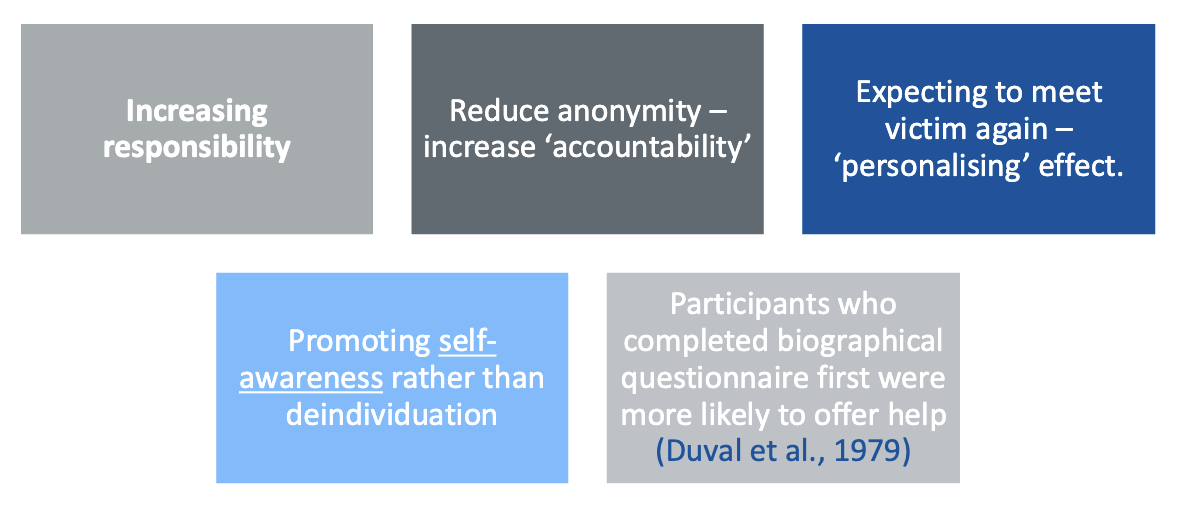
Guilt & Self-image
Participants whose guilt-levels were increased were subsequently more likely to offer help (58% vs 33%) (Katzvez, 1978)
The ‘foor in the face’ tecnhique: make a big request that you expect to be refused, then ‘counter’ with smaller request (Cialdini et al., 1975):
A. Take some children to the zoo?
B1. Two years as counsellor to needy children?
B2. Take some children to the zoo?
A = 32% YES
B2 = 56% YES