AP Gov Videos 2.1-2.3
2.1 Congress: The Senate and the House of Representatives Video 1
How Is Congress Designed:
House of Reps | Senate | |
|---|---|---|
# of members | 435 | 100 |
# of Members per State | Minimum of 1 | 2 |
Minimum age requirement | 25 | 30 |
U.S. Residency Requirement | 7 Years | 9 Years |
Length of Term | 2 Years | 6 Years |
Constituencies | Citizens within a geographic district in a state | All the Citizens of a state |
Diff in Chamber Size and Constituencies Influence Debate
House of reps: A larger number of members representing their own unique constituencies, debate in the house must be more formal in order to move bills through the process.
Senate: A smaller number rep all citizens in the state, the Senate can operate in a less formal manner. Coalitions would be easier to build due to longer terms.
Formality in the Houses of Reps
Due to the # of members, debate must be limited.
Each member can speak for no more than one hour.
The speaker of the house controls who speaks.
The Rules Committee assigns every bill to the appropriate standing committee.
Formality in the Senate
Less centralized than the house
does not have the strict hierarchy found in the house
Senators speak as long as they want if they are given floor
The filibuster allows a senator to stall or kill a bill by talking long enough to run out a deadline on voting.
Coalitions
Members of each house who belong to the same party are collectively called a caucus or conference
Within each party, subgroups form based on race, ethnicity, or some other common interest
Groups that are made up of members of both parties are called bipartisan
Members from states across the country may group together around a particular cause or interest.
Topic 2.1 Video 2
Implied powers that expanded the powers of Congress
Implied powers of Congress come from the necessary and proper clause
“To make all laws which shall be necessary and proper for carrying into execution the foregoing powers”
Examples of Implied Powers used by Congress
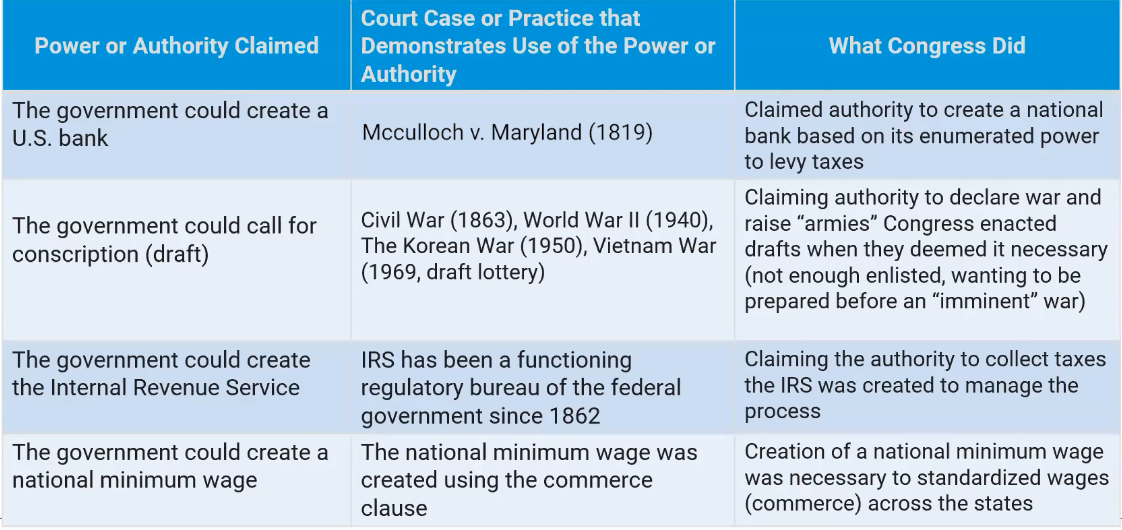
Implied Powers and Congressional Legislation
The regulation of firearms using the commerce clause
Prohibiting mail fraud based on the authority to establish post offices.
Creation of the Americans with Disabilities Act based on the Commerce Clause and later upheld using the 14th Amendment
Legislation on national health care using the clause for general welfare and collecting taxes
The gvmt can punish tax evaders using the power to collect taxes clause.
The power of the Purse is a critically important function
Passing a Budget and Raising Revenue
Article 1, Section 9, Clause 7 provides the basis for Congress's authority to create and pass a budget.
Article 1, Section 7, Clause 1 provides Congress the authority to raise revenue
Coining Money
Article 1 Section 8 states Congress has the power to coin money.
It also states no state shall make anything but gold and silver coin a Tender in Payment of Debts