2.07 Business Cycles
Business cycle - an economic model showing fluctuations (changes) in aggregate output and employment because of changes in aggregate supply and/or aggregate demand
Example:

Aggregate economy - the total of all economic activity in the country; It is either the demand for everything in the whole economy (aggregate expenditures approach to calculating GDP) or the supply of everything in the whole economy (income approach to calculating GDP)
Same economic situations represented as a production possibility curve and a business cycle:
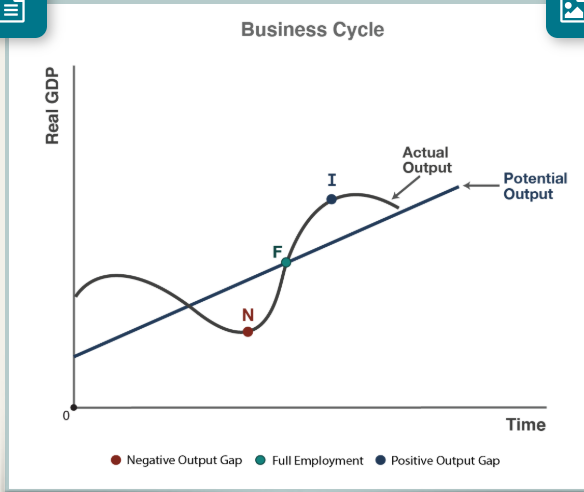

⭐️ The full employment of resources in the economy, the realistic ideal, can be represented with a classic PPC or the straight trendline of the business cycle.
Inflationary gap (or positive output gap) - also known as a posititive output gap, when an economy’s real output exceeds its potential output; unsustainable activity that will push prices up
Recessionary gap (or negative output gap) - also known as a negative output gap, when an economy’s actual output is less than its potential output, characterized most often by an increasing unemployment rate
the output gap does not indicate whether the economy is in recession or expansion.
⭐ ️Roughly half of expansion is closing a negative output gap, and half is rising above potential output and making a positive output gap. Half of a recession is closing that positive output gap and then making a negative output gap.
⭐️ If there is both an inflationary gap and production beyond the ppc in reality, it is a temporary, unstable condition (an economy cannot withstand the overheating of producing beyond its full employment capacity)

If the economy’s expansion begins to inflate average prices, try to help it slow down or contract.
If the economy’s contraction begins to increase the unemployment rate above the natural rate, try to help it speed up or expand.
