5.4 - The Articular System
Classification of Joints
Joints are classified according to their structure (what they are made of) or their function (the type and extent of movement they permit).
The structural classification recognizes three main types of joints:
Fibrous joints → Bound tightly together by connective tissue and allow no movement. These are the joints between the interlocking bones of the skull, known as sutures. After birth, all suture joints become immobile.
Cartilaginous joints → Bone connects to another bone by the use of cartilage. You can move slightly. The intervertebral “disks” of the spinal cord have this joint
Synovial joints → The joint that allows for the most movement. These joints are found in the knee, the shoulder and ankle.
The Synovial Joint
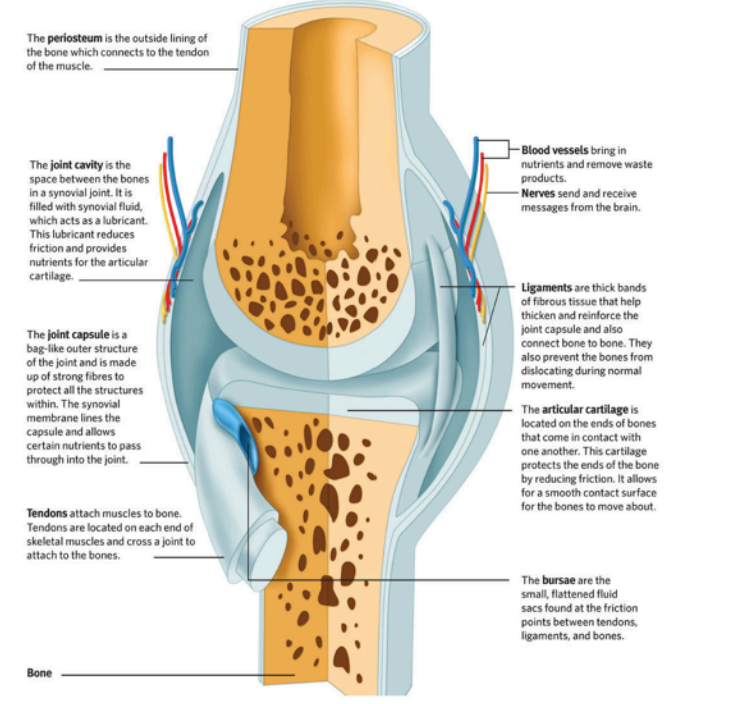
The Characteristics of Synovial Joints
Synovial joints permit movement between bones and are distinguished by the following:
Articular cartilage is located on the ends of bones that come in contact with one another.
The joint capsule consists of the synovial membrane and fibrous capsule.
The joint cavity is filled with synovial fluid, which acts as a lubricant for the joint.
The bursae are the small fluid sacs found at the friction points (“bursa” is the singular).
Intrinsic ligaments are thick bands of fibrous connective tissue that help thicken and reinforce the joint capsule.
Extrinsic ligaments separate from the joint capsule and help to reinforce the joint.
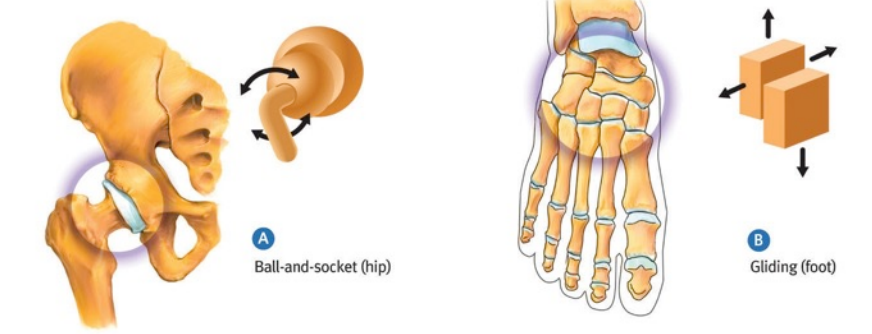
Ball & Socket and Gliding Joints
Ball-and-socket (spheroidal) joints. The “ball” at one bone fits into the “socket” of another, allowing movement around three axes (e.g., the humerus rests in the glenoid cavity).
Gliding (or plane or arthrodial) joints. This type connects flat or slightly curved bone surfaces that glide against one another (e.g., between the tarsals and among the carpals).
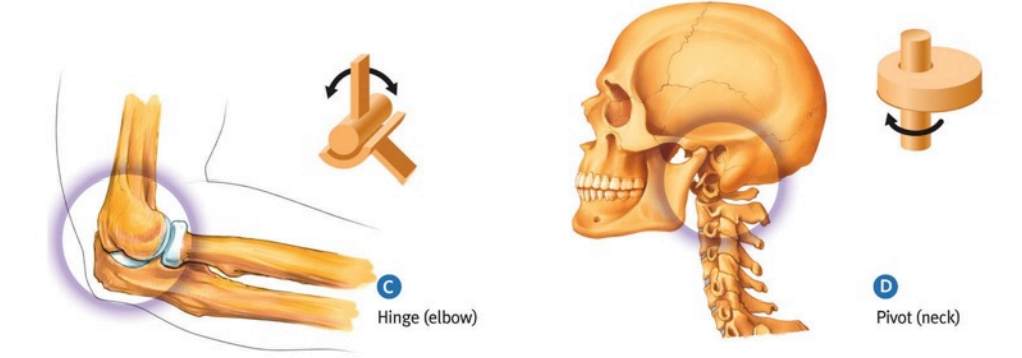
Hinge and Pivot Joints
Hinge (ginglymus) joints. A convex portion of one bone fits into a concave portion of another (movement in one plane). The joint between the ulna and the humerus is an example.
Pivot (or trochoid) joints. A rounded point of one bone fits into a groove of another (e.g., the joint between the first two vertebrae in the neck, which allows the rotation of the head).
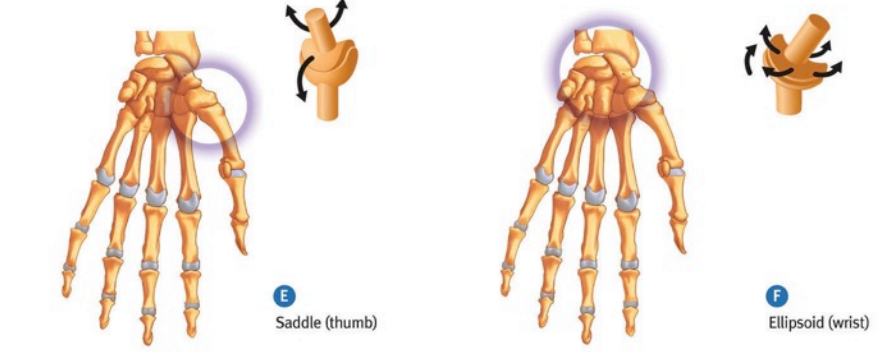
Saddle and Ellipsoid Joints
Saddle joints. Saddle joints allow movement in two planes (but not rotation like a ball-and-socket joint). A key saddle joint is found at the carpometacarpal articulation of the thumb.
Elipsoid joints. This type of synovial joint also allows movement in two planes. The wrist is an example of an ellipsoid joint.
Joint-Related Injuries and Disease
Dislocations: A dislocation occurs when a bone is displaced from its joint. Dislocations are often caused by collisions or falls, and are common in finger and shoulder joints.
Separations: A separation is more serious than a dislocation. In a shoulder separation, the ligaments attaching your collarbone (clavicle) and shoulder blade (scapula) are disrupted.
Osteoarthritis: Osteoarthritis is a condition involving loss of cartilage at joints. Osteoarthritis (a joint disease) is often confused with osteoporosis, which is a disease characterized by low bone mass and bone deterioration.
Spains: Occur when ligments are over stretched. First degree, easily treated, few ligamnts are stretched, minimal swelling and some pain. Second degree, partially torn ligament fibres, results in bruising and will need more attention, more swelling and pain. Third degree, entire ligament is completely (nearly completely), surgery in needed to reattach the ligament to the bone and return to the activity after 3 or more months.
Rotator Cuff Tears
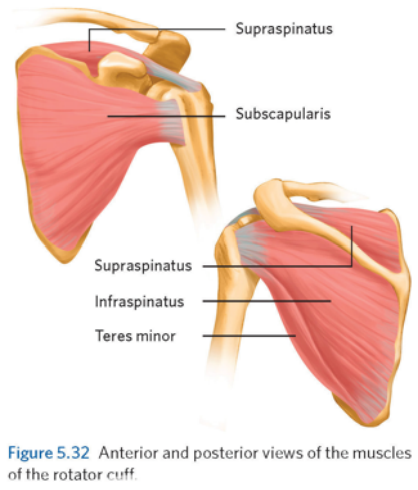
Rotator cuff tears usually involve one or all four muscles that make up the rotator cuff at the shoulder joint:
supraspinatus
infraspinatus
teres minor
subscapularis.
These muscles share a common tendinous insertion on the greater tubercle of the humerus. Thus, when a part of the tendon is torn, all three muscles around the joint are affected.
The severity of a rotator cuff tear must be diagnosed by a doctor