Week 12 (II) - Brain and Behaviour
Lecture 20: Nov 18
How does the brain cause behaviour?
2 critical things of the brain
(1) Nervous system → decomposes environmental stimuli into separate components, the re-assembles the components into a representation of the external world.
(2) The brain sends commands through the nervous system to control muscles and organs producing reactions and behaviours.
Examines the relationship between the brain and behaviour.
Focuses on how the nervous system processes and responds to environmental stimuli.
Learning
Definition of Learning:
Learning is the association of environmental events. (taking in stimuli forms associations)
Learning is a neural process
Hebbian Learning
Named after Donald Hebb (1904-1985) who researched neurons.
Key Concept: "Neurons that fire together wire together."
Learning, memory, and cognition must involve relatively long-lasting physical change in neurons.
"When an axon of cell A is near enough to excite a cell B and repeatedly or persistently takes part in firing it, some growth process or metabolic change takes place in one or both cells such that A’s efficiency, as one of the cells firing B, is increased." (thus lasting change in efficiency of the system)
Neurotransmission Process (form of communication)
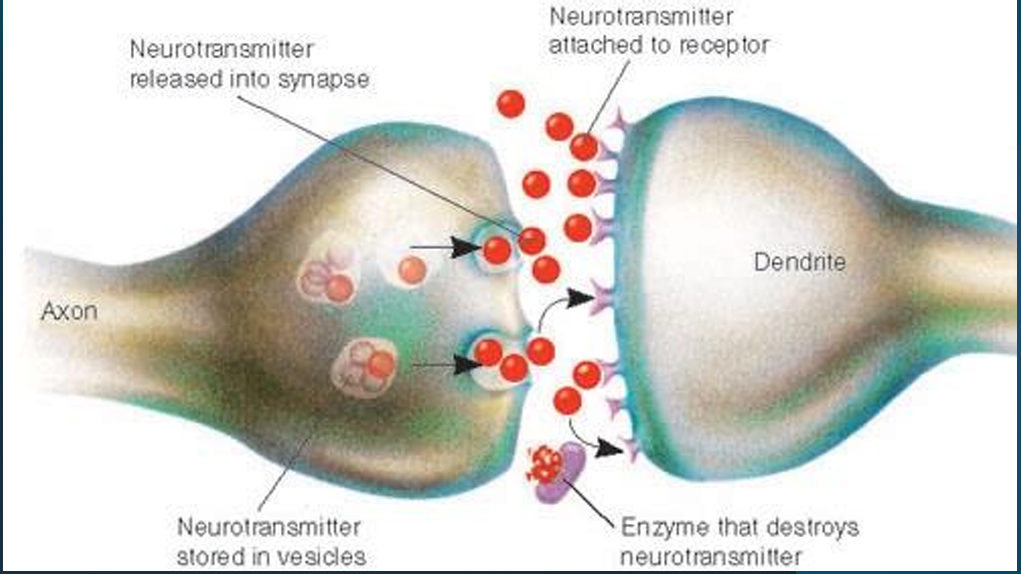
Axon:
Conducts electrical impulses away from the neuron's cell body.
Neurotransmitters:
Chemicals released into the synapse (the gap between neurons).
Bind to receptors on the dendrite of a neighboring neuron.
Dendrite:
Receives signals from neurotransmitters attached to receptors.
Storage:
Neurotransmitters are stored in vesicles.
Destruction:
Enzymes can destroy neurotransmitters after they have served their purpose.
I.e: Bumblebee. When a bee lands on a flower…
Odor is detected by antenna (happening at same time)
Sucrose is detected by proboscis (extends antenna + detects sucrose, then extends tongue)
How are they able to pair this odor with sucrose?
Classical Conditioning
= Stimuli that don’t elicit a reflexive response can be conditional (trained) to elicit a reflexive response.
In Classical (Pavlovian) conditioning the response is reflexive and reliably produced.
I.e:
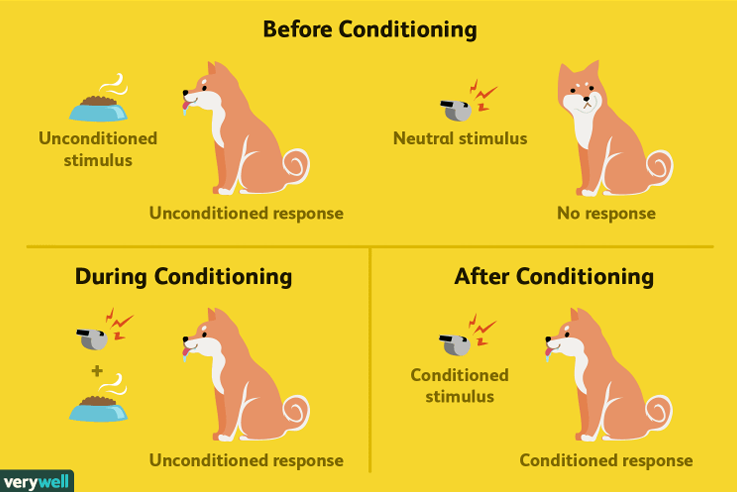
Before conditioning:
Dog salivates at the presence of food. Doesn’t require any training to cause this.
A neutral stimulus such as blowing a whistle causes no reflexive response in the dog.
During conditioning:
Pairing both the whistle and food together to train the animal to responds to the neutral stimulus.
After conditioning:
The dog now salivates when it hears the whistle.
US = unconditioned stimulus, UR = unconditioned response, CS = conditioned stimulus
Bee case revisited
Odor detected by the antenna → is the conditioned stimulus
Sucrose detected by the proboscis → Is the unconditioned stimulus
Honeybees can learn to associate a novel odor with the occurrence of sucrose.
The novel odor is a conditioned stimulus (CS) that predicts the occurrence (US)
Sucrose produces the unconditioned response (UR), of proboscis extension. The proboscis extension response (PER)
After several parings, odor alone causes proboscis extension, the conditioned response (CR)
Researches tested this and saw that more trial increase %PER (the amount that honeybees extended their tongues).
Order (ascending pathway, reverse the way shown):
High order represent (mushroom bodies + lateral horn fire together in synchrony) → Primary processing (antennal lobe) → Detection (antenna)
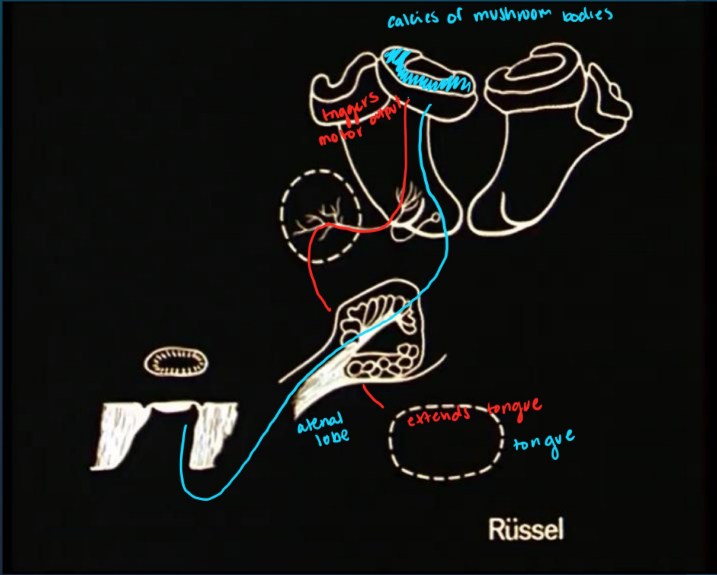
* Know general pathway. Happens bilaterally. Olfactory stimuli and sucrose stimuli use 2 pathways. Goes up into the mushroom bodies and then lateral horn. After repeated measures, won’t need SOG circuit.
Case Study: Controlling the Insect Brain
Species Studied: Emerald jewel wasp (Ampulex compressa) and the cockroach.
"Known as “zombie cockroaches”
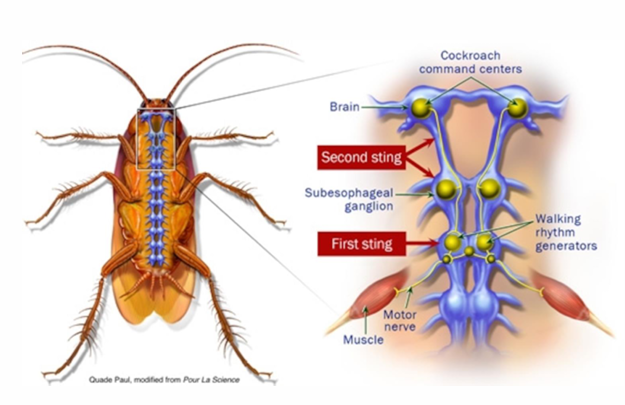
Wasp will hunt for cockroach (bigger then them). Will sting it. 1sting disables the cockroaches legs. 2nd sting goes into the brain (doesn’t kill cockroach but disables it’s reflexes). The wasp will taste the blood to see how effective its sting was. Will take the cockroach back to its cave and lay eggs on it.
Neuroscience Experiment (Zombie Cockroaches):
First Sting: Affects motor system. Blocks chloride channels in thoracic neurons (which control movement).
Second Sting (closer to the brain):
Increases dopamine induced grooming of cockroach
Octopamine (“fight or flight response”) antagonists remove self-initiated walking behaviours. Prevents flight response.
GABA (inhibitory neurotransmitter) reduces response to stimuli, including startle.
*Stings must be precise.
Adaptive Specialization in the brain
Brain structures have evolved to support adaptive behaviours
The brain structures of dif species have evolved in different ways to support species specific behavioral adaptations.
I.e: Food-Storing Behaviour in Chickadees
Is an example of adaptive specialization. Chickadees store hundreds of food items every day from early fall to late winter.
Each cache contains one piece of food
Cache sites are not re-used (every cache site is new)
Cache sites are scattered
Cached food is retrieved within a few days
Cache Retrieval:
More accurate than expected by chance
More accurate than expected from site preferance
Doesn’t depend on seeing or smelling food
Doesn’t depend on marking the cache sites
Doesn’t depend on the sequence of caching
CHICKADEES are using spatial memory to locate cache sites.
Do food storing birds have bigger brains than non-storing birds?
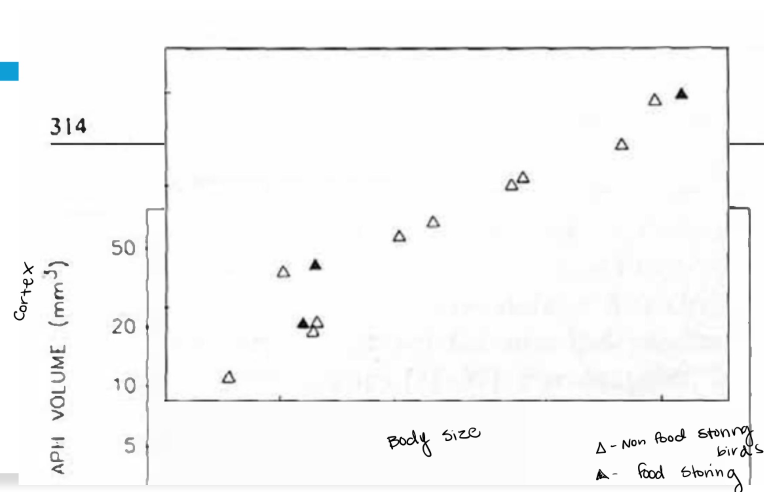
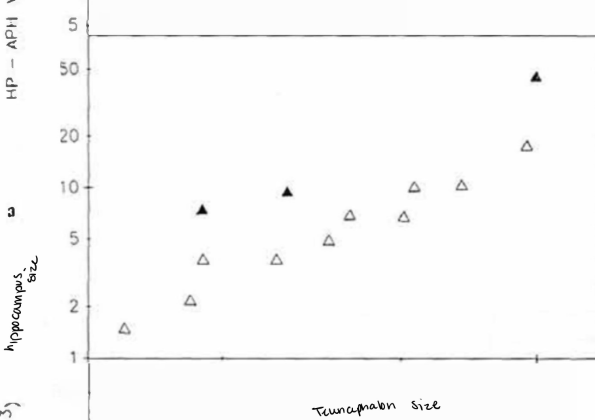
We would expect that bigger birds would have a bigger hippocampus and thus a bigger brain. However, hippocampus is bigger than expected for food storing birds.
The avian hippocampus - supports spatial memory. This is homologous structures in birds, rodents and primates.
Adaptive specialization in chickadees:
Chickadees, for ecological reasons, benefit from food storing.
Memory for cache sites makes food storing more effective.
Natural selection for memory, especially memory for spatial locations, has modified the brain of chickadees.
Spatial memory of brain has evolved for food storing (this is an investment)