Membrane Transport
The cell membrane keeps the contents of the cell separated from the fluid surrounding the cells, and tightly controls the transport of molecules into and out of the cell
Cell membrane
Cell membranes are mainly composed of lipids (phospholipid bilayer and cholesterol), proteins, and carbohydrate groups.
Phospholipid is a lipid made of glycerol, two fatty acid tails (hydrophobic), and a phosphate-linked head (hydrophilic) group.
Cell membranes usually involve two layers of phospholipids with their tails pointing inward (known as phospholipid bilayer)
Cholesterol is another lipid found alongside phospholipids in the core of the membrane. It stabilizes the structure of the membrane when the temperature changes. This is critical because the membrane must maintain a certain state of fluidity in order to function.
Membrane proteins may extend partway into the membrane, cross entirely, or be loosely attached to the inside or outside face of the membrane.
Carbohydrate groups can be attached to proteins (in which case they are referred to as glycoproteins) or lipids (known as glycolipids).
Membrane transport is the movement of substances across the cell membrane.
Selective permeability is a key characteristic of cell membranes, allowing them to regulate the internal environment by controlling the passage of molecules.
The mechanisms of membrane transport can be categorized into diffusion and active transport processes, each utilizing different energy requirements and concentration gradients to facilitate the movement of molecules.
Diffusion- the passive movement of molecules from an area of HIGH concentration to an area of LOW concentration. This process does not require energy, as it relies on the inherent kinetic energy of the molecules involved.
Active transport- the process that moves molecules against their concentration gradient, from an area of LOW concentration to an area of HIGH concentration. This mechanism requires energy, usually derived from ATP, to enable the transport proteins, such as pumps, to move substances across the membrane.
Diffusion
The behaviour of solutes in body fluids obeys the rule that substances naturally want to move down their concentration gradient until the concentration in the two areas becomes equal.
Simple diffusion is a passive transport process where lipid-soluble substances, like oxygen and carbon dioxide, can freely pass through the lipid bilayer of the membrane, allowing for a balance of concentrations without the need for energy input.
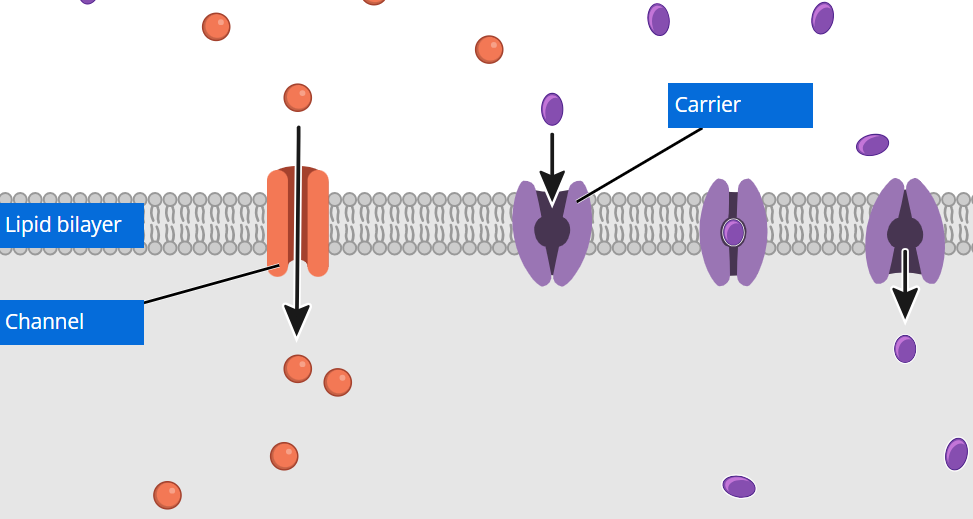
Facilitated diffusion- Water-soluble substances must use facilitated diffusion to cross cell membranes. Their transport is facilitated by membrane proteins embedded in the cell membrane.
These proteins can be divided into 2 classes: channels and carrier proteins (limited #s of each)
Channels are watery tunnels through the cell membrane that permit the passage of specific substances. Water crosses the membrane in bulk using water channels called aquaporins. Channel-mediated diffusion can be regulated, because some channels have gates that can be opened or closed.
Other substances (glucose is the most important) diffuse across the membrane through carrier proteins. Carrier proteins, like channels, only allow passage of specific solutes. However, unlike channel proteins, carriers must change shape in order to enable transport. This form of transport has a maximum rate, much like a revolving door, that depends on the number of carrier proteins the cell has. Carriers can only admit so many particles in a given period of time.
Active transport
Active transport maintains concentration gradients by moving solutes "uphill" from an area of low concentration into an area of high concentration
Transport protein pumps force particles across a membrane from the low concentration side to the high concentration side, using energy obtained from ATP.
The most important pump in the body is the sodium–potassium pump, abbreviated Na+/K+ -ATPase.
The abbreviation indicates that an ATP chemical bond is broken to generate energy for transport of sodium and potassium across the cell membrane
Sodium is more concentrated outside the cell, whereas potassium is more concentrated inside the cell.
sodium naturally moves down its concentration gradient from outside the cell to inside via facilitated diffusion, and potassium does the opposite; moving from inside to outside the cell.
The sodium–potassium pump maintains the sodium and potassium gradients against the steady "leak" of ions down their concentration gradients by forcing sodium ions out of the cell and potassium ions into the cell against their respective concentration gradients.
Osmosis
If a solute cannot leave the more concentrated solution, water will move in (down a water gradient) instead from the less concentrated solution to dilute it.
water's concentration depends on the total number of particles in the solution. The relative size of the particles doesn't matter
Solute concentration is expressed as osmolarity: the number of particles of solute per litre of solvent (water).
usually expressed as milliosmoles per litre (mOsm/L).
An osmotic gradient exists between two solutions of different osmolarities
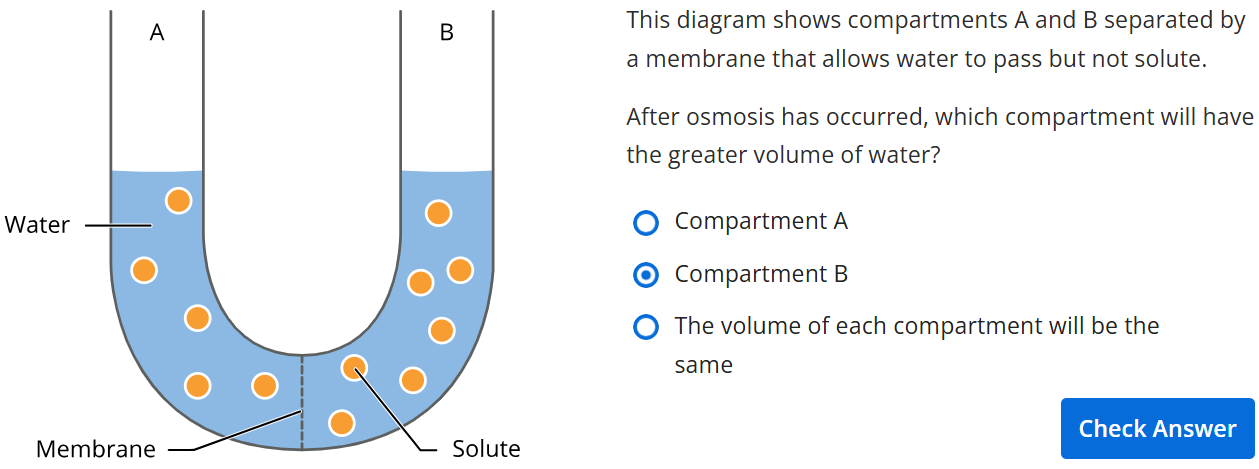
Osmosis is the movement of water across a semipermeable membrane from an area of low solute osmolarity (higher water concentration) to an area of higher solute osmolarity (lower water concentration).
EX: imagine a semipermeable membrane separating two salt water solutions of different concentrations. If the membrane does not permit salt to cross, water will move from the less salty side (which has higher water concentration) to the saltier side (which has a lower water concentration) until enough water has moved to the salty side to dilute it to the point that the salt concentrations are equal.
Tonicity
Tonicity is the relative solute concentration between two environments separated by a semipermeable membrane.
Unlike osmolarity, tonicity accounts for both the solute concentrations and the cell membrane's permeability to those solutes. In other words, tonicity reflects the osmotic pressure gradient across the membrane and predicts the movement of water in or out of cells or spaces in the body where fluid resides.
Isotonic- the two solutions being compared have equal concentrations of solutes
Hypertonic- the solution with the higher concentration of solutes
Hypotonic- the solution with the lower concentration of solutes
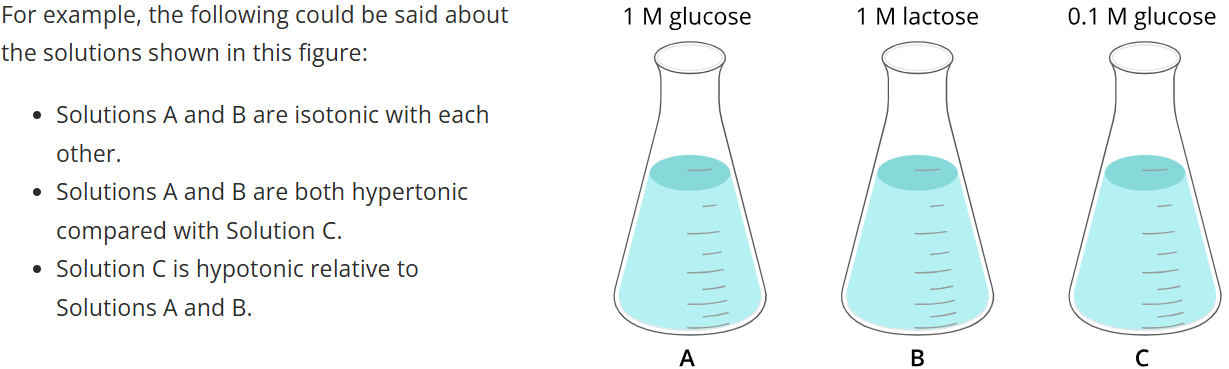
Understanding tonicity allows us to predict the direction of water movement by osmosis between spaces and cells in the body.
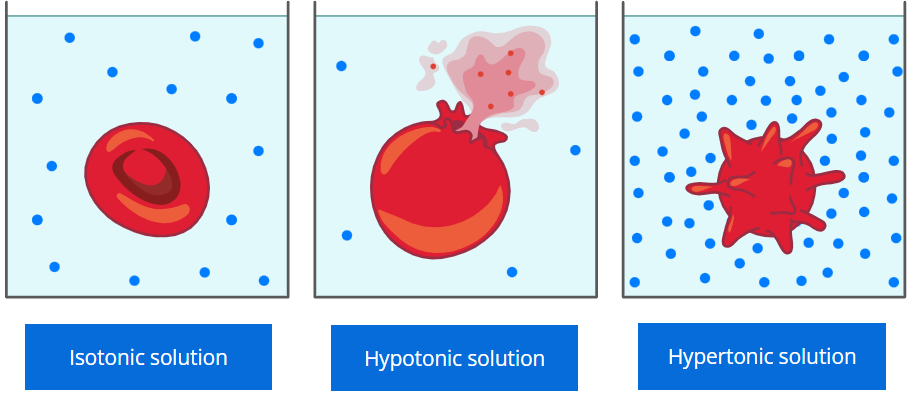
A helpful way to see osmosis and tonicity in action is to observe what happens when red blood cells are placed in solutions with differing tonicities. Normal red blood cells are the shape of a biconcave disk.
When dropped into a solution that is isotonic with the cytosol (the fluid contained in the cytoplasm), the disk shape is maintained.
When dropped into a hypotonic solution, the cells become visibly swollen and lose their biconcave shape. In an even more hypotonic solution, the cells swell so much that eventually they burst.
When dropped into a hypertonic solution, the cells collapse and assume a spiky appearance.