Ground Handling
Without reference, identify basic facts and terms about safe for aircraft maintenance, jacking,
towing, and mooring and the purpose and description of tow vehicles and tow bars. A
minimum of 4 out of 5 responses must be correct.
INTRODUCTION
As you may have already picked up on by now, crew chiefs are considered a “jack of all
trades.” You will be interacting with other maintenance personnel (specialists) daily. The
success of aircraft maintenance needs this interaction. In these day-to-day actions, you will
have the opportunity to perform a variety of maintenance tasks with the help of specialists.
These tasks include preforming a safe for maintenance check, launching and recovering
aircraft, towing, mooring, and jacking. As always, you must comply with all safety
procedures and tool control requirements.
INFORMATION: Ground Handling
Purpose
Ground Handling covers all tasks concerning moving and handling of the aircraft on the
ground. Launching and recovering (parking) your aircraft, installing/removing covers,
servicing, and towing are just some of the tasks you will accomplish on a day-to-day basis.
With every task done on the flightline there are procedures that must be followed, so when it
comes to ground handling, there is no exception. The technical data applicable to ground
handling is DAFMAN 11-218, Aircraft Operations and Movement on the Ground, DAFMAN
91-203, Air Force Consolidated Occupational Safety Instruction, and TO 00-25-172, Ground
Servicing of Aircraft and Static Grounding/Bonding. It is essential to become familiar with
these, as this information will be used daily to ensure safe movement and handling of an
aircraft while it is on the ground.
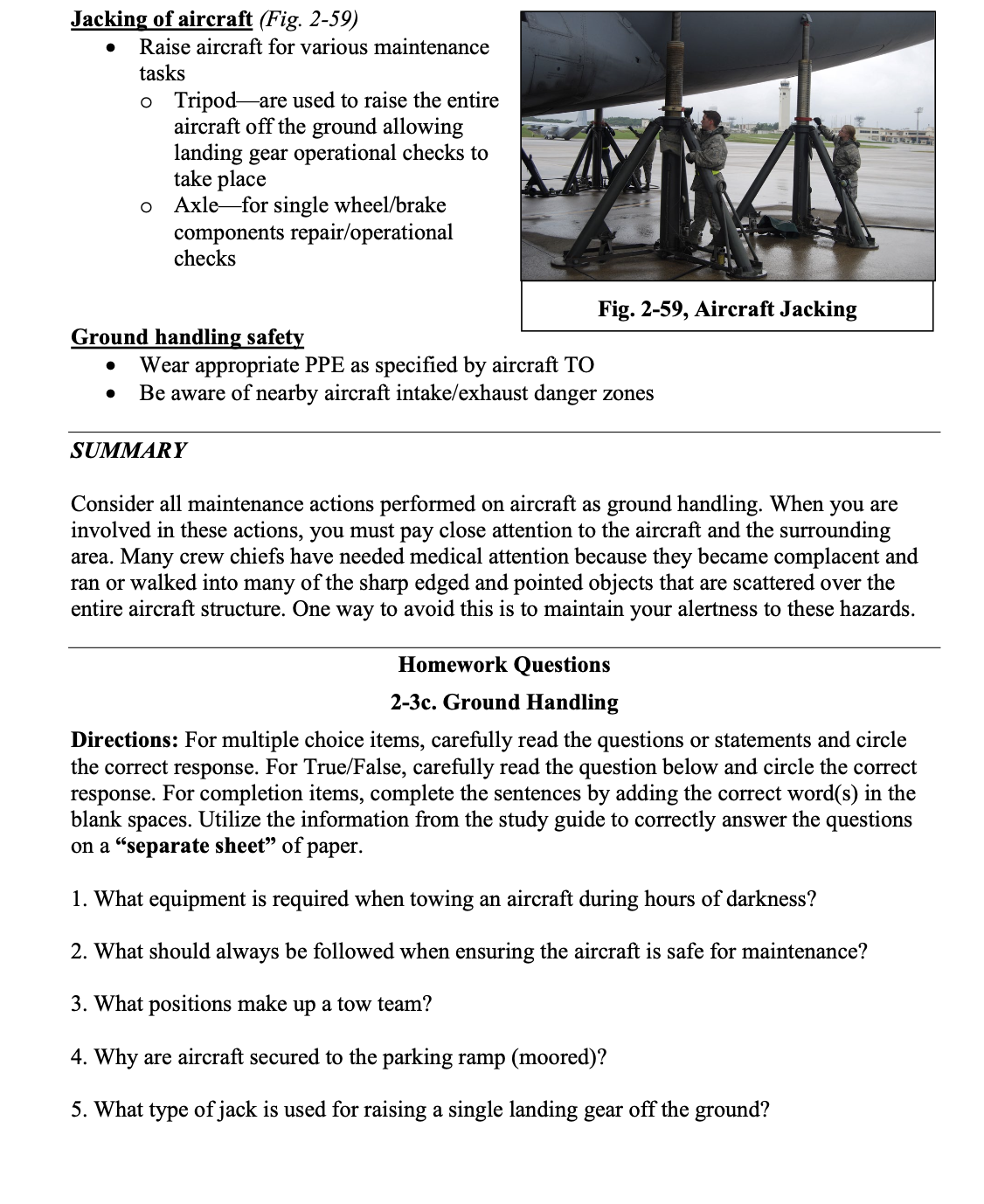
Launch/Recovery Procedures (fig. 2-54)
• Launch–to send aircraft on a mission/sortie
o Aircraft preparation
o Assist aircrew/pilot as needed
• Recovery–receive a returning aircraft after
flight and return to a mission-ready
condition
o Identify servicing requirements (fuel,
oil, hydraulic fluids)
o Inspection requir ments for next
mission/sortie
Safe For Maintenance
Always ensure the aircraft is safe before starting any maintenance. Basic mandatory items
needed to be checked as to not injure yourself or damage the aircraft are listed below:
• Verify condition in AFTO Form 781s
• Safety pins inserted for all landing gear
• Wheel chocks in place
• Ensure all egress safety devices are appropriately installed
• Properly ground ACFT IAW appropriate TOs
• Verify portable ground fire extinguishers are in place as required
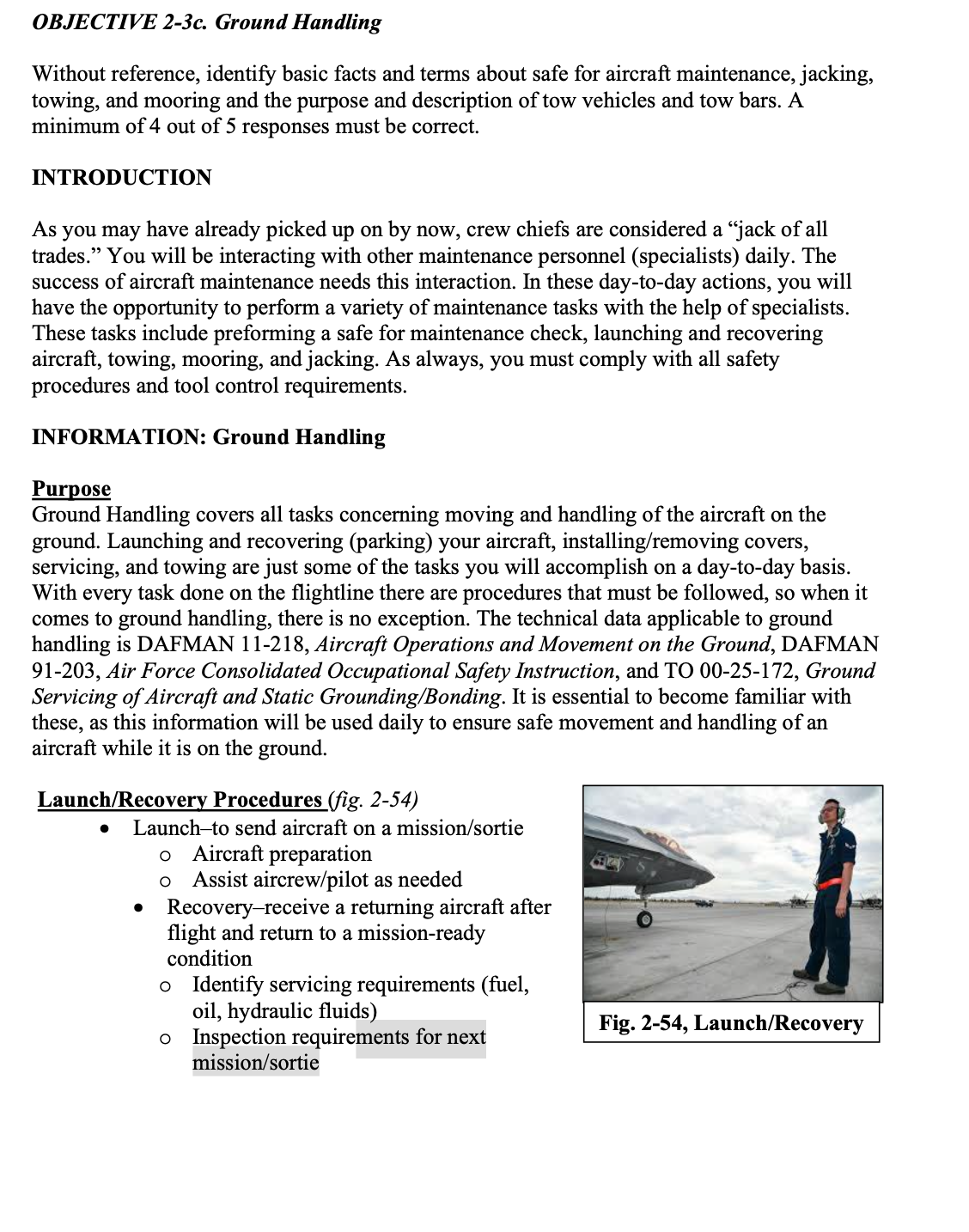
Aircraft Towing
This is the most common way to move or
reposition aircraft (fig. 2-55). Personnel
involved in the towing of the aircraft must
be alert and exercise extreme care because
towing can be a hazardous operation.
Personnel should plan towing operations so
that no part of an aircraft is within 25
horizontal feet of an obstruction. A tow
team (Table 2-16) is required to accomplish
this task and a team will consist of the
following positions.
Fig. 2-55, Towing
Table 2-16, Tow Team Description
Member Description
Tow Supervisor
• In complete charge of tow team
• Conducts pre-brief for all tow team members
• Also acts as nose walker
• The only team member who can start towing process
Brake Operator • Applies aircraft brakes in case of an emergency
• Must be alert and always maintain eye contact with tow supervisor
Tow Vehicle
Operator
• Must always maintain a direct line of sight with the tow supervisor
• Must be licensed and trained to drive the tow vehicle
• Follow tow supervisor’s directions
Wing Walkers
• Required when moving aircraft in and out of hangars
• Required in congested areas
• Must always maintain a direct line of sight with the tow supervisor
Tail Walker
• Ensures adequate tail clearance while towing in congested areas
• Required when backing aircraft
• Must always maintain a direct line of sight with the tow supervisor
Equipment Required
Tow Vehicle (fig. 2-56)
• Utilized to reposition aircraft without having to
use its engines
• The operator must be licensed and trained to
drive
• Different types and sizes for different aircraft
• The larger the aircraft, the larger the tow vehicle
• Most equipped with four-wheel steering for ease
in positioning aircraft
Tow Bar (fig. 2-57)
• Allows the movement of aircraft on the ground
without the use of engines
• Connection between aircraft and tow vehicle
(typically)
• All tow bars are equipped with shear bolts to
prevent aircraft damage during high-stress
applications
• Size of tow bar dependent on the size of aircraft
(TO will specify which tow bar is to be used)
o Universal—used on multiple types of aircraft
o Aircraft Specific—can only be used on a specific type of aircraft
Safety Precautions
• WARNING—NEVER step over a tow bar once it is connected to both the aircraft and
tow vehicle
• Use approved hand signals per TO
• Use lighted wands during night tows/inclement weather
• Emergency audio can be used (whistles/portable horns)
• Towing speed—5 MPH or walking speed of the slowest tow team member
• Tow team members cannot ride on any exterior portion of aircraft or tow vehicle
unless dictated by technical orders
Mooring of aircraft (fig. 2-58)
• Secure or tie-down aircraft due to high winds or for long periods of time
• Restraint devices attached from aircraft to ramp (flight line) mooring points

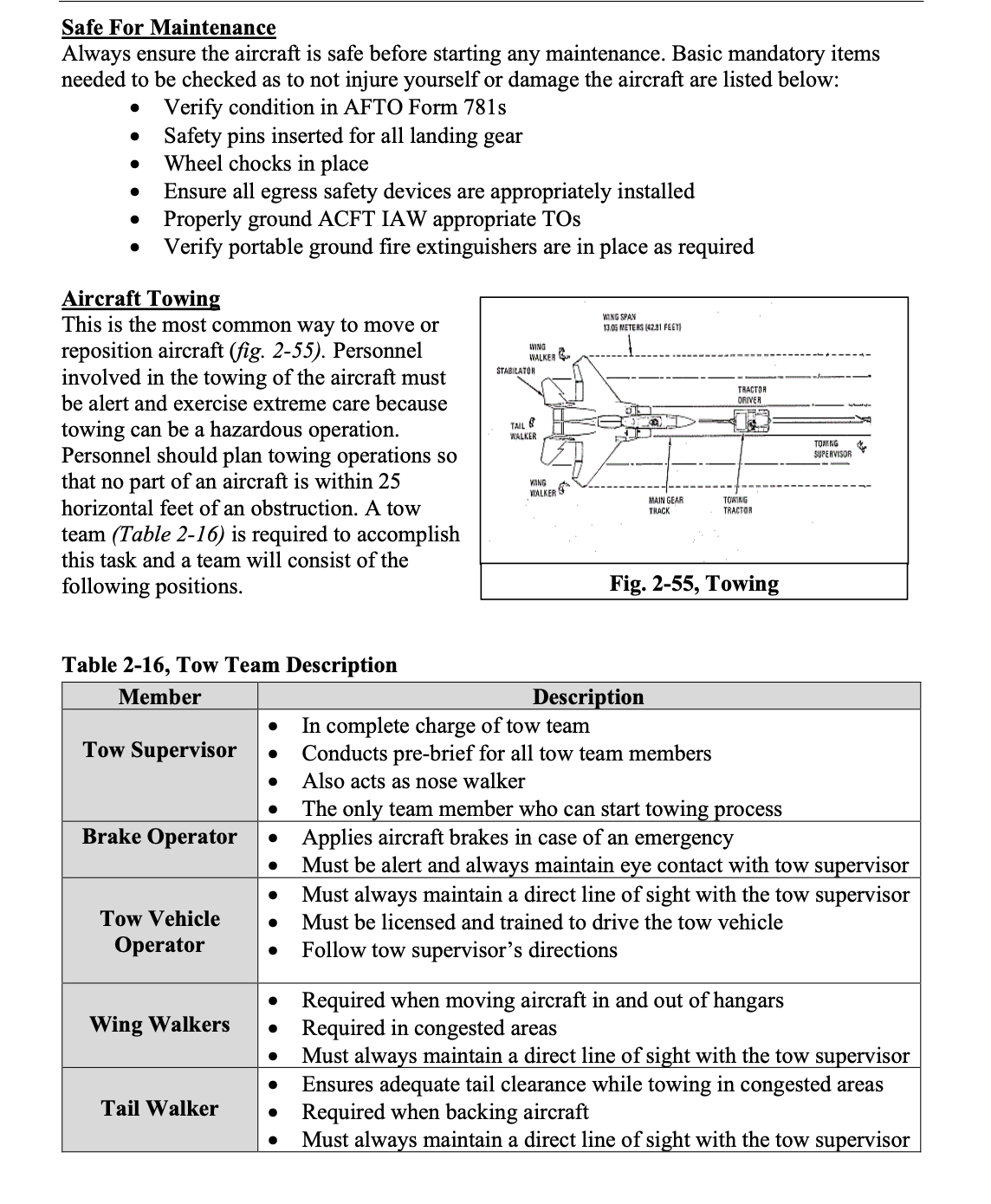
Jacking of aircraft (Fig. 2-59)
• Raise aircraft for various maintenance
tasks
o Tripod—are used to raise the entire
aircraft off the ground allowing
landing gear operational checks to
take place
o Axle—for single wheel/brake
components repair/operational
checks
Fig. 2-59, Aircraft Jacking
Ground handling safety
• Wear appropriate PPE as specified by aircraft TO
• Be aware of nearby aircraft intake/exhaust danger zones
SUMMARY
Consider all maintenance actions performed on aircraft as ground handling. When you are
involved in these actions, you must pay close attention to the aircraft and the surrounding
area. Many crew chiefs have needed medical attention because they became complacent and
ran or walked into many of the sharp edged and pointed objects that are scattered over the
entire aircraft structure. One way to avoid this is to maintain your alertness to these hazards.
Homework Questions
2-3c. Ground Handling
Directions: For multiple choice items, carefully read the questions or statements and circle
the correct response. For True/False, carefully read the question below and circle the correct
response. For completion items, complete the sentences by adding the correct word(s) in the
blank spaces. Utilize the information from the study guide to correctly answer the questions
on a “separate sheet” of paper.
1. What equipment is required when towing an aircraft during hours of darkness?
2. What should always be followed when ensuring the aircraft is safe for maintenance?
3. What positions make up a tow team?
4. Why are aircraft secured to the parking ramp (moored)?
5. What type of jack is used for raising a single landing gear off the ground?