tech 4
Week 4 lecture
Innovation is a systemic phenomenon = for big innovations to happen, companies usually need to work with other groups. They can't do it alone.
This is a concept called the "triple helix," which involves three groups working together:
1. Universities (like research labs at colleges)
2. Companies (private businesses)
3. Government (provides funding and regulations)
These three groups support each other, making it easier to develop new ideas.
Example: Robot Spot by Boston Dynamics: This robot was created by a company called Boston Dynamics, which started as a project at MIT (a university) with funding from DARPA (a government agency). example of universities, companies, and the government working together to create something new.
how innovation (creating new ideas, products, or technology) happens from two different viewpoints:
Policy Perspective (Big-picture, national level): What the government needs to do to support innovation across the country.
This is about how a government (like the Ministry of Industry) should support different types of organizations to encourage innovation.
The government would want:
Large Companies: Big companies (like Google or IBM) that have a lot of money and resources. They’re good at improving existing technologies.
Small Start-Ups: Newer, smaller companies that bring fresh, disruptive ideas and create new markets (like what Uber did with ride-sharing).
Universities: Places like research universities that develop new knowledge and train skilled workers.
Government’s Own Role: The government provides funding, policies, and can act as a big buyer of new technology (like in defense or healthcare).
Together, these groups create a strong innovation ecosystem—they all play different but complementary roles.
Role of the Government
The government helps fund research through universities and national labs.
It sets policies to create a stable economy where companies can thrive.
The government can also act as a big customer for new technology, which supports innovation. For example, U.S. defense spending helped the growth of Silicon Valley.
Example: Oxford-AstraZeneca COVID-19 Vaccine
Oxford University (university) developed the initial vaccine.
AstraZeneca (large company) helped scale it up, manufacture, and distribute it.
This shows how universities and companies need each other, with government often providing funds or regulatory support.
Summary: The government should support both large and small companies, as well as universities, to make innovation possible.
2. Managerial Perspective: What Companies Should Focus On
This is about what different types of companies should focus on for innovation, depending on their size and type.
Large Companies (like IBM, Microsoft):
They are best at incremental innovation (small improvements to existing products).
They’re good at investing in big projects that take time and money.
They can handle big technological changes but don’t like changing their whole business model.
Start-Ups (newer, smaller companies):
They’re better for disruptive innovation (creating completely new products or markets).
They do well with new ideas that large companies might ignore initially because they don’t seem profitable right away (like Uber when it first launched).
Start-ups are good when the initial investment is small or when they get venture capital support.
Summary: Large companies are good for improving existing products, while start-ups are better for creating completely new ideas or markets.
Sources of information come from
1. Firms
2. Unis, gov instution and other not for profit organisation
3. Individual inventors
Companies can use various sources for innovation:
Internal sources
o Employees
o R&D
o Design offices
o Production
o IT departments: They create new ideas from within.
Users (like lead users TOP PERFORMING USERS WHO INNOVATE THE PRODUCT): They suggest improvements because they use the product a lot.
Suppliers: They may introduce new materials or processes that help improve products.
Competitors and Complementors: Observing competitors or working with other companies can also lead to new ideas.
Each industry (like tech, healthcare, etc.) might find some sources more useful than others. This depends on the industry’s specific needs and how it operates.
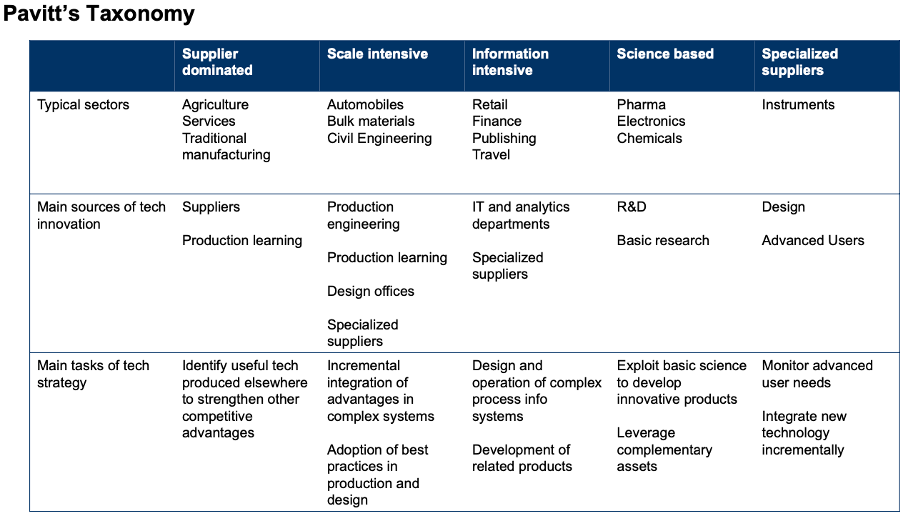
Pavitt’s Taxonomy, which is a way of classifying which sources of innovation are most important for different types of industries.
- categorizes industries based on the sources of innovation they typically rely on. It helps us understand which sources are most important for each industry and the strategic focus companies in these sectors should have. Here’s how it breaks down:
Managerial Implications
· Technology and Competitive Advantage: Understanding where competitive advantage comes from in each sector (suppliers, R&D, users, etc.) helps firms decide where to focus their innovation efforts.
· Investment and Relationships: Firms should invest in relationships with the most important sources of innovation for their industry, such as:
o Building R&D capacity for science-based sectors.
o Strengthening supplier relationships in supplier-dominated sectors.
o Focusing on data and information systems in information-intensive sectors.
How Innovation Strategies Differ by Industry
This framework shows that different industries rely on different innovation sources, and they don’t all approach innovation the same way. For example:
· Automobiles (scale-intensive) focus on refining processes, incorporating best practices, and gradual integration of new technologies.
· Pharmaceuticals (science-based) focus on R&D and collaborations with the scientific community to discover breakthrough products.
· Retail (information-intensive) focus on customer data, IT systems, and ensuring integration across multiple shopping channels.
Limitations of Pavitt’s Taxonomy
· Simplified View: It may not cover all firms, as some firms belong to more than one category, especially large firms with diverse operations.
· Change Over Time: Innovation sources may shift with technological advances. For example, the car industry is increasingly science-based with developments like autonomous driving and electrification, even though traditionally it was scale-intensive.
Triple Helix: a collaborative framework involving government, academia, and industry working
together to foster innovation and economic development.
Lead users: individuals or entities within a target market who, due to their unique needs, experiences,
or early recognition of emerging trends, are at the forefront of innovation and are likely to adopt and
adapt new products or technologies ahead of the broader market.
Pavitt’s Taxonomy: a categorization of industries according to their main sources of innovation.
(You are required to know the 5 categories of industries and how they differ).
Innovation
You probably know the robot Spot
produced by Boston Dynamics, a
spin-off of MIT. Early robots by this
company were developed with
funding by DARPA. The search for a
Covid19 vaccine.
UK AI strategy
■Innovation is a systemic phenomenon – no company innovates in a vacuum
■The ‘triple helix’ of innovation: Companies, Universities, and the Government
The recent history of
autonomous vehicles in
the US
DARPA challenge 2004
(DARPA is a research
organization of the US
Defence Department),
taken up by teams in which
universities and industry
collaborated showing that it
was possible, then the idea
was picked up by industry
with renewed interest.
Perspectives on sources of Innovation
■Policy vs. Managerial perspective
■From a policy perspective (meaning, if you were the Ministry for Industry and had to design the
innovation policy of a country –or if you vote for those designing it): what kind of entities/actors do I
want to make sure are around and what should I incentivize them to do?
oLarge and established tech-intensive companies
oNew and entrepreneurial tech start-ups
oUniversities
oGovernment
■From a managerial perspective: what innovations are more suitable for my
company?
Managerial Perspective
What innovations are more suitable for large, established, tech-
intensive companies? (Think about the types of innovations we studied
in previous weeks)
Strengths and weaknesses of large, established, technology
intensive firms vs tech-based start-ups
■Large, established, technology-intensive firms
oGood at incremental innovation, competence-enhancing innovations, sustaining
innovations, innovations that require a lot of investment
oCan cope reasonably well with even a drastic technological transition as long as it does not
change business models –so they can cope with technological innovations that are
competence-destroying (new tech competencies) but also sustaining (no new
market/business model)
■Tech-base start-up do very well when
oInitial investment is low (but consider venture capital)
oThe innovation is disruptive for large companies (large companies have no interest
because it is not (yet) their market that is in play)
➢Examples: Apple with first Desktop, Amazon with birth of ecommerce, Uber with Taxi
services, Transferwise with international money transfer and banks, etc.
The policy perspective (1/3)
■Large and small companies have complementary roles.
oDifferent types of innovation
oMany very important discoveries and inventions have historically come from the R&D labs of large
companies (e.g., Xerox’s PARC and Bell Labs)
oLarge companies often act as clients for young entrepreneurial companies, or might fund them in the
early stage or acquire them if they are successful (e.g., Microsoft and IBM; DeepMind and Google)
oLarge companies often provide the nurturing ground for entrepreneurs and their innovative
companies, providing them with essential industry and managerial experience: spin-offs founded by
former employees (e.g., Intel; the automotive cluster around Detroit; Transferwise)
Oxford-Astra Zeneca Covid19 candidate vaccine
The research was the vaccine was conducted at Oxford University laboratories. The lab at Oxford University then established a
relationship with Astra Zeneca to help with licensure, manufacturing and distribution. As part of the process IRBM was contracted
to produce enough vaccine to conduct the trial. Moving from the vary small quantities produced from the lab to the quantities
necessary to run a trial in not a simple thing -‘scaling up’ is a complex and difficult process in the pharmaceutical and chemical
industries. IRBM was a research unit divested from Merck & Co that re-opened as an independent drug discovery company.
The policy perspective (2/3)
■From a policy perspective, you need both set of entities for a successful
innovation ecosystem
oDeveloping a ‘biotechnology cluster’ in countries that do not have large pharmaceutical companies is
very difficult.
oIn turn, the lack of large pharmaceutical companies and biotech start-ups weakens the research
ability of universities.
■Today’s large established firms in the tech sector (Google, IBM, Microsoft) are
incubating quantum computing machines – in a way that is strikingly like what the
Bell Labs of AT&T did with microprocessors.
■Caveat: there are indications that large firms are decreasing their investment in
blue-sky R&D (they have learnt from Xerox and Bell Labs – but this becomes a big
policy problem)
The policy perspective (3/3)
■What is the role of government?
■Usually thought of in terms of funding (basic) research via the university system
and national research centers and general economic policies (tax, employment),
etc.
■Government plays a key role as buyer of advanced technology too
oSilicon valley and US Defense spending
Olivetti 1962 – Programma101 and a
conservative public administration
Sources of innovation – the ecosystem
■Firms
■Universities, government institutions, and other not for profit organizations
■Individual inventors
Sources of innovation (firms)
■Internal sources
oEmployees
oR&D Department
oDesign offices
oProduction
oIT/Systems-Digital-analytics departments
■Users
Users as a source of innovation
LEAD USERS –TOP
PERFORMING USERS WHO
INNOVATE THE PRODUCT
Sources of innovation (firms)
■Internal sources
oEmployees
oR&D Department
oDesign offices
oProduction
oIT/Systems-Digital-analytics departments
■Users
■Suppliers
■Competitors
■Complementors
■…
Are specific sources of innovation equally important for all firms?
■Most innovative firms have very thick innovation linkages both internally (e.g., R&D with the other
operations of the firm) and externally (with customers, suppliers, universities…) – utilizing multiple
sources of innovation.
■Yet, there are significant differences across industries: Pavitt’s Taxonomy
Pavitt’s Taxonomy
Typical sectors Agriculture Automobiles Retail Pharma Instruments
Main sources of tech
innovation
Main tasks of tech
strategy
Agriculture today
Agriculture – which sources are most important?
“Our farm is large and is at the forefront of the
technological revolution that is changing the shape of
agriculture. Sowing, watering, fertilizing and harvesting
are all computer‐controlled. The seeds are improved
varieties provided by advanced biotechnology
companies, and we are even beginning to experiment
with robots for picking up tomatoes. Getting here has
been difficult, and we have spent countless hours trying
to understand what technologies are available, what
advantages and disadvantages they bring given their
current position in the market. Once the decision has
been made, implementing is never easy, and there are a
lot of improvements to be done on how the technologies
work.”
Pavitt’s Taxonomy
Supplier
dominated
Typical sectors Agriculture
Services
Traditional
manufacturing
Main sources of tech
innovation
Suppliers
Production learning
Main tasks of tech
strategy
Identify useful tech
produced elsewhere
to strengthen other
competitive
advantages
(Traditional) Automotive
(Traditional) Automotive– which sources are most important?
“Producing a new car is a very complex process that requires
the integration of inputs from a variety of sources, from
marketing to the production line – even without considering all
the improvements and innovations that come from the
suppliers of components such as control systems. Attractive
new cars are the aim of designers, while production
engineering has to devise the new and advanced production
processes that will allow a new design to be actually built and
sold, as well as providing ways to cut costs. “Continuous
improvement” techniques are in place in the production line,
and a lot of information about what is easy to manufacture
needs to be fed back to production engineering and the design
office. None of this is really revolutionary, but getting all the
minor technical improvements to work together is not easy. It
is no wonder that a lot of emphasis is put in developing and
copying best practices.”
Pavitt’s Taxonomy
Supplier
dominated
Typical sectors Agriculture
Services
Traditional
manufacturing
Main sources of tech
innovation
Suppliers
Production learning
Main tasks of tech
strategy
Identify useful tech
produced elsewhere
to strengthen other
competitive
advantages
Scale intensive
Automobiles
Bulk materials
Civil Engineering
Production
engineering
Production learning
Design offices
Specialized
suppliers
Incremental
integration of
advantages in
complex systems
Adoption of best
practices in
production and
design
Retail
Retail - which sources are most important?
“Innovating in retailing today is all about knowing your
customer and ensuring that the merchandise is available
to the customer by whichever channel they want it, in
the physical store, on‐line on the web, or through the
app. Trends are shifting very fast and it is not easy to
keep being innovative in the products and how to reach
clients. Retailers increasingly rely on data analytics and
other IT to run all of their systems –and integrating new
systems in the architecture as well as ensuring the
coordination of all the channels is no minor challenge.”
Pavitt’s Taxonomy
Supplier
dominated
Typical sectors Agriculture
Services
Traditional
manufacturing
Main sources of tech
innovation
Suppliers
Production learning
Main tasks of tech
strategy
Identify useful tech
produced elsewhere
to strengthen other
competitive
advantages
Scale intensive Automobiles
Bulk materials
Civil Engineering
Production
engineering
Production learning
Design offices
Specialized
suppliers
Incremental
integration of
advantages in
complex systems
Adoption of best
practices in
production and
design
Information
intensive
Retail
Finance
Publishing
Travel
IT and analytics
departments
Specialized
suppliers
Design and
operation of complex
process info
systems
Development of
related products
Pharma
Pharma - which sources are most important?
“Getting new drugs on the market is an incredibly
complex and expensive process. There is no doubt that
it all begins in the company’s vast R&D labs, in which
scientist keep up to date with development in
universities and attend numerous conferences. But it is
not only R&D. Clinical trials and obtaining regulatory
approval is as complex, and then, once the drug is
approved, there is a large organization that is needed to
contact the medical community and to gather further
data on the drug.”
Pavitt’s Taxonomy
Supplier
dominated
Typical sectors Agriculture
Services
Traditional
manufacturing
Main sources of tech
innovation
Suppliers
Production learning
Main tasks of tech
strategy
Identify useful tech
produced elsewhere
to strengthen other
competitive
advantages
Scale intensive Automobiles
Bulk materials
Civil Engineering
Production
engineering
Production learning
Design offices
Specialized
suppliers
Incremental
integration of
advantages in
complex systems
Adoption of best
practices in
production and
design
Information
intensive
Retail
Finance
Publishing
Travel
IT and analytics
departments
Specialized
suppliers
Design and
operation of complex
process info
systems
Development of
related products
Science based
Pharma
Electronics
Chemicals
R&D
Basic research
Exploit basic science
to develop
innovative products
Leverage
complementary
assets
Instruments
Instruments - which sources are most important?
“People at the company work relentlessly to try and
improve the current instruments and develop new ones.
There is a dedicated instrument design unit for this, and
technicians there maintain very strong contact with the
most advanced user of their instruments. These users
know the instruments inside out, and all their quirks.
They are also very hands‐on and sometime modify the
instruments to make them more precise or have ideas
about how to add new functionalities. Also, there always
something new that they need, and the company knows
that it needs to keep an eye on that too.”
Pavitt’s Taxonomy
Supplier
dominated
Typical sectors Agriculture
Services
Traditional
manufacturing
Main sources of tech
innovation
Suppliers
Production learning
Main tasks of tech
strategy
Identify useful tech
produced elsewhere
to strengthen other
competitive
advantages
Scale intensive Automobiles
Bulk materials
Civil Engineering
Production
engineering
Production learning
Design offices
Specialized
suppliers
Incremental
integration of
advantages in
complex systems
Adoption of best
practices in
production and
design
Information
intensive
Retail
Finance
Publishing
Travel
IT and analytics
departments
Specialized
suppliers
Design and
operation of complex
process info
systems
Development of
related products
Science based Pharma
Electronics
Chemicals
R&D
Basic research
Exploit basic science
to develop
innovative products
Leverage
complementary
assets
Specialized
suppliers
Instruments
Design
Advanced Users
Monitor advanced
user needs
Integrate new
technology
incrementally
Pavitt’s Taxonomy
■Managerial implications for
oWhere competitive advantage based on technology primarily comes from
oWhere to invest and which links to develop (customers or suppliers)?
■Provides a way to integrate science-push and demand(need) pull approaches by
showing how in certain industries, such as Pharmaceuticals, science and R&D are
much more important than say, in Instruments where a lot of innovation comes
from design activities and users.
Limitations
■The taxonomy applies to the technological leaders in an industry
■Simplification (e.g., supplier dominated firms exist in electronic and chemicals, but
they are not technological-pace setters)
■Some firms belong in more than one trajectory, especially large firms
■Although the taxonomy has held up reasonably well to subsequent investigations,
there will be change over time, particularly with radical technological breakthrough
■When you use it, ask:
owhat are the sources of innovation for a technological leader in this industry?
ohow are current technological developments changing this?
Example: Trends affecting car industry today
■Autonomous driving
■Electrification
■Platform business
■Changing trend in car ownership
Science-based?
Information intensive?
Eventually,
when the
technology
stabilizes,
supplier-
dominated?
What you have learnt today
■Sources of innovation include individuals (both inventors and employees), the
R&D lab, suppliers, customers, the ‘Science System’
■Most successful companies draw on a combination of these sources - which are
complementary rather than substitute
oInternal and external
■Yet, the importance of different sources as well as the main tasks for a strategy
based on technological innovation depend on the industry
■Technological innovation may change the importance of sources of innovation for
an industry (e.g., car industry)