AP Physics C: E&M — Unit 4: Statics and Dynamics of Magnetic Fields
4.1 Forces on Moving Charges in Magnetic Fields
Defines of Magnetic Field ()
Magnetic Fields are vector fields produced by moving electric charges or intrinsic magnetic moments of elementary particles. Unlike electric fields which originate from static charges, magnetic fields have no "monopoles"; magnetic field lines always form closed loops.
- Symbol:
- SI Unit: Tesla (T). Note: .
- Visual Representation: Field lines emerge from the North pole and enter the South pole. The density of lines indicates field strength.
The Lorentz Force
A charged particle moving through a magnetic field experiences a magnetic force. This is the fundamental interaction in magnetostatics.
Where:
- $q$ is the electric charge Magnitude and sign matter.
- is the velocity vector of the particle.
- is the magnetic field vector.
- denotes the vector cross product.
Key Consequences Calculation:
- Magnitude: , where is the angle between and .
- Zero Force Conditions: The force is zero if the particle is stationary ($v=0$) or moving parallel/anti-parallel to the field ().
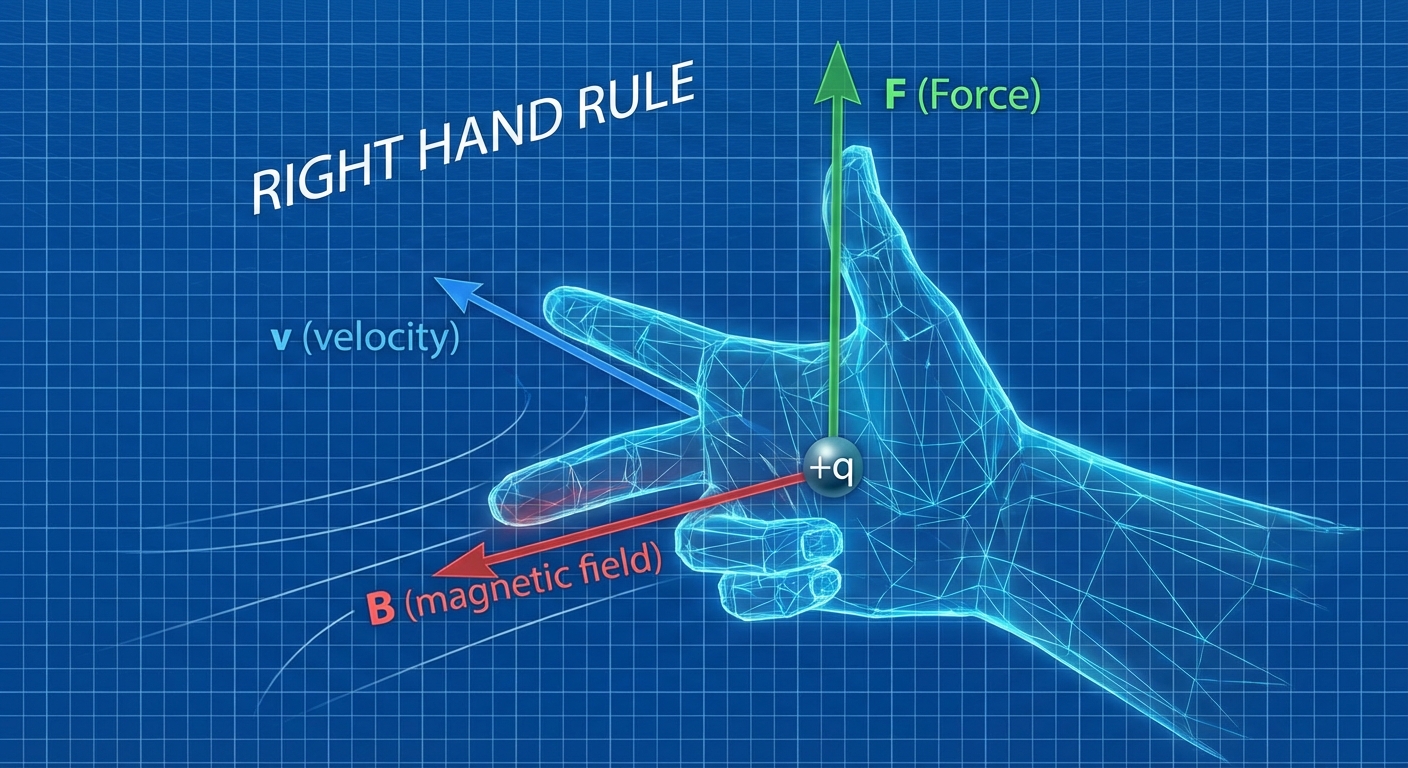
- Direction: Perpendicular to the plane defined by and . Determined by the Right-Hand Rule.
- Work: The magnetic force is always perpendicular to motion (). Therefore, magnetic forces do NO work on charged particles (). They can change direction, but not speed or kinetic energy.
The Right-Hand Rule (RHR) for Forces
Used to determine the cross-product direction for a positive charge.
- Point fingers of right hand in direction of velocity .
- Curl fingers toward magnetic field .
- Thumb points in direction of Force .
Note: For a negative charge (like an electron), find the direction for a positive charge and flip it 180 degrees.
Motion in a Uniform Magnetic Field
When a charged particle enters a uniform magnetic field with velocity perpendicular to the field, it undergoes Uniform Circular Motion.
- Centripetal Force: The magnetic force acts as the centripetal force.
- Radius of Path (Cyclotron Radius):
- Period ($T$) & Frequency ($f$):
Helical Motion: If the velocity has a component parallel to the field (), the particle moves in a helix. The parallel component remains constant (pitch), while the perpendicular component drives the circular motion.
Applications
- Velocity Selector: Crossed and fields create opposing forces. Only particles with pass through undeflected ($qE = qvB$).
- Mass Spectrometer: Uses a velocity selector followed by a region of pure field to separate ions by mass-to-charge ratio ($m/q$) based on the radius of curvature.
4.2 Forces on Current-Carrying Wires
Current is simply a collection of moving charges. Therefore, a wire carrying current in a magnetic field experiences a cumulative force.
Force Formula
For a straight wire of length $L$ carrying current $I$ in a uniform field:
For a curved wire or non-uniform field, we integrate along the path:
- or points in the direction of conventional current.
Maxwell's Note: If a wire forms a complete closed loop in a uniform magnetic field, the net force is zero.
Torque on a Current Loop
While the net force on a closed loop in a uniform field is zero, the net torque () is not. This is the principle behind electric motors.
- Magnetic Dipole Moment (): A vector defined for a current loop.
- $N$: Number of turns.
- $I$: Current.
- $A$: Area of the loop.
- : Normal vector (direction determined by RHR—curl fingers with current, thumb points to ).
Potential Energy of a Dipole:
- Lowest energy (stable equilibrium) when is parallel to .
- Highest energy (unstable) when anti-parallel.
4.3 Biot-Savart Law: Sources of Magnetic Fields
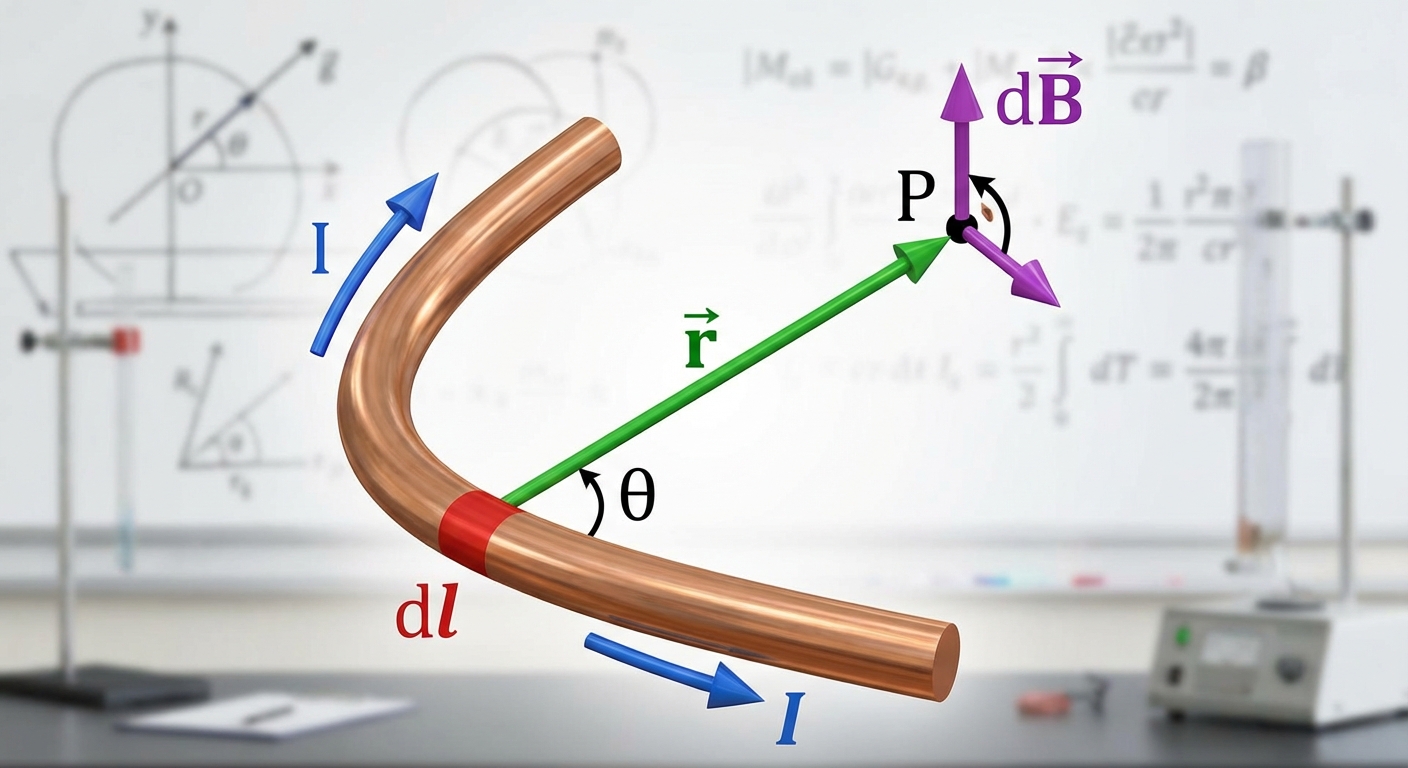
Just as Coulomb’s Law calculates the E-field from a point charge, the Biot-Savart Law calculates the B-field produced by a moving charge or current element.
General Formula
- : Permeability of free space ().
- : Infinitesimal length vector pointing in current direction.
- : Unit vector pointing from the wire element to the point of interest.
- $r$: Distance from the wire element to the point.
Important Derivations (AP C Learning Objectives)
1. Long Straight Wire
Integrating Biot-Savart for an infinite line of current yields:
- Direction: Circular loops around the wire (RHR: thumb along current, fingers curl along B).
2. Center of a Circular Loop (Radius $R$)
3. On the Axis of a Current Loop
At a distance $z$ from the center of a loop of radius $R$:
- At $z=0$, this reduces to the "center of loop" formula.
- At , it approximates the field of a dipole ().
Force Between Parallel Wires
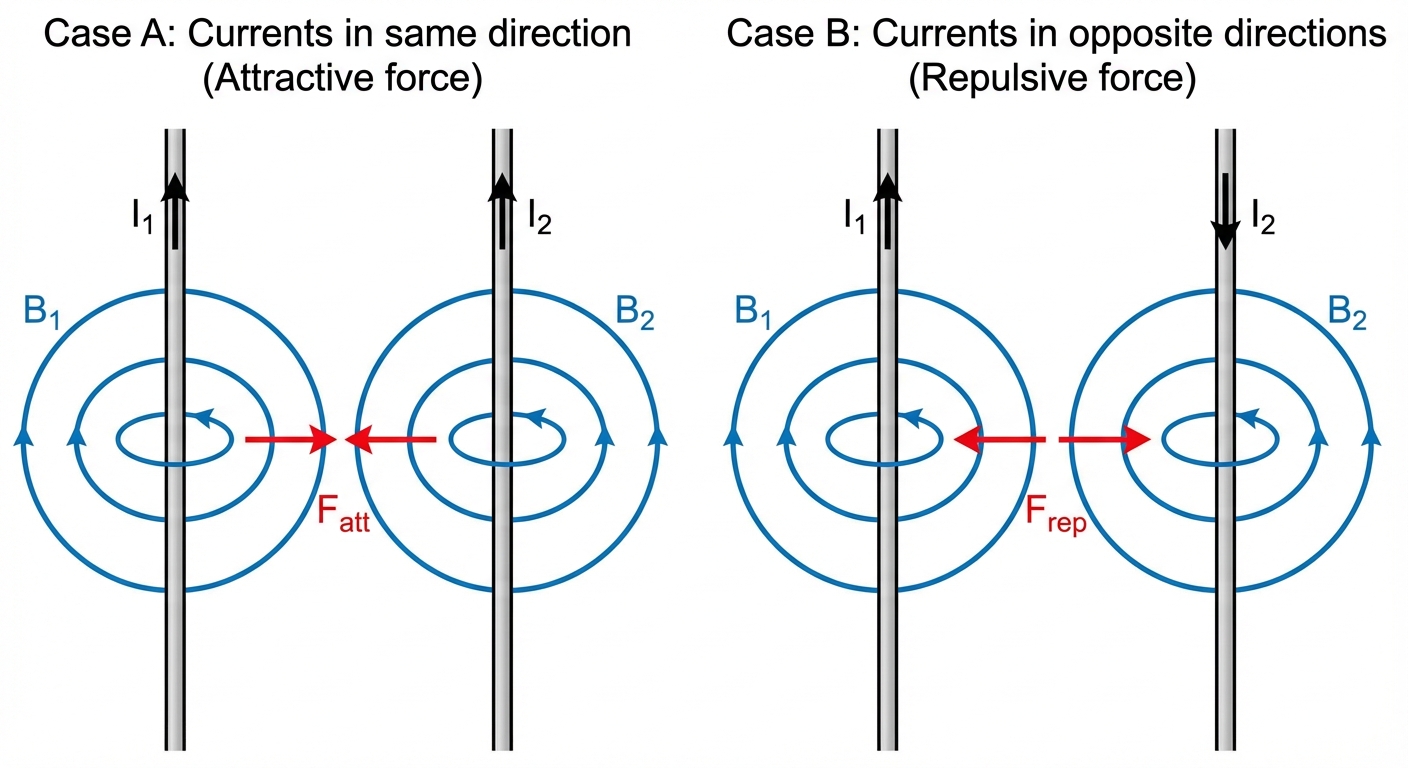
Two parallel wires exert magnetic forces on each other. Wire 1 creates a field at the location of Wire 2, which exerts a force on Wire 2.
- Parallel Currents: Attract.
- Anti-Parallel Currents: Repel.
4.4 Ampère’s Law
Ampère’s Law is the magnetic equivalent of Gauss’s Law. It is useful for finding magnetic fields in highly symmetric situations.
The Integral Form
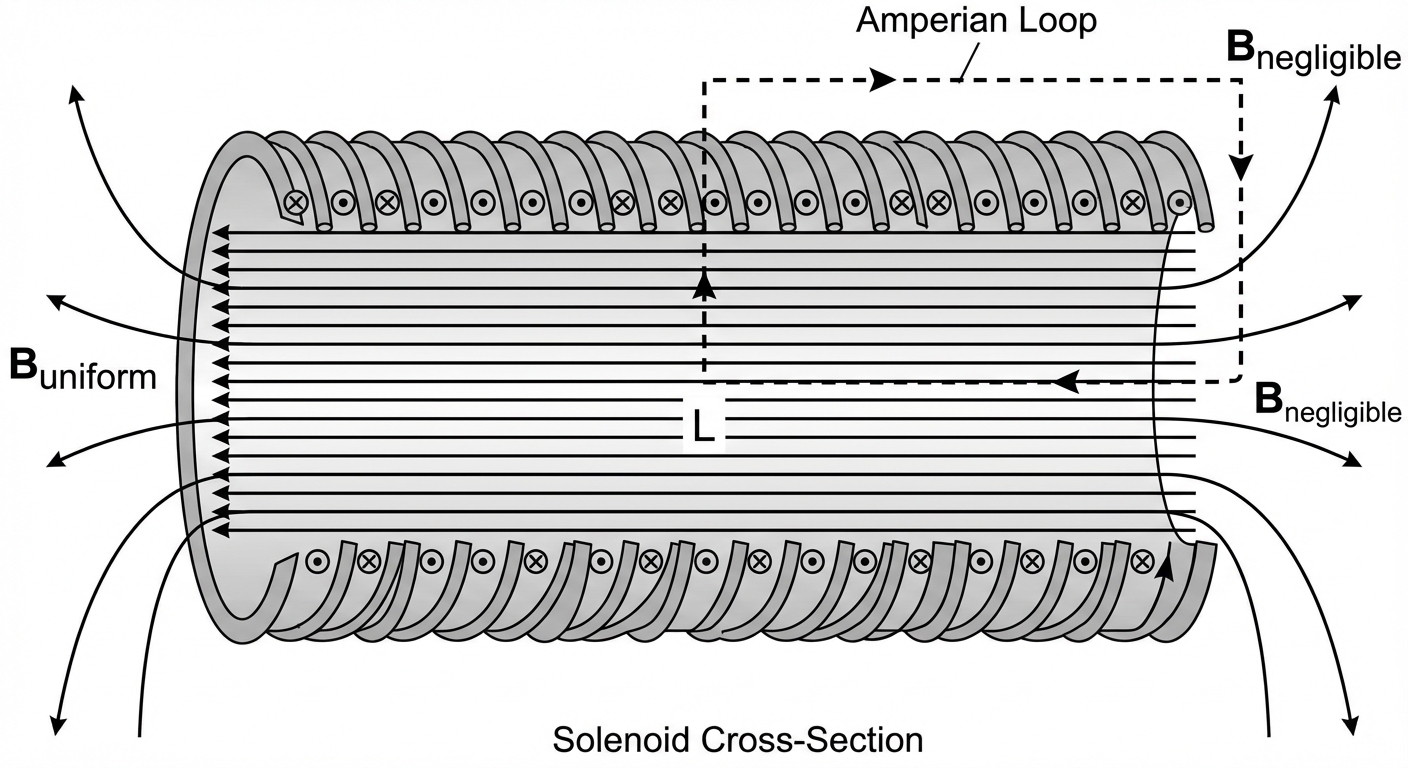
- : Line integral around a closed loop (Amperian loop).
- : Vector along the path of the loop.
- $I_{enc}$: Net current penetrating the area defined by the loop.
Sign Convention: Curl your right fingers in the direction of integration (). Your thumb defines the positive direction for current.
Applications of Ampère's Law
1. Long Straight Wire (Outside vs. Inside)
- Outside ($r > R$): We draw a circular loop radius $r$. .
- Inside ($r < R$): Assuming uniform current density .
The field increases linearly from the center to the surface.
2. Solenoid
An ideal solenoid (long, tightly wound) has a uniform field inside and zero field outside.
- $n = N/L$: Number of turns per unit length.
- The field is parallel to the axis. Direction given by RHR (curl fingers with current, thumb points North).
3. Toroid
A solenoid bent into a donut shape. Determine the field at a radius $r$ inside the coils ($N$ total turns).
- The field is non-uniform (stronger at the inner radius, weaker at the outer radius).
- $B = 0$ outside the toroid entirely.
4.5 Common Mistakes & Pitfalls
- Magnetic Work: A common trick question asks for the work done by the magnetic force on a charge moving in a circle. The answer is always Zero. Magnetic force changes direction, not Kinetic Energy.
- Cross Product Order: . The order matters. Reversing them flips the sign (direction). Always use (fingers) then (curl).
- Electric vs. Magnetic Force: Electric force ($FE = qE$) acts on moving and stationary charges parallel to the field. Magnetic force () acts only on moving charges perpendicular to the field.
- vs : Don't confuse the constants. is for magnetism (); is for electricity.
- Using Ampère's Law for Finite Wires: Ampère's law in the simple form requires symmetry. You cannot use it easily for a short wire segment; you must use Biot-Savart for that.
- Current Direction in Parallel Wires: Students often confusingly apply the "likes repel" rule from electrostatics to currents. For wires: Like currents Attract; Opposite currents Repel.