Things to Know for South Asia (DVHS)
Siddhartha Gautama & Buddhism:
Born a prince and kept in a castle by his father because of a prophecy that said the family would lose their kingdom if he left
Snuck out of the palace and encountered human suffering (an old man, a dying man, and a corpse)
Renounced the crown and sought out holy men to find out how life could come to such a terrible end
Became an ascetic and meditated and fasted for days at a time
Reached enlightenment after meditating for about a month under a tree
Understood the meaning of life and began teaching it to people who would become his disciples
Four Noble Truths and the Noble Eightfold Path
The Noble Eightfold Path:
Right understanding: Our actions and beliefs have consequences that persist after death
Right aspiration (“right thought”): Avoid violence and hateful conduct
Right speech: No lying, rude speech, or gossiping to inflict harm
Right action: No killing, injuring, stealing, sexual misconduct, or material desires
Right livelihood: No trading in weapons, living beings (trafficking), meat, liquor, or poisons
Right effort: Generate wholesome states and prevent the rise of the five hindrances
Sensory desire: seeking pleasure
Ill will: resentment, hate, or bitterness
Sloth: doing things halfheartedly
Restlessness and worry: not being able to calm the mind and focus one’s energy
Doubt: lack of conviction or trust in one’s ability
Right mindfulness: be aware of the present moment, never absentminded
Right concentration: “right meditation” aiming for insight
Hinduism:
The word “Hinduism” is thought to come from the Persian word “hindu” meaning river, used to refer to the Indus River Valley
Oldest existing major religion
No specific founder
Most Hindus follow Shiva or Vishnu as the true god or look inward to the divine self, atman
Despite their differences in belief, most Hindus recognize the authority of the Brahmin and the Vedas
Vedas:
Sacred texts dating back to 2500 BCE
Included the caste system
When Purusha, a spirit, was divided into parts, his mouth became the Brahmin, his arms the Kshatriyas, his thighs the Vaisyas, and his feet the Sudras
Untouchables were outside the system altogether and considered the lowest rank
This group was eliminated in the Indian constitution
“Ritual sacrifices associated with numerous gods who represented the forces of nature”
I do not know what this means
Ramadan:
One of the five pillars of Islam
Muslims fast from sunrise to sunset every day for a month
Seen as a way to cleanse the soul and have empathy for those less fortunate
Ninth month of the Islamic lunar-based calendar, meaning it starts on a different date every year in the Gregorian calendar
Also meant to avoid drinking, smoking, sexual activity, and unkind or impure thoughts, words, or behavior
Ends with a three-day celebration called Eid al-Fitr
A time for self-reflection and self-restraint
Indus Valley Civilization
Very few weapons and no evidence of an army has been discovered
Buildings and excavated human bones show no signs of battle
Didn’t devote many resources as offerings to the dead, instead keeping them in circulation
Stone seal discovered in Harappa may have the world’s first language system
Settlements built on giant platforms and elevated ground for protection from floods and polluted waters
Bricks used to construct buildings
All houses were connected to sophisticated drainage systems, carrying sewage and dirty water out of living spaces
Organized roads in patterns with straight lines and right angles
Craftsmanship and trade evidenced by pottery, textiles, and beads
Bartering and trade spread Indus culture
Religion was important, shown by (i.e.) clay figurines of goddesses and more
Lasted from circa 2500 BCE to around 1900 BCE
Became fragmented into smaller regional cultures
Many believe the civilization declined due to Aryan invasions from the north, but since there’s little evidence of fighting or violence, many historians claim that changes in river patterns disrupted farming and trading systems and led to irreparable flooding
Kashmir:
Princely state of Jammu & Kashmir given the choice to join either Pakistan or India during partition
Hindu monarch chose to stay neutral despite Muslim majority population
Kashmiri citizens rebelled, helped by armed tribesmen from Pakistan
Monarch asked India for military help, agreeing to join India in return
First Indo-Pakistani War, 1947
UN classified Kashmir as Indian-administered, meaning it was officially temporarily under Indian control
UN Security Council brokered a ceasefire agreement in 1949 that split Kashmir between India and Pakistan and ordered both to withdraw troops
Allowed people to vote for which country they wanted to be part of
No vote was held and neither country withdrew
The area of Jammu & Kashmir got some autonomy from Article 370 in the Indian constitution, allowing it its own flag, prime minister, constitution, and more
Article 370 was revoked in 2019, apparently because it prevented Kashmir and India from becoming unified
Prime minister Narendra Modi promised to strip Kashmir of its privileges while running for reelection in early 2019
Pakistan argues Muslim majority population means they should control Kashmir, India argues the state was given to them and added it to their constitution
Second Indo-Pakistani War in 1965
War ended with another ceasefire, but no change in “borders”
Pakistan lost East Pakistan in Third Indo-Pakistani War in 1971
Kashmir became more important and one of the most militarized places on Earth
Separatist (people who believe Kashmir should be granted independence) groups started challenging pro-India political groups
Armed groups were formed in the 80s; some say they’re fighting for independence and some for a Pakistan-controlled Kashmir
India allegedly rigged an election in Kashmir in 1987 in favor of a pro-India candidate
Thousands of Kashmiris felt they were denied the chance to vote and took to the streets in protest of the Indian occupation
India met the protest with resistance, leading to more violence
Hindu residents in Kashmir known as Kashmiri Pandits were targeted
Hundreds were killed and thousands had to leave the area
Kashmiri militias started recruiting Muslim youth to help them fight for independence and attacks on the Indian military increased
Pakistan used this as an opportunity to introduce radical Islamic groups that would fight for pro-Pakistan Kashmir
Dominated insurgency by mid-1990s
India deployed 500,000 troops in response and cracked down on militants and protestors
Unarmed civilians were killed and many had to flee
Both India and Pakistan had developed nuclear weapons by 1998, raising the stakes
Fourth Indo-Pakistani War started in 1999 and ended with another ceasefire
Pakistan militant group Lashkar-e-Taiba’s members bombed India’s parliament building in New Delhi in 2001, resulting in 14 deaths
10 members of the same group killed 174 and wounded 300 people in Mumbai in 2008
India’s military cracked down on protestors, firing on unarmed civilians with bullets and pellets
India uses the armed separatist uprising to justify its estimated 700,000 troops, nearly half its active military, in Kashmir
India accuses Pakistan of supporting the uprising
India has said there are only 200-300 militants
According to a report in 2018, out of 160 civilians killed, 71 died because of Indian security forces
Continuous cycle of India’s crackdown incentivizing Kashmiris to join Pakistan-backed militant groups, which carry out attacks on India’s military, prompting them to respond even more harshly against civilians and unarmed protestors
Gupta Empire:
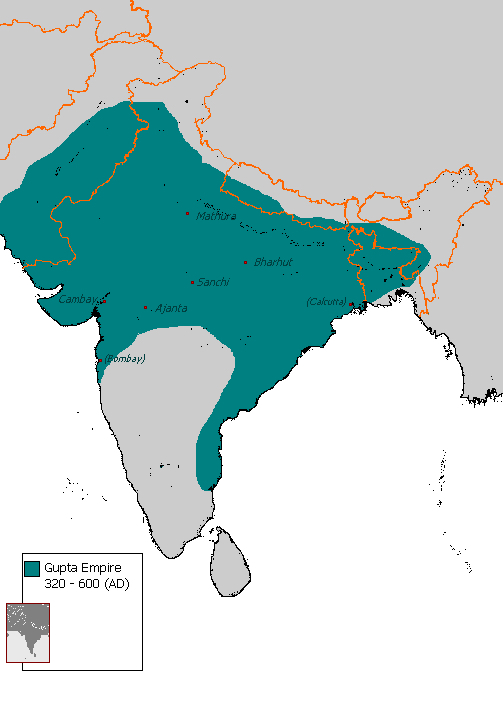
Defined by creativity: arts and literature, rather than wealth or trade
Small states warred in India for almost 500 years after the collapse of the Mauryan Empire in 185 BCE after the assassination of its last king(s? The article was not clear)
Chandragupta I ascended the throne and gave rise to a new empire
Revived many Mauryan principles
Paved the way for his son to develop and extensive empire
Samudragupta, son of Chandragupta I, was passionate about conquest and a great warrior
Sought to unite India under his rule
Waged wars across much of the Indian subcontinent
Many people hoped for mercy if they offered tribute and presents to Samudragupta as he passed
This did not work very well
Defeated nine kings in the north and twelve in the south
Many horses were killed to celebrate his victories
Often compared to Alexander the Great and Napoleon
Gupta villages had local squads consisting of an elephant, a chariot, three armed cavalrymen, and five foot soldiers, which protected them from raids and revolts
These squads would join together in times of war to form a powerful royal army
Samudragupta was also a lover and supporter of the arts, evidenced by engraved coins and inscribed pillars from the time of his reign
Samudragupta set the stage for the emergence of classical art, under the reign of his son, Chandragupta II
Artists were paid for their work under Chandragupta II’s rule, which may have been one reason as to why so much progress was made in literature and science in that period
Most literature during this time was drama and poetry
Lyric poetry, narrative history, religious and meditative writing emerged to educate and entertain people
Kalidasa was a famous playwright of the time; his plays had humor and epic heroism
Formal essays were composed on grammar, math, astronomy, and more
The Kamasutra is the best-known essay of the period, talking about the rules of love and marriage according to Hindu laws
Aryabhatta was a famous scientist who proposed that Earth had been a rotating sphere centuries before Columbus’ famous journey and calculated that a solar year was 365.358 days long, which is only three hours off from modern-day calculations
Much notable architecture, sculpture, and paintings also emerged, including the paintings illustrating the various lives of the Buddha found on the walls of the Ajanta Caves in southern India
An 18-foot statue of Hindu god Shiva was found in a Gupta-dynasty rock temple near Mumbai
Evidence of a Buddhist university suggests there was religious freedom and peace between Buddhists and Hindus
Gupta dynasty weakened during the rule of the two successors to Chandragupta II
Starting in 480 CE, the Huns launched a wave of invasions
Gupta kings had little territory under their control by 500 CE, and the empire had completely perished by 550 CE
Mughal Empire:
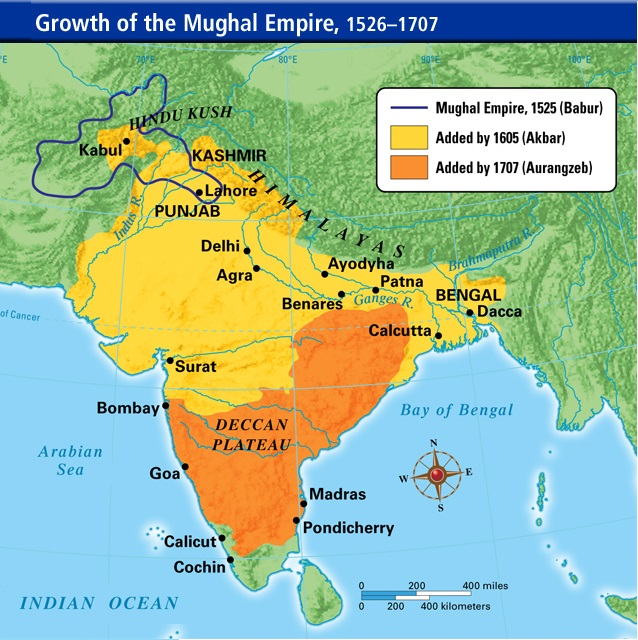
A Muslim dynasty of Turkic-Mongol origin that ruled much of India from the early 1500s to mid-1700s
Continued to exist afterwards as a considerably reduced and increasingly weak entity until the mid-1800s
Notable for its more than 200 years of effective rule over India, its capable rulers, who maintained a record of unusual talent, and its administrative organization
Founded by Chagatai Turkic prince Babur, who reigned from 1526-30
Descended from Turkic conqueror Tamerlane on his father’s side and the second son of Genghis Khan on his mother’s side
Secured control of the Punjab region from his base in Kabul, Afghanistan
Routed the forces of Delhi sultan Ibrahim Lodi in 1526 at the First Battle of Panipat
Overwhelmed the Rajput confederacy under Rana Sanga of Mewar in 1527
Defeated the Afghans of modern-day eastern Uttar Pradesh and Bihar states in 1529
By his death in 1530, he controlled all of northern India from the Indus River to Bihar (near Nepal) and the Himalayas to Gwalior (around New Delhi) in the south
Afghan rebels took control of the empire from Babur’s son Humayun, who ruled from 1530-40
Humayun’s son Akbar defeated Hindu usurper Hemu at the Second Battle of Panipat in 1556 and reestablished Humayun’s dynasty in the territory
Akbar, greatest of the rulers of the Mughal Empire, conquered and annexed all of northern and part of central India
Adopted conciliatory policies towards his Hindu subjects, looking to enlist them in his armies and government service
Created political, administrative, and military structures that were the chief factor behind its continued survival for more than 150 years afterwards
By Akbar’s death in 1605, the empire extended from Afghanistan to the Bay of Bengal and from southward to the modern-day Gujurat state and the northern Deccan region (Deccan Plateau)
Akbar’s son, Jahangir, was a relatively successful ruler from 1605-27
Continued Akbar’s policy of tolerance towards Hindus and administrative systems
Jahangir’s son, Shah Jahan, reigned from 1628-58 and had a passion for building
The Taj Mahal and Great Mosque of Delhi were build under his rule
Reign marked the cultural peak of the Mughal Empire
Military expeditions brought the empire to near bankruptcy
Shah Jahan’s successor, Aurangzeb, ruled from 1658-1707 and was more orthodox (following a doctrine) than his predecessors
Annexed the Muslim Deccan kingdoms of Vijayapura (Bijapur) and Golconda, bringing the empire to its greatest extent
Politically and religiously intolerant
Excluded Hindus from office and destroyed their schools and temples
Persecuted Sikhs in Punjab, turning that sect against Muslim rule
Sparked rebellions among Rajputs, Sikhs, and Marathas
Levied heavy taxes, impoverishing the farming population
Mughal government quality declined, resulting in an economic decline
Died having failed to quash the Marathas of the Deccan and his authority disputed throughout the empire
Empire began breaking up during the reign of Muhammad Shah, who ruled from 1719-48
Process was sped up by dynastic warfare, factional rivalries, and a brief yet disruptive invasion of northern India by Iranian conqueror Nadir Shah in 1739
Marathas overran almost all of northern India after Muhammad Shah’s death in 1748
Mughal rule reduced to a small area around Delhi, which was controlled by the Marathas and then the British
Bahadur Shah II, the last Mughal, was exiled to Yangon for involvement in the Indian Mutiny of 1857-58