3.5 & 3.6 Equilibrium in the Aggregate Demand-Aggregate Supply Model + Changes in the AD-AS Model in the Short Run
3.5 Equilibrium in the Aggregate Demand-Aggregate Supply Model
AD-AS model - model that shows the downward-sloped aggregate demand curve, upward-sloping short-run aggregate supply, and the vertical long-run aggregate supply, illustrating a negative output gap, full employment, or an inflationary gap.

the LRAS curve is drawn as a vertical line at the economy’s full employment output
The dotted lines are short-run equilibrium, where the SRAS and the AD intersect.
Long run equilibrium - the equilibriumm price level and aggregate output with full employment, indicated by the intersection of aggregate demand, short-run aggregate supply, and long-run aggregate supply at the same point.
In long-run equilibrium, the unemployment rate must be equal to the natural rate of unemployment (NRU), or the sum of frictional and structural unemployment.
There is no cyclical unemployment in long-run equilibrium.

in a recession, the economy is not using all of its resources. The unemployment rate is going up. So, the actual, real GDP is less than it would be at full unemployment output
UR = underutilized resources.


3.6 Changes in the AD-AS Model in the Short Run

In the short run, with a positive demand shock (a shift of the aggregate demand curve to the right), the price level will increase, as well as output and unemployment, which means the unemployment rate will decrease.
Anything other than a price level decrease that increases C, I, G, or Xn will shift the AD curve right.
Ex. a big government infrastructure project, an act of autonomous spending, an increase in exports, an increase in business or consumer optimism/expectations, etc.

in the short run, with a negative demand shock (a shift of the aggregate demand curve to the left), the price level will decrease, as well as output and unemployment, which means the unemployment rate will increase.

In the short run, with a positive supply shock (a shift of the short-run aggregate supply curve to the right), the price level will decrease, but output and employment will increase, which means the unemployment rate will decrease
Decreased input prices, lower wages, improved (more efficient) technology, and expected deflation will all shift the short-run aggregate supply curve to the right.
ex. the electronic computer in the 1980s and the internet in the 1990s.

In the short run, with a negative supply shock (a shift of the short-run aggregate supply curve to the left), the price level will increase, but output and employment will decrease, which means the unemployment rate will increase.
Increased input prices, higher wages, significant technological failures, or expected inflation will all shift the short-run aggregate supply curve to the left
ex. natural disasters and energy cost increases.
The two causes of inflation:
Demand-pull - a situation in which a rightward shift of aggregate demand pulls the price level in an economy up.
the most common
if a shift in aggregate to the right is the root cause of the inflation, demand is pulling the price up.
Cost-push - when a leftward shift of the short-run aggregate supply curve pushes the price level in an economy up.
many different causes but they all boil down to something shifting the aggregate supply curve left, which pushes the price level up.
It’s important to know the differences between the two because the remedies for the two sources of inflation are very different.
Stagflation - a situation in which an economy experiences high unemployment and high inflation, so economic stagnation and inflation, most often caused by a negative supply shock.
a negative supply shock that causes inflation to persis in addition to a high unemployment rate
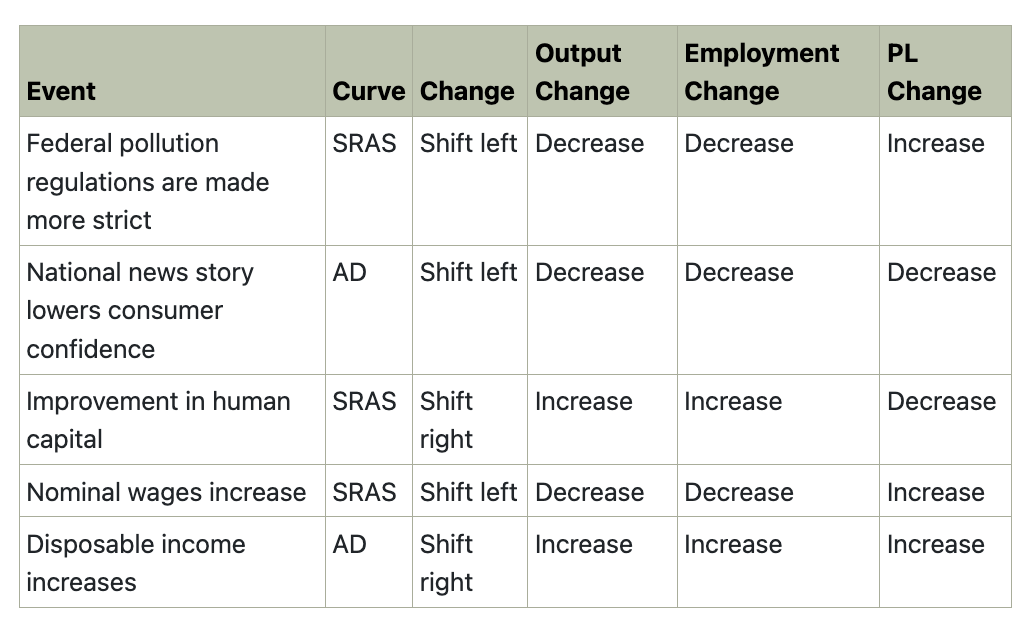
⭐ ️if AD and SRAS both move, either the price level or the change in real output will be indeterminate.
compare the shocks separately!

⭐️ If a change in AD is explained with a reference to a price level change, the curve is not moving; in all likelihood the SRAS is moving and changing the short-run equilibrium. If the AD is changing because of something other than price level, than the curve is shifting.
Income and wages
Wages and income are separate in the context of analyzing AD-AS
A change in overall income impacts aggregate demand
bcuz income drives the consumption of aggregate demand and could come from things other than wages, such as capital investments, inheritance, etc…
Wages impact short-run aggregate supply
bcuz nominal wages directly impact the production costs for businesses
⭐ ️A scenario mentioning “wages” will affect SRAS. A scenario mentioning “income” will affect AD.