3.1.3 Lipids
Lipids
- @@Non-polar and hydrophobic@@ (insoluble in water)
- There are two groups of lipid that you need to know:
- @@Triglycerides@@ (the main component of fats and oils)
- @@Phospholipids@@
Triglycerides
- Are @@non-polar, hydrophobic@@ molecules
- The monomers are @@glycerol and fatty acids@@
- Glycerol is an alcohol (an organic molecule that contains a hydroxyl group bonded to a carbon atom)
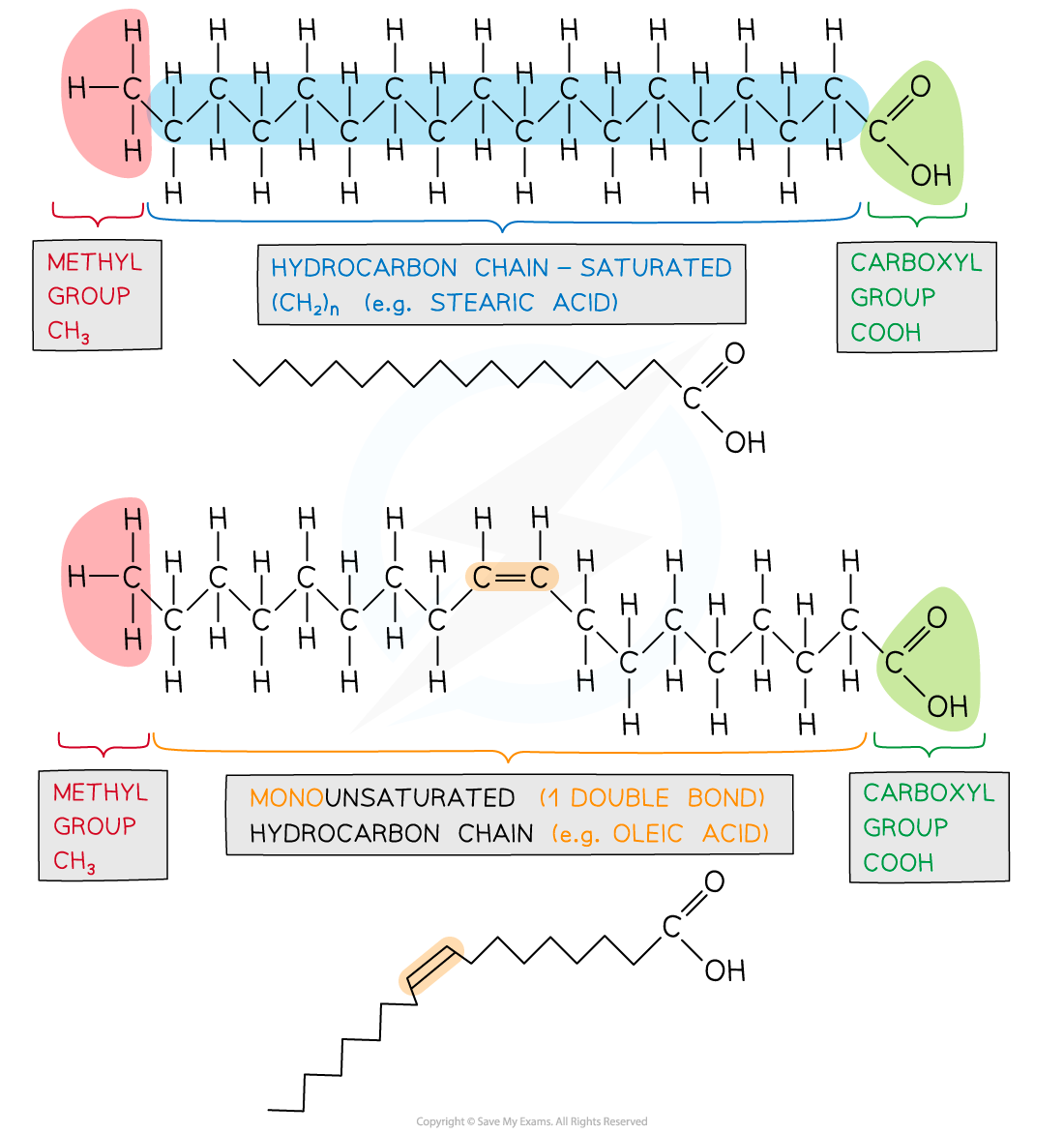
- Fatty acids contain a methyl group at one end of a hydrocarbon chain known as the R group (chains of hydrogens bonded to carbon atoms, typically 4 to 24 carbons long) and at the other is a carboxyl group
- The shorthand chemical formula for a fatty acid is RCOOH
- Unsaturated fatty acids can be mono or poly-unsaturated:
- If H atoms are on the same side of the double bond they are cis-fatty acids and are metabolised by enzymes
- If H atoms are on opposite sides of the double bond they are trans-fatty acids and cannot form enzyme-substrate complexes, therefore, are not metabolised. They are linked with coronary heart disease
- Triglycerides are formed by @@esterification@@
- An ester bond forms when a hydroxyl (-OH) group on glycerol bonds with the carboxyl (-COOH) group of the fatty acid:
- An H from glycerol combines with an OH from the fatty acid to make water
- The formation of an ester bond is a @@condensation reaction@@
- For each ester bond formed a water molecule is released
- Three fatty acids join to one glycerol molecule to form a triglyceride
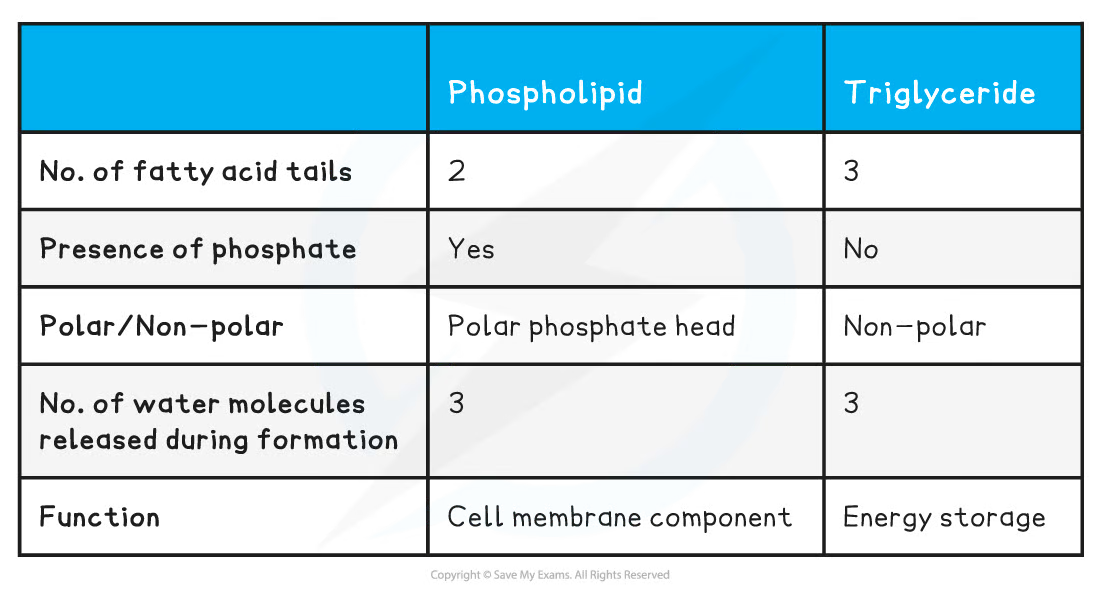
Therefore for @@one triglyceride to form, three water molecules are released@@
Functions of Triglycerides
- The long hydrocarbon chains contain many carbon-hydrogen bonds with little oxygen (triglycerides are highly reduced)
- So when @@triglycerides are oxidised during cellular respiration this causes these bonds to break releasing energy used to produce ATP@@
- As triglycerides are @@hydrophobic@@ they do @@not cause osmotic water uptake in cells so more can be stored@@
- Plants store triglycerides, in the form of oils, in their seeds and fruits. If extracted from seeds and fruits these are generally liquid at room temperature due to the presence of double bonds which add kinks to the fatty acid chains altering their properties
- Mammals store triglycerides as oil droplets in adipose tissue to help them survive when food is scarce (e.g. hibernating bears)
- Triglycerides are part of the composition of the myelin sheath that surrounds nerve fibres
- This provides insulation which increases the speed of transmission of nerve impulses
- The low density of fat tissue increases the ability of animals to float more easily
Phospholipids
- @@Two fatty acids bonded to a glycerol molecule in a phospholipid as one has been replaced by a phosphate ion (PO43-)@@
- As the phosphate is polar it is soluble in water (hydrophilic) The fatty acid ‘tails’ are non-polar and therefore insoluble in water (hydrophobic)
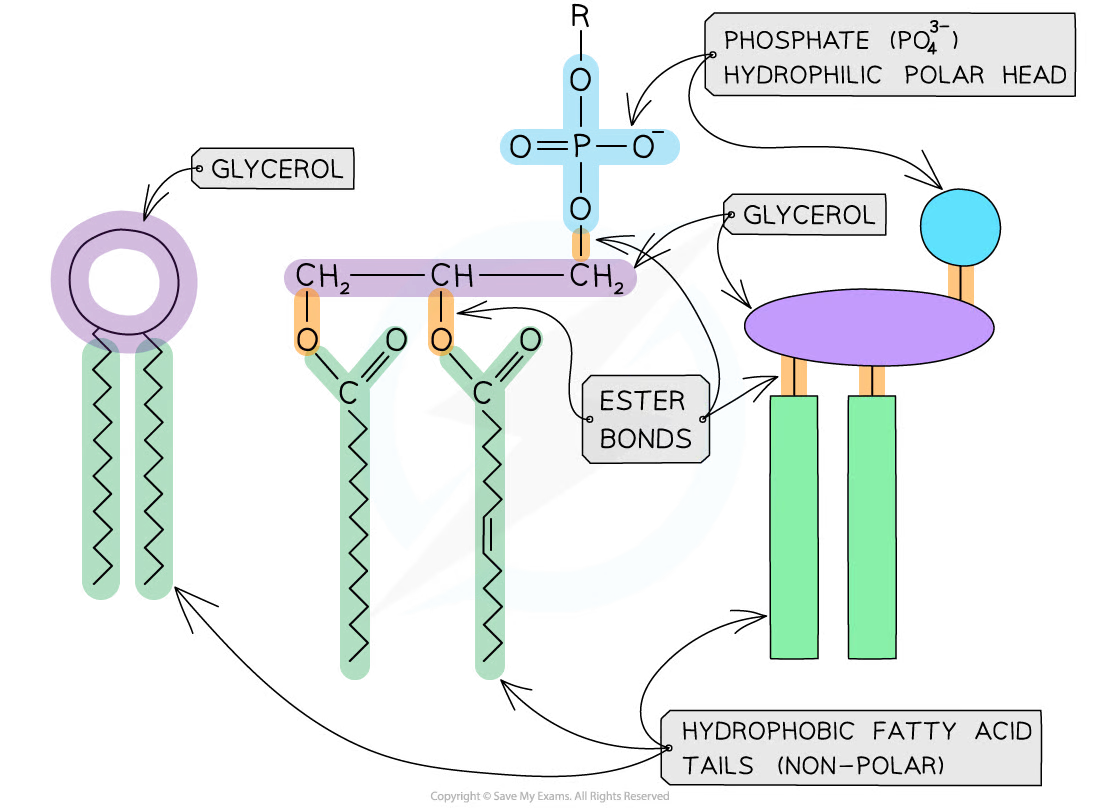
- @@As a result of having hydrophobic and hydrophilic parts phospholipid molecules form monolayers or bilayers in water@@
- The main component (building block) of cell membranes
- Due to the presence of hydrophobic fatty acid tails, a hydrophobic core is created when a phospholipid bilayer forms
- @@This acts as a barrier to water-soluble molecules@@
- Composition of phospholipids contributes to the fluidity of the cell membrane
- If there are mainly saturated fatty acid tails then the membrane will be less fluid
- If there are mainly unsaturated fatty acid tails then the membrane will be more fluid
Biochemical Test for Lipids
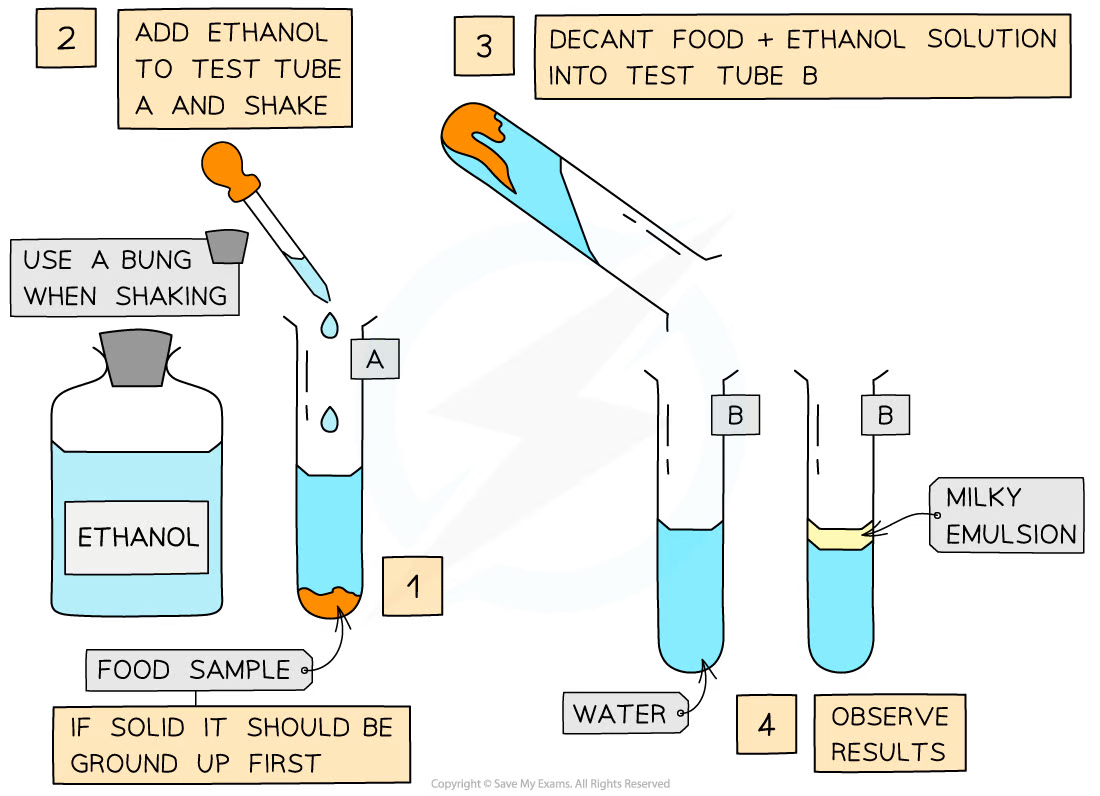
- @@The emulsion test@@ that can be carried out quickly and easily in a lab to determine if a sample contains lipids
- Lipids are nonpolar molecules that do not dissolve in water but will dissolve in organic solvents such as ethanol
- Add ethanol to the sample to be tested, shake to mix and then add the mixture to a test tube of water
- If lipids are present, a milky emulsion will form (the solution appears ‘cloudy’); the more lipid present, the more obvious the milky colour of the solution
- If no lipid is present, the solution remains clear