Drama Notes - MOCK EXAM
Length: 1 hour 5 minutes
Section A: 5 minutes
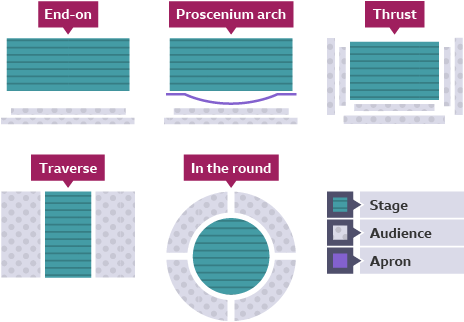
You will be asked four multiple choice questions on theatre roles, stage configurations, and stage positions.
4 multiple choice questions.
Upstage Right | Upstage Centre | Upstage Left |
Centre Stage Right | Centre Stage | Centre Stage Left |
Downstage Right | Downstage Centre | Downstage Left |
Theatre roles and what they do:
Playwright: Writes the script.
Understudy: Learns the part so they can take over a role for an absent actor.
Performer: Acts.
Set designer: Designs the set and oversees the set creation.
Costume designer: Designs the actor’s clothing and ensures all costumes fit.
Lighting designer: Designs the lighting states and effects (creates lighting plot).
Sound designer: Designs sound required and considers amplification (creates sound plot).
Puppet designer: Designs puppets and style.
Stage manager: Runs backstage elements — for example rehearsal schedules, lists of props and technical needs, prompt book, and calling cues.
Theatre manager: Runs the building, e.g. box office.
Technician: Operates all technical equipment.
Director: Oversees the creative process — directing actors, liaising with designers, giving notes for improvement.
Section B.1: 5 minutes
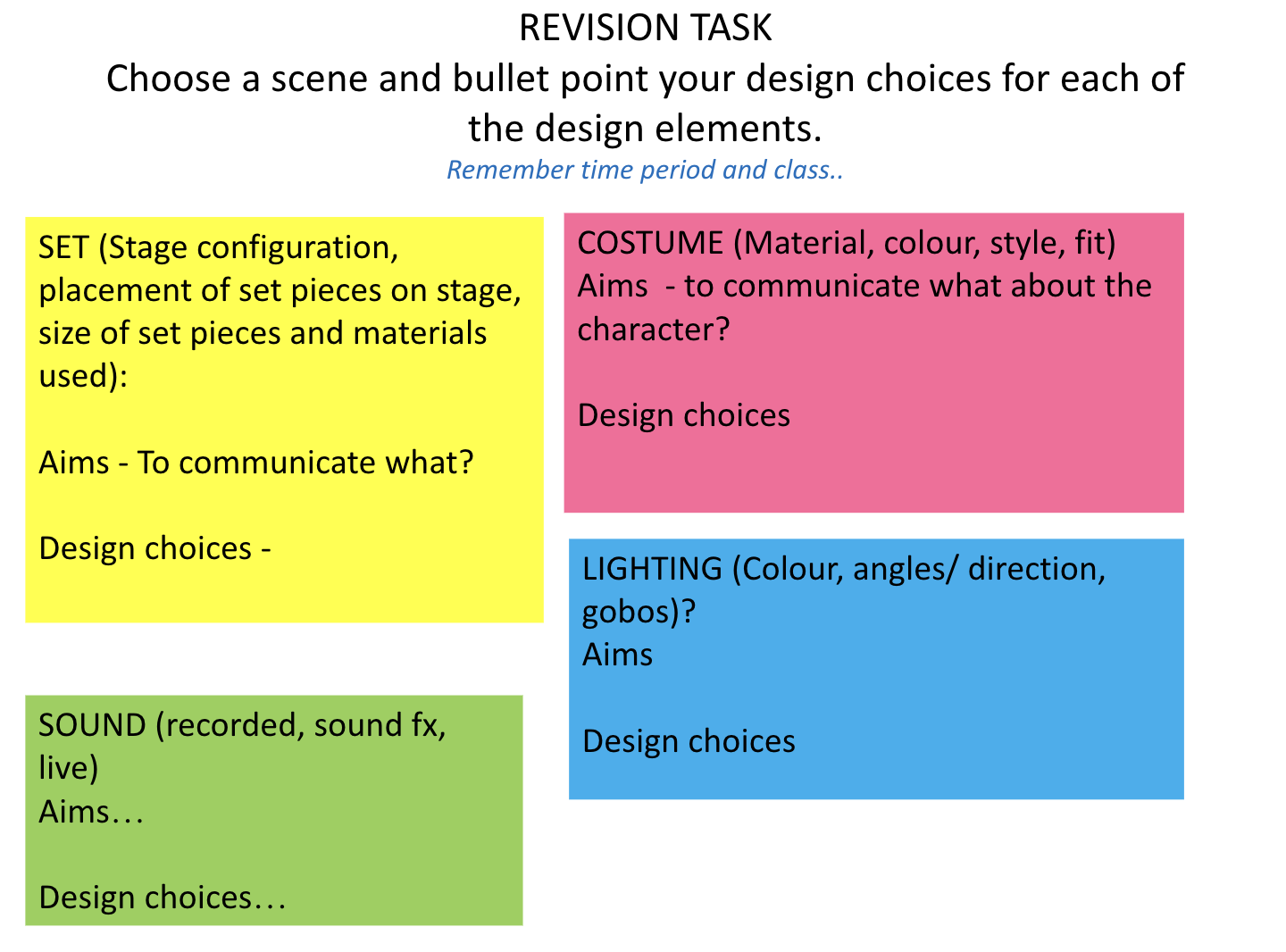
Blood brothers Q1 - Design (4 marks).
1 paragraph.
Re-read the play. Revisit your designs and notes. The question will either be costume, set, lights or sound. You will NEVER have to describe all of the design elements. Remember, you only have to describe, you do not need to justify.
Characteristics of the play you have to consider in this question:
The themes and message of the play.
Scenes flow into one another with limited gaps/ blackouts.
The action often takes place in a variety of places in the course of many short scenes, which would require a composite set (a set made up of several elements).
The performances are ensemble style, with actors being involved in multi-role and scenic changes.
Time period - play spans 1950’s - 1980s.
Lighting and sound may be used to suggest mood or setting.
Some set and props are described in stage directions.
Keep your ideas simple with a few ‘clever’ concepts.
Make sure your ideas fit with the style of the play.
Consider the practicalities of your design – e.g. if Mrs Johnstone is in a full costume for one scene, can she change into a completely different full costume for the next?
Make sure your design is specific to the extract – it doesn’t need to mention other scenes.
Keep explanations and context short and simple (if they are needed at all).
Section B.2: 10 minutes
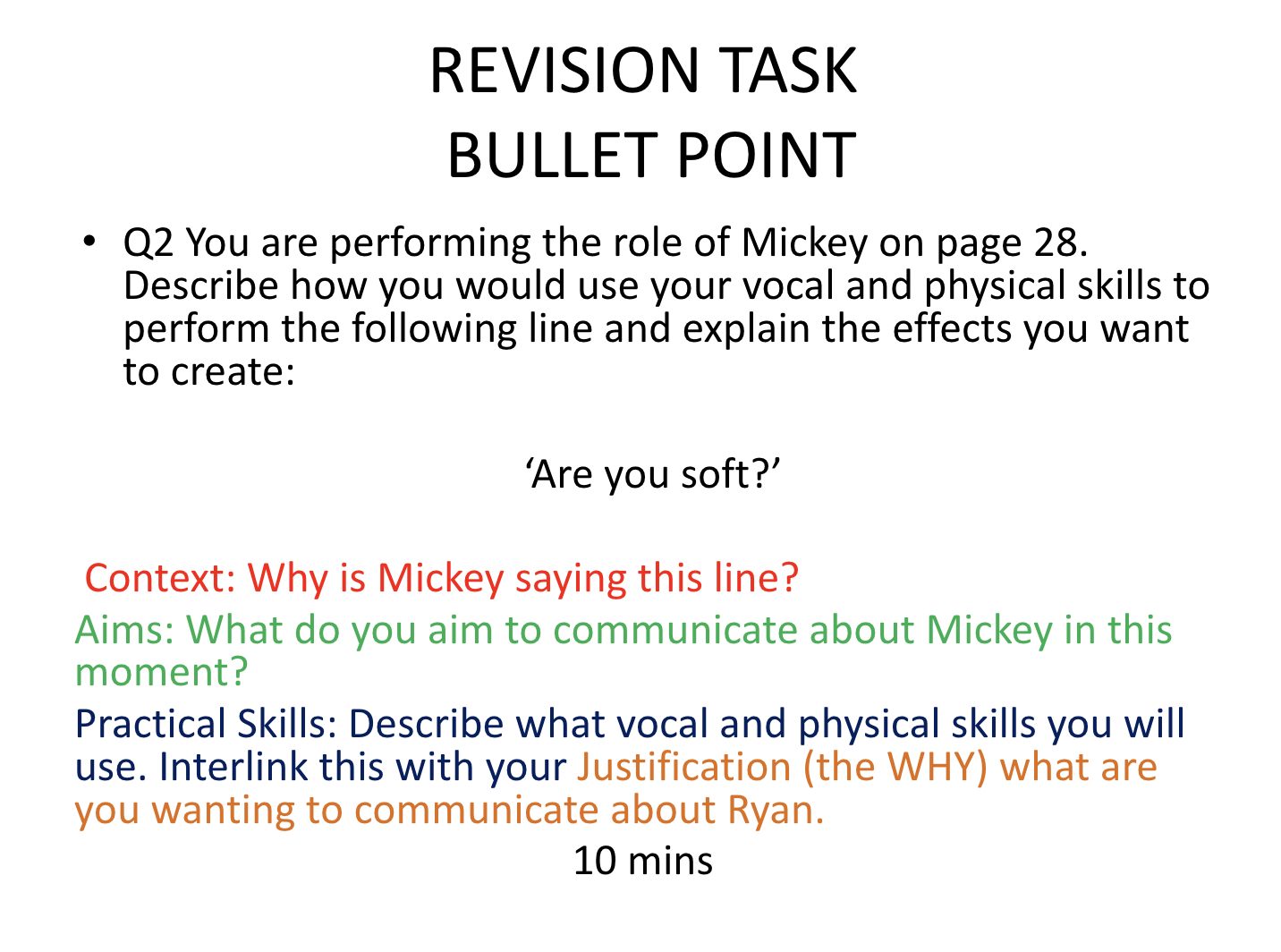
Blood brothers Q2 - How would you perform this line vocally and physically?
Intro is your context and aims and then one paragraph.
Practice by choosing random lines from the play and try describing how you would deliver the line and justify your reasons why. Go through the drama terminology (create flashcards for vocal and physical terminology – pace, pitch, manner etc).
Include aims for the character that you are playing – what do you aim to show about how they are feeling?
How to respond to this question with CAPJ:
Context: Why is ___ saying this line?
Aims: What do you aim to communicate about your character in this moment?
Practical Skills: Describe what vocal and physical skills you will use. Interlink this with your reasoning.
Justification: What are you wanting to communicate about your character?
Keep your introductions short and relevant to the section that you are talking about. Keep the context brief.
Section B.3: 20 minutes
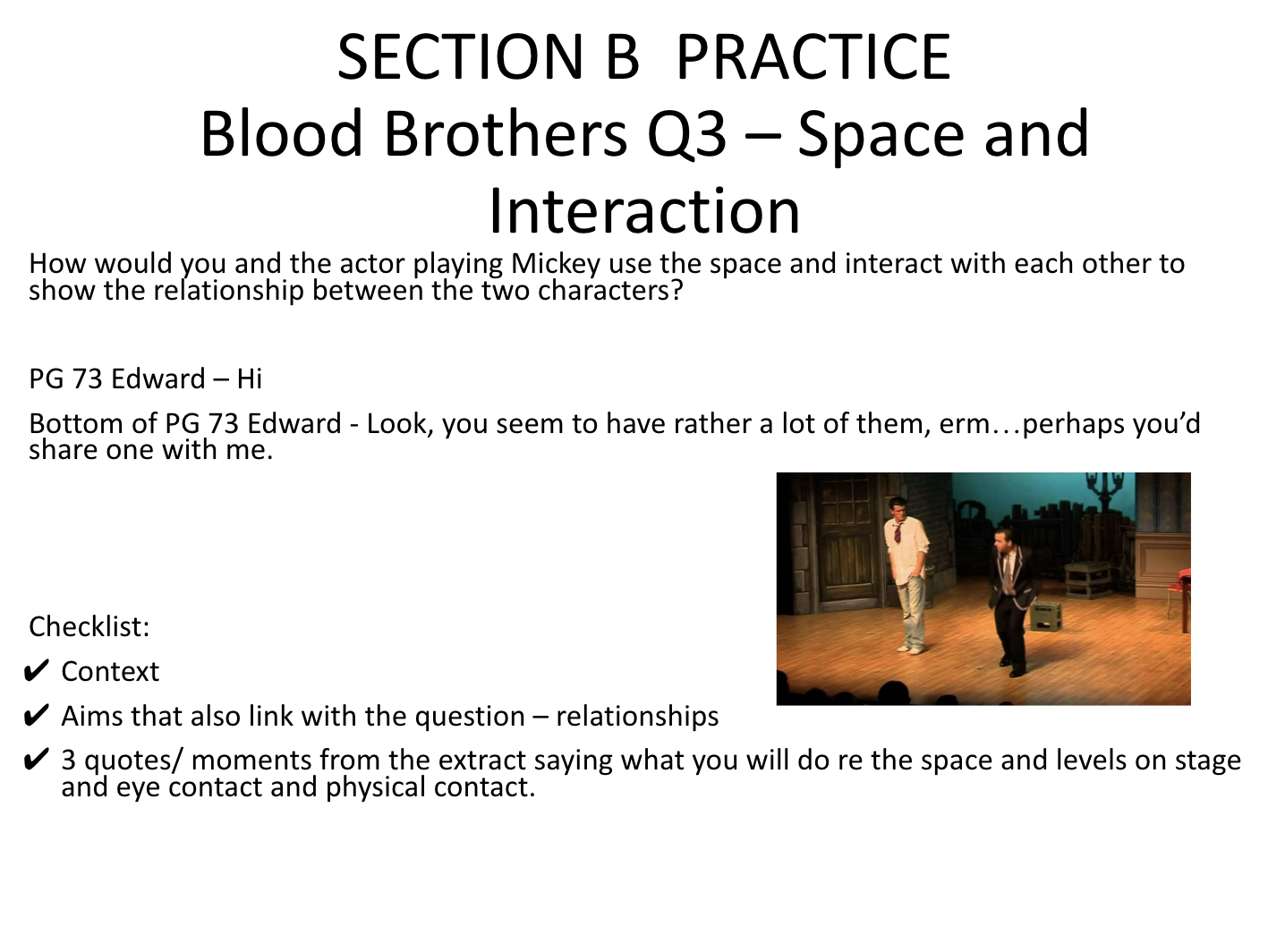
Blood brothers Q3 - Space and interaction.
Introduction is context and aims and then 3 short paragraphs.
Practice by choosing a random extract from the play and choose 3 moments from that extract. Try describing your use of space, eye contact and physical contact with the other actor(s) in the scene for each of the 3 moments and justify why.
State where you are on the stage and whether sitting/standing etc, and focus on use of space on the stage and space between each character.
Only refer to voice and physicality towards the other character.
How to respond to this question:
Read the question – it asks you to consider the motivations of both you as your character and the actor playing another character.
All suggestions should be about space and interaction – e.g. if you are talking about a character’s voice or facial expression, it should be directed at the other person.
Use stage directions in your suggestions.
Consider how your set can be moved around – e.g. tables and chairs.
Consider what has happened previously in the extract and how this would affect your ideas.
Look for important moments in the extract that might change the atmosphere or attitudes (e.g. mentioning another character).
Make sure that your suggestions are linked to exactly what is being said.
Section B.4: 30 minutes
Blood brothers Q4 - Character interaction.
Introduction and then 2-3 paragraphs. (Your introduction MUST be your interpretation of the character as a whole)
Go over the notes made in class. For each character create a timeline - what is their journey: where do they start at the beginning of the play and where did they end up? What are their key scenes? What are their key quotes? What is your interpretation of that character?
You must start with a line from the extract provided first, followed by at least one line from another moment in the play that either links/contrasts this.
Treat each paragraph as an 8 marker; finding a quote from elsewhere providing context and what you aim to show about the character — then describe how you will deliver the line.
How to respond to this question:
Begin with a clear and simple interpretation of the character that will be backed up with the points in your paragraphs.
Make sure you show an awareness of different sides to the character.
Your context can be incorporated into the justification for your interpretation of character – it needn’t be separate.
Begin your paragraphs with a link to the previous point, e.g. “In contrast to this…” or “this side can also be seen when…”
Name the other scenes and acts that you are referring to.
Try to cram in a range of practical ideas, then justify them (you don’t need to justify one by one) with a coat-hanger statement.
Try to give creative and considered practical suggestions that really reveal something about the character.
Other points:
It is not an English essay – you HAVE to include a range of practical ideas, not just character analysis.
Be definite – don’t say ‘I might / could’ but ‘I would’.
Tone – this means the attitude or emotion behind your voice (you can’t have a ‘quiet tone’, but you can have a ‘timid tone’).
Don’t use the word ‘gait’ unless you’re sure what it means!
Always start with describing where they are on stage & the physical, so the examiner can picture it clearly.
Be creative with your practical ideas – enjoy creating the picture of the moment in your heads!