CHEM 400 Exam 1
Week 1 Main Concepts
Early Atomic Theory
1807 - John Dalton aka “Father of Modern Atomic Theory”
All matter is made up of atoms. Atoms are the smallest particle that retain the identity of an element.
Element consists of only one type of atoms.
Atoms of one element differ from atoms of all other elements.
Compound is made up of 2 or more types of atoms combined in small, whole number ratios.
Atoms are neither created nor destroyed, but rearranged. Conservation of mass.
Law of Definite Proportions: same compound always has the same composition
Law of Multiple Proportions: same elements can combine in different ratios to make up different compounds
Modern Atomic Discoveries
J.J. Thomson discovered electrons.
Robert Millikan obtained the charge of electrons
Rutherford’s gold foil experiment
Atoms are mostly empty space
Nucleus is small, very heavy, and positively charged
James Chadwick discovered neutrons
A = mass number, sum of protons and neutrons
Z = atomic number, number of protons
AzSy - standard isotopic notation
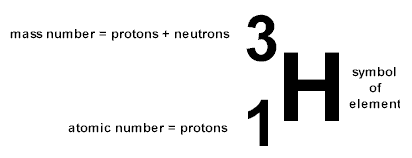
Isotopes: atoms of the same element with different number of neutrons
Average mass of an element is calculated by averaging all the masses of the isotopes and weighing them by their relative percent abundance in the universe.
Periodic Table
Metals v. nonmetals
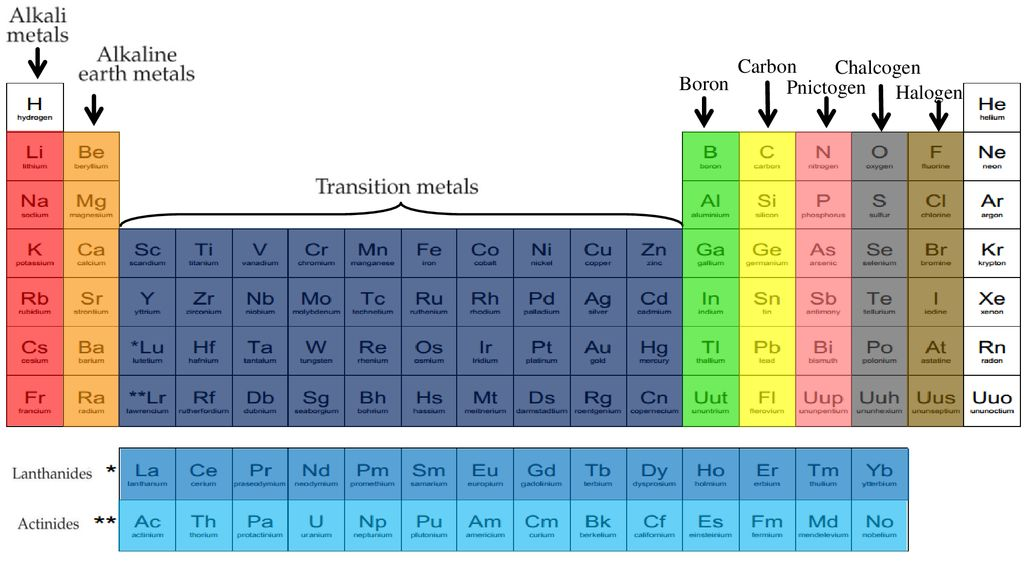
Main group elements v. transition elements
Families are the vertical columns
Family 1 - Alkali
Family 2 - Alkali earth metals
Family 15 - Pnictogens
Family 16 - Chalcogens
Family 17 - Halogens
Family 18 - Noble gases
Lanthanides and actinides
Nomenclature of Ionic Compounds
Metal first, nonmetal second
Positive ion first, negative ion second
The sum of all charges on all ions must be zero
Parentheses are used when a polyatomic ion is needed more than once
Nomenclature of Molecular Compounds
Nonmetal followed by a nonmetal
Use prefixes to indicate the number of atoms present in the compound.
Mono = one
Di = two
Tri = three
Tetra = four
Penta = five
Hexa = six
Hepta = seven
Octa = eight
Nona = nine
Deca = ten
Week 2 Main Concepts
Nomenclature
Ionic Compounds
Metal + nonmetal
Cation + anion
Naming ionic compounds
Binary - have only two types of atoms
Ternary - contain a polyatomic ion
All charges must add up to zero
Molecular compounds
All nonmetals
Naming Binary Molecular compounds
First element + second element ending in -ide
Use prefixes: mono, di, tri, tetra, penta, hexa, hepta, octa, nona, deca
Moles
NA = 6.022 × 1023 = Avogadro’s number
Molar mass = mass of 1 mole of particles
Periodic table always reports mass of one moles of atoms
Formula mass is the sum of all masses making up the formula
Converting between grams, moles, number of formula units, number of specific atoms if a formula is given.
% composition
Week 3 Main Concepts
Moles
NA = 6.022 × 10²³
Molar mass = mass of 1 mole of particles
Periodic table always reports mass of one moles of atoms
Formula mass is the sum of all masses making up the formula
Converting between grams, moles, number of formula units, number of specific atoms if a formula is given.
% composition
Empirical/molecular formula
Molarity = mol/L
Stoichiometry
Molar relationships between different substances in a balanced equation.
Mole-mole stoichiometry problems
Mole-mass stoichiometry problems
Mass-mass stoichiometry problems
Limiting reagent problems
Actual yield: the amount of product that is realistically made in a lab setting
Theoretical yield: the amount of product that can be calculated on paper
Percent yield: (Actual/Theoretical) x 100%
Double Replacement Reactions
AX + BY —> AY + BX
Acid base neutralization reactions are double replacement reactions.
Precipitation reactions are double replacement reactions.
Solubility rules
Chemistry History
John Dalton aka “Father of Modern Atomic Theory”
All matter is made up of atoms. Atoms are the smallest particle that retain the identity of an element.
Element consists of only one type of atoms.
Atoms of one element differ from atoms of all other elements.
Compound is made up of 2 or more types of atoms combined in small, whole number ratios.
Atoms are neither created nor destroyed, but rearranged. Conservation of mass.
Law of Definite Proportions: same compound always has the same composition
Law of Multiple Proportions: same elements can combine in different ratios to make up different compounds
Robert Millikan obtained the charge of electrons through the Oil Drop Experiment.
Rutherford’s Gold Foil Experiment: discovers nucleus and protons
Alpha particles through gold foil.
Most alpha particles travel through the foil undetected
Atoms are mostly empty space
Some alpha particles are deflected by small angles
Nucleus is small, very heavy, and positively charged
Occasionally, an alpha particle travels back from the foil
The nucleus carries most of the atom’s mass
James Chadwick discovered neutrons.
J.J. Thomson discovered electrons.