CHEM100 Chapter 1 Flashcards
Section 1.1: The Scientific Method
Definition: The scientific method is a repetitive and refined process involving the formulation of questions arising from observations, careful design of experiments, and thoughtful analysis of results.
Core Purpose: It involves identifying ways to test the validity of new ideas, and rarely is there only one way to go about it.
Main Elements of the Scientific Method
Observation:
Systematically recording natural phenomena using descriptions or measurements.
Hypothesis:
Proposing a testable explanation based on prior knowledge and observations.
Experiment:
A controlled procedure to test the hypothesis that isolates variables.
Involves changing one variable at a time.
Incorporates background research, personal experiences, determining variables, and determining accuracy and precision.
may not actually lead to a conclusion, may lead to another hypothesis, to another experiment, etc.
Conclusion:
A summary of the experiment that explains what the results show.States whether the data support or do not support the hypothesis.
Uses evidence from the data to justify the claim.
Theory:
A well-supported scientific explanation of natural phenomena based on repeated experimental evidence.
A theory is not a guess and does not become a law.
It can be revised as new evidence is discovered.
Report the Results:
The process of communicating experimental findings using graphs, tables, written reports, or presentations.
Section 1.2: Measurements and SI Units
Importance of Units:
Chemistry is an experimental science that relies heavily on precise measurement.
Ensures reproducibility across experiments.
Enables accurate measurement of physical quantities.
Serves as a global chemistry language.
Practical Context: Cookie Baking Exploration Example
Scenario: A friend texts: "Use 3 for the flour, 1 for the sugar and bake it at 350 for 10."
Missing Information: Specific units of measurement (e.g., cups, grams, or tablespoons for ingredients; degrees Fahrenheit vs. Celsius for temperature; minutes vs. hours for baking time).
Risks: Omitting units is dangerous or disastrous because improper proportions or heating parameters result in ruined recipes, inedible food, or physical kitchen hazards.
The International System of Units (SI System)
Established in 1960 as the Système Internationale d’Unités.
Comprises seven fundamental base units.
Guarantees standardization and consistency across global scientific research.

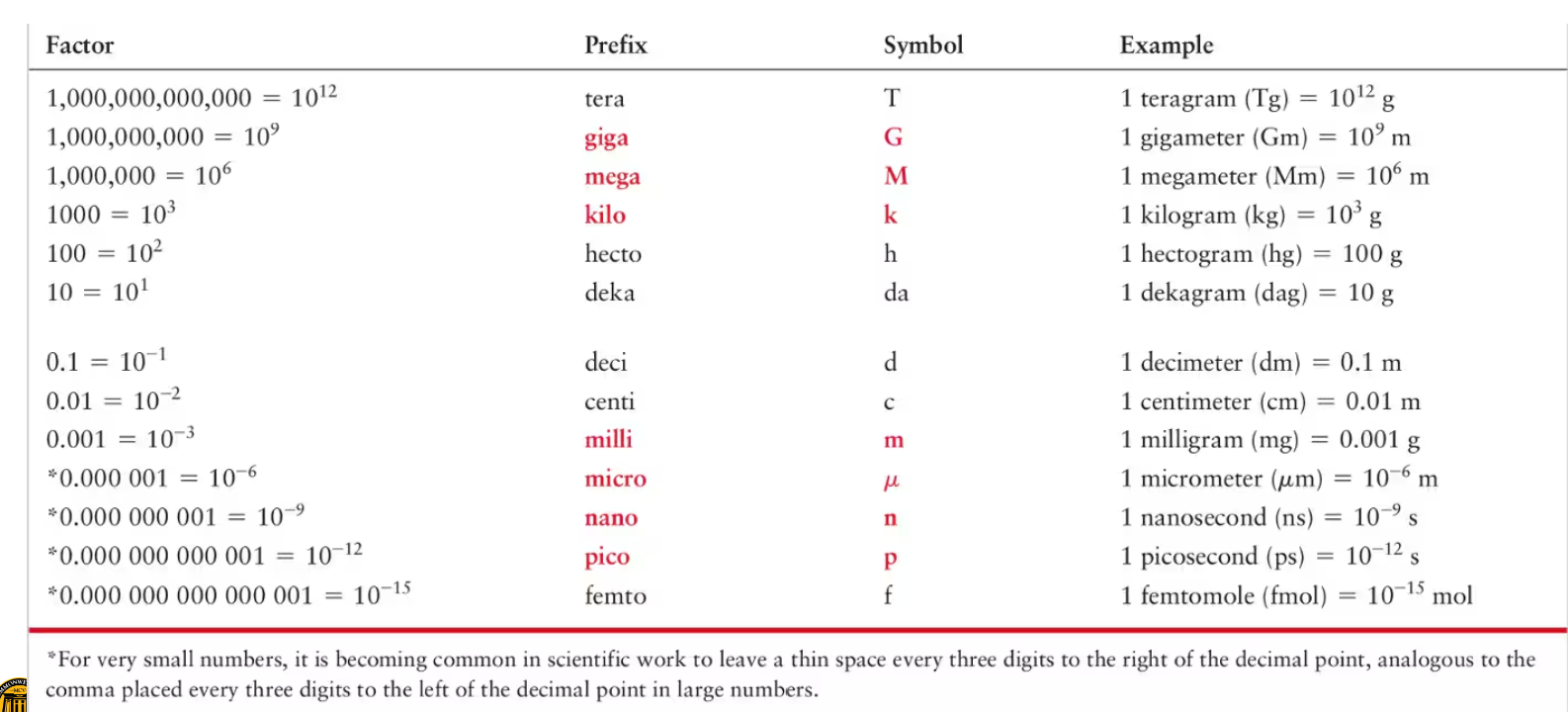
Metric Prefixes and Conversion Standards
Multiples and Submultiples of SI Units (Table 1.2)
Tera:
Prefix: tera
Symbol:
Factor:
Example:
Giga:
Prefix: giga
Symbol:
Factor:
Example:
Mega:
Prefix: mega
Symbol:
Factor:
Example:
Kilo:
Prefix: kilo
Symbol:
Factor:
Example:
Hecto:
Prefix: hecto
Symbol:
Factor:
Example:
Deka:
Prefix: deka
Symbol:
Factor:
Example:
Deci:
Prefix: deci
Symbol:
Factor:
Example:
Centi:
Prefix: centi
Symbol:
Factor:
Example:
Milli:
Prefix: milli
Symbol:
Factor:
Example:
Micro:
Prefix: micro
Symbol:
Factor:
Example: 1\,\text{micrometer (\mu m)} = 10^{-6}\,\text{m}
Nano:
Prefix: nano
Symbol:
Factor:
Example:
Pico:
Prefix: pico
Symbol:
Factor:
Example:
Femto:
Prefix: femto
Symbol:
Factor:
Example:
Scientific Formatting Standard for Small Numbers
For extremely small numbers, modern scientific practice leaves a thin space every three digits to the right of the decimal point (e.g., ).
This convention is directly analogous to inserting a comma every three digits to the left of the decimal point in large numbers.
Visualizing Prefixes and Scale Conversions
Measurement Matching Exploration
Height of a tree: (meter)
Distance between two cities: (kilometer)
Length of a virus: (nanometer)
Mass of a car: (kilogram)
Scientific Notation
Primary Functions of Scientific Notation
Simplifies very large or very small numerical values.
Streamlines mathematical calculations.
Prevents errors associated with miscounting zeros.
Expresses measurement units clearly and consistently.
Practice Problems
Problem 1: The average distance from the Earth to the Sun is about . Write this distance in scientific notation.
Solution:
Problem 2: Light from the Sun takes about to reach Earth. Rewrite this time in scientific notation.
Solution: (or )
Problem 3: A single human red blood cell is about in diameter. Express this length in scientific notation.
Solution:
Section 1.9: Accuracy, Precision, and Significant Figures
Determinants of Measurement Quality
Skill of the Individual: The analytical technique and proficiency of the person performing the experiment (e.g., general laboratory measurements).
Reliability of Equipment: The calibrated quality and inherent precision of the instrument being utilized (e.g., weight measurement instruments).
Fundamental Principle: There is always some degree of uncertainty in the value of any physical measurement.
Key Concepts in Measurement Uncertainty
Accuracy: Indicates how close a given measurement is to the true or accepted value.
Precision: Indicates how well a series of independent measurements agree with one another.
Measurement Evaluation Example
Sample: A tennis ball with a true mass of .
Testing Procedure: Take three independent mass measurements across three distinct types of balance instruments to evaluate accuracy and precision.
Standard Rule for Expressing Measurement Uncertainty
To properly indicate uncertainty in a physical measurement, the recorded value must contain all digits that are known with certainty plus one final digit that is estimated.