The Crisis of Democracy and Democratic Backsliding - Lecture 3c
Democracy in Crisis
Democracy is seemingly in decline, found to be for reasons as such:
→ Members of the public do not care to be involved with politics and find dissatisfaction in democratic regime
→ Members of the public are not knowledgable, educated on politics or considered politically literate
→ Trust declination in politicians and government involvement
→ The amount of actors who does not stay accountable to their promises but also to their own government is increasing, meaning political representation is ineffective
→ Increase in government plans, arrangements, and processes that aren’t transparent to both public and other branches of government, and are not accountable to either.
Democracy as a regime also faces some challenges to do with its theory and its application. These are as follow:
→ Contextual
This is to do with globalisation and any foreign affairs
→ Intrinsic Threats
Ways to control society can be broken down and distanced from traditional methods
Any political authority that may be representing society could be turned on and considered and illegitimate form
Government cannot perform effectively to the demands it receives
→ Societal
Pressures on trends and structures within society
Inequality can arise economically
Members of the public have contrastingly different political viewpoints creating distrust in representation as it does not meet their own viewpoint
Distrust in democracy as a political regime
Own views, values, ideals, and beliefs take forefront
What is a Crisis?
Crises are situations that must be solved and must be solved quickly. They are the type of situations that are on a deadline to be fixed due to the impact it could have if not. The level of impact is dependent on what type of crisis it is, whether acute or chronic, one lasting a short while and one lasting long term, respectively.
When a democracy is in crisis though, signs that often present itself are as follow:
→ Loss of engagement and support for political parties
→ Loss of confidence from public in the government and institutions that follow the democratic regime
→ Open conflicts about the democratic institutions emerging
→ Government cannot maintain order within society without repressing their own democratic powers / institution.
Although, like all situations, aspects, and topics to do with democracy, how it is actually defined will mean a different viewpoint. Therefore, one can only be able to diagnose democracy to be in a crisis depending on what their definition actually is. One viewpoint could see democracy declining and the other could see it improving.
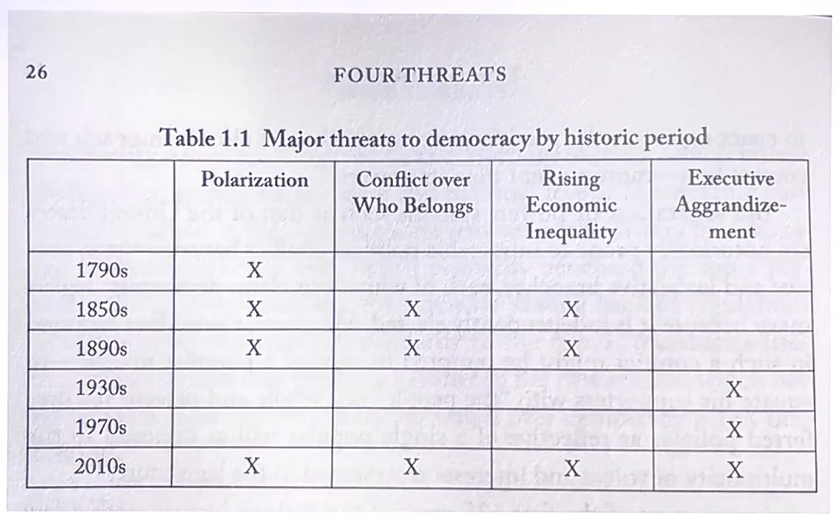
What does Democratic Backsliding Look Like?
Democratic backsliding (or decline) can be seen through the following factors / situations appearing, ranging in speeds, methods, and processes:
→ Executive Aggrandisement
Happens slowly and gradually without any need for replacement in the executive branch
More common form of democratic decline / backsliding
Arises when heads of the executive fail to stay accountable to the executive branch and its powers one by one
This results in changes institutionally and can restrict the opposition party from keeping executive accountable
→ Promissory Coups
The framing of the process of removing the elected executive head from their position
Happens in justification of improving and stabilising democratic legality
Plans and promises to the public to hold elections again and reestablish democracy as it should be
→ Strategic Electoral Manipulation
The process of influencing the electoral playing field in order to be more advantageous towards those who are currently in power, without making it seem fraudulent in any way, which is done by:
Controlling the media in terms of access and what is broadcasted
Employing the government budget to market towards the current leader
Harassing the opposition and ensuring they cannot be voted for
Rigging voting regestrations
Redesigning electoral districts so one candidate gains more votes than the other
Replacing electoral laws with new ones to suit the incumbents
Happens before polling day and does not include any overt law violations
Intentionally does not get the attention of international and national observers to criticise and call them out
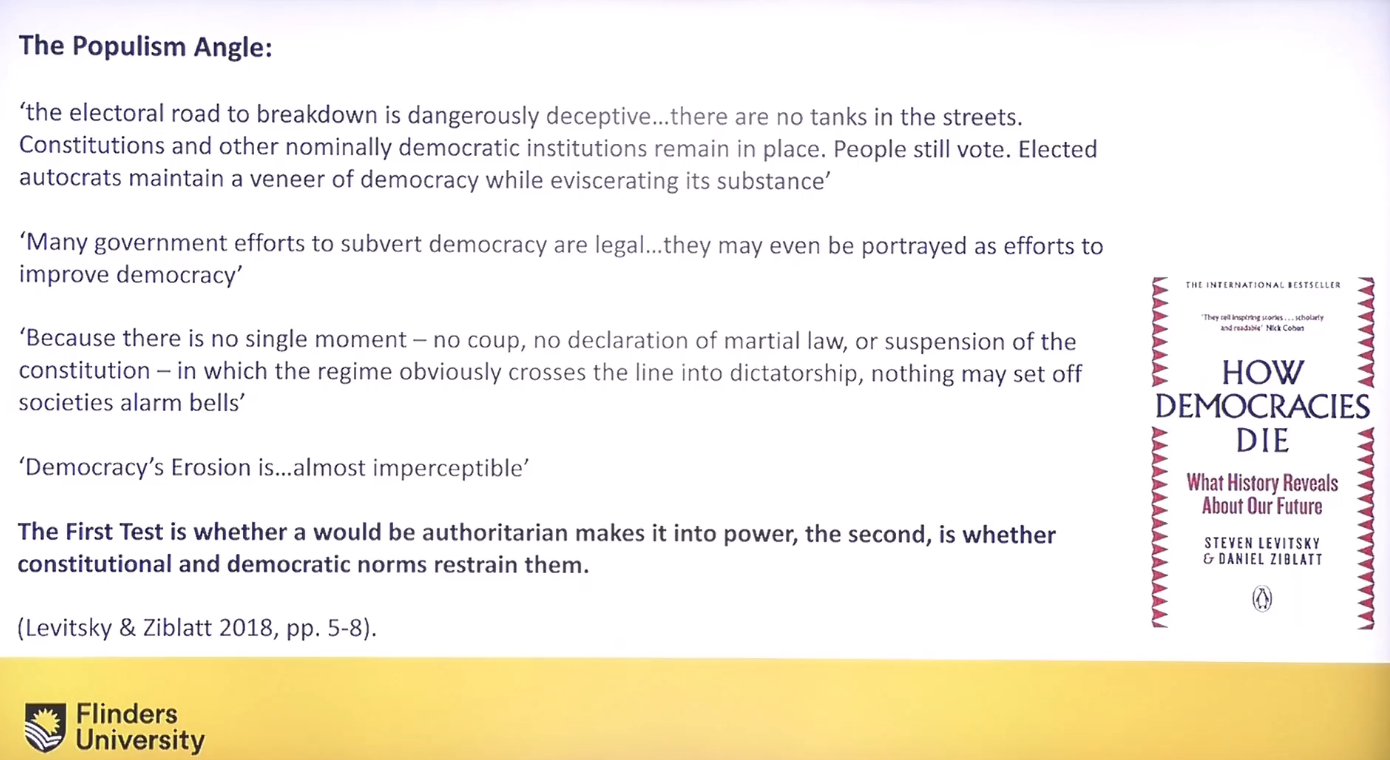
The Populism Angle
Populists are well-known to be anti-pluarlist and anti-establishment, so when pluralists attempt to get into government, they will often take democratic backsliding methods seen above to do this. However, the public view on them can be two-sided; either favoured or not by members of the public.
Most democratic backsliding is done covertly, to not alert the attention of the public and make them aware of the changes but enough change so the democracy slowly loses some characteristics and becomes more autocratic. Such procedures to become more autocratic may even look like ones that can improve the democratic political state of the country. If someone who is authoritarian makes into the executive head, its a challenge to see whether the structures and foundations of a constitution-led and democratic state could actually restrain the authoritarian successfully.
For a democracy to reach autocracy, it will go through three stages:
→ Mounting Citizens’ Discontent
→ Rising of Anti-Pluralist Ideologies
→ Complete Autocratisation
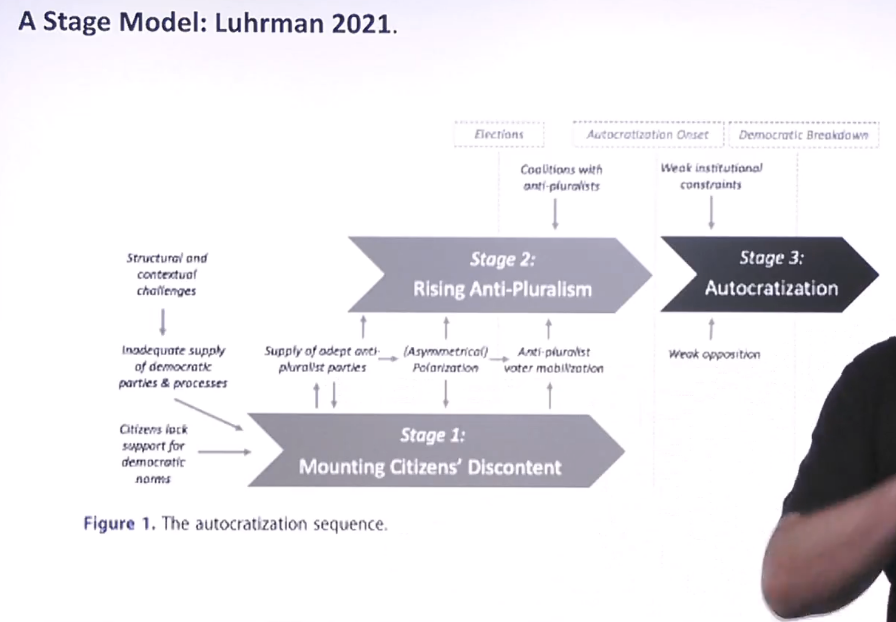
Autocratisation is when any democratic qualities within a regime may start to decline, weaken, and break down. This can happen within both democracies and autocracies.
Democratic Resilience
For a democracy to be resilient against autocratisation, it must have high feedback, engagement, trust, and belief by public of the democracy regime itself.
Three ways to strengthen democracy include:
→ Maintenance
Ensuring status quo of trust in democracy to stay and be reestablished
→ Marginality
Making slight changes to the democracy in order for it to be well-received
→ Renewal
Completing redoing, transforming, and reinvigorating the democracy institutions and establishment of the state.
Questions
How is the slide referring to the populism angle, the populism angle?
→