topic 8: atomic spectroscopy
Atoms are structured by their protons and neutrons sitting in the nucleus, and the electrons are dots in the orbitals. When we write out an atoms electron configuration, the state it is in naturally is called the “ground state,” because it is the lowest energy state electron configuration. All atoms have an infinite number of energy shells (n), but most of them are unoccupied. An electron that is very far from the nucleus (in an orbital with a really large value of n), feels very weak attraction to the nucleus, and has no binding energy. When n = infinity, the binding energy of the electron = 0 (when n = infinity, E = 0). The Rydberg equation gives us a way to calculate the energy of the orbital energy levels:

z: atomic number
n: shell number
We can use the Rydberg equation to calculate the energy levels for any value of n.
Note that electrons carry a negative charge, so the more binding energy they have/the closer they are to the nucleus, the more NEGATIVE the energy level is.
When comparing isoelectronic species, the electrons will be more tightly bound to the nucleus that has more protons. This means that the energy level for n = 1 will be more negative for a heavier atom than for a lighter atom (the species with the greater value of Z will have a more negative energy level).
Calculating energy differences
An electron can move up (excitation) or down (relaxation) energy levels by absorbing or releasing just the right amount of energy.

if deltaE = (+), then energy has been absorbed, and it was a process of excitation
if deltaE = (-), then energy has been released, and it was a process of relaxation
Note than when an electron relaxes, the energy is released in the form of a photon. The energy of the photon can be measured via spectroscopy. The energy of the photon is equal to the change in energy of the electron:

Wave properties
Light = EM radiation = energy travelling through space
Light acts like both a wave and a particle. Waves have: wavelength, frequency, and amplitude
wavelength (λ) is the distance between 2 consecutive peaks in a wave
measured in nm
frequency (v): the number of waves that pass a given point per second
1 hertz = cycle/sec
if λ changes, so does v. they are inversely proportional
amplitude (A): the height of the wave from the center line to the peak
intensity = (amplitude)2
speed of light (c) = 3E8 m/s. the speed of light is a constant for all waves in the EM spectrum, so the formula for the speed of a wave (c), is c = λv
Photons
The energy of light is proportional to its frequency.
The energy of light is inversely proportional to its wavelength
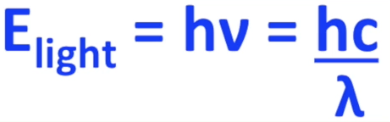
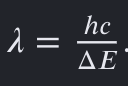
The wavelength (λ, in nm) of a photon is inversely proportional to the energy of a photon
h = Planck’s constant: 6.626 × 10⁻³⁴ J-s
Note that the larger the energy gap, the smaller the λ of the photon
Red light NEVER has enough energy to overcome the bonding of electrons and kick them out, releasing energy. Higher frequency light, such as blue light, does have enough energy to do so.
Photons in light: Light comes in little packets. More intense light means more packets, but each packet still has the same energy on its own. High intensity bright light is made up of very many photons
Line Spectra
The length of the wavelength may appear on the visible light spectrum. Light spectra tell us the wavelength of the photons being emitted as the electrons relax energy levels, and allow us to characterise and identify atoms.
In order to find the wavelength of the photon emitted, we need to…
identify which orbital levels we are moving between
calculate the energy of each relevant orbital level
find the difference in energy between the orbital levels (
use (see below) to calculate wavelength of photons
convert to nm if need be
Or, you can use a different expression to directly calculate ΔE without having to calculate the energy of the orbital levels first. Use this:

Always solve for the value in the parentheses first