ROCKET NOZZLE CONFIGURATION
Primary Groups of Nozzle Types:
1. Cone (conical, linear)
nozzle diverge at a constant angle
Small nozzle divergence - angles may allow most of the momentum to remain axial and thus produce high specific impulses, but they result long nozzles
Larger divergence angles give shorter, lightweight designs, but their performance may become unacceptably low.
theoretical correction factor 𝜆 must be applied to the nozzle exit momentum in any ideal rocket propulsion system using a conical nozzle.
half angle value of 15°
2. Bell (contoured, shaped, classic converging-diverging)
most commonly used nozzle
minimizes the turning divergence losses
shock losses
isentropic and produce a nearly axial flow at the nozzle exit
Near the throat*, 20 to 50 degrees
3. Annular (spike, aero-spike, plug, expansion, expansion deflection)
plug or altitude compensating nozzle
Annular – refers to the fact that its combustion occurs along a ring or “annulus”, around the base of the nozzle.
Plug – the center body that blocks the flow from what would be the center portion of a traditional nozzle.
Radial Outflow Nozzles - Exhaust gases are forced outward from a central chamber in a circular (radial) pattern
Expansion-Deflection (E-D) Nozzle
Reverse-Flow (R-F) Nozzles: Gases are redirected 180°
Horizontal-Flow (H-F) Nozzles: Gases are redirected 90°
Radial Inflow Nozzles • often referred as spike nozzle
External Expansion
Internal-External Expansion
Internal Expansion
Truncated aerospike nozzles:
Advanced Nozzles (Adaptive Designs)
1. Two-Step Nozzles
a. Extendible Nozzles
Key concerns here are reliable, rugged mechanisms to move the extension into position, the hot gas seal between the nozzle sections, and the extra weights involved. Its principal merit is the short nozzle length while stored
b. Droppable Insert Concept
It avoids any moving mechanisms and gas seals but has a potential stagnation temperature problem at the joint of the two segments.
c. Dual-Bell Nozzle Concept
uses two shortened bell nozzles combined into one with a “ring-shaped bump” or inflection point between them, as shown
Multiple Nozzle
Whenever possible, reducing nozzle length by replacing a single large nozzle with a cluster of smaller nozzles on liquid engines or solid motor units (with the same total thrust) will reduce vehicle length and often vehicle structure and inert mass.
Quadruple thrust chamber arrangements have been used effectively in several U.S. and many large Russian space launch vehicles and missiles.
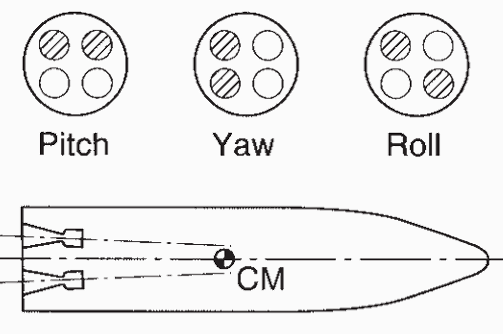
Multiple nozzles can be designed to provide thrust vector control.
The nozzle length of such a cluster can be about 30% shorter than a single nozzle
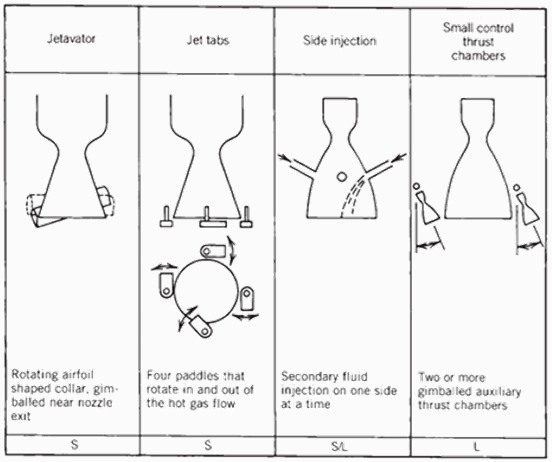
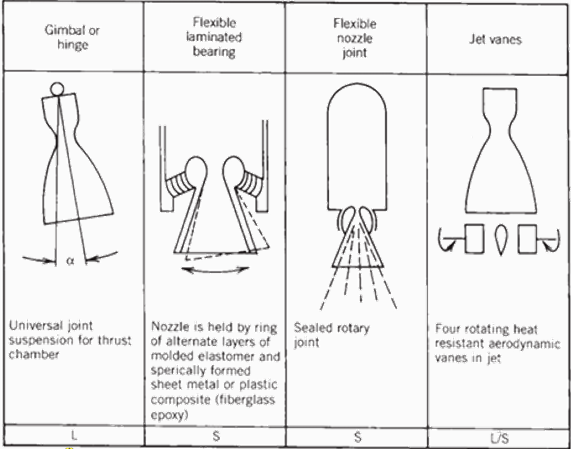
THRUST VECTOR CONTROL (TVC) MECHANISMS
The letter L means it is used with liquid propellant rocket engines.
S means used with solid propellant motors