9) New Economic Policy - NEP
War Communism
Harsh economic measures during Civil War to survive.
Two main aims:
Implement communist theory by redistributing wealth.
Support the war by supplying towns and Red Army with food and weapons.
Government took control of all large factories.
Vesenkha (Supreme Economic Council) planned and organised production.
Strict discipline: workers who struck could be shot.
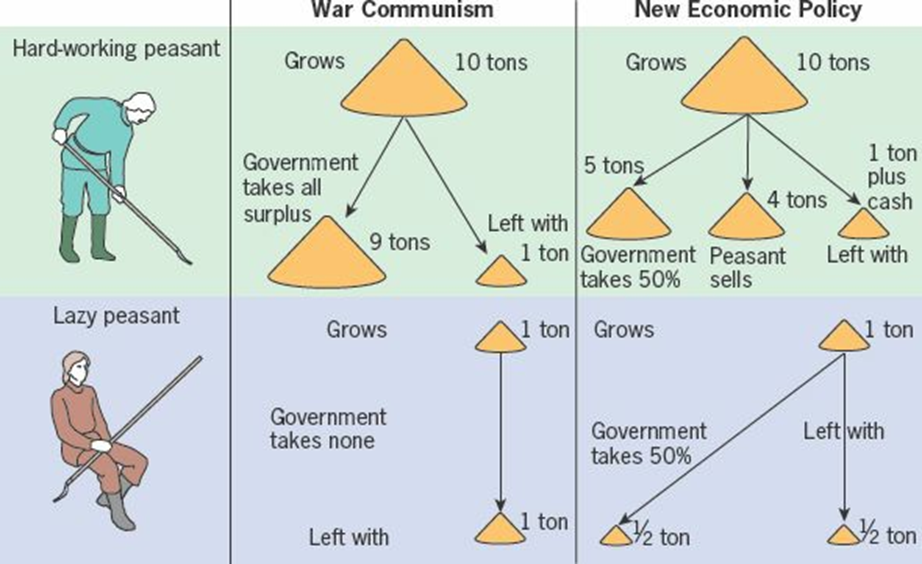
Peasants forced to hand over surplus food; refusal = execution.
Food rationed; free enterprise illegal; all production and trade state-controlled.
Caused severe hardship: by 1921, industrial output = 1/5 of 1913 levels; currency collapsed, bartering common.
Peasants resisted, leading to food shortages and famine; ~7 million died, reports of cannibalism.
War Communism was the harsh economic system the Bolsheviks used during the Civil War to redistribute wealth and keep the Red Army supplied. Factories were nationalised and production planned by Vesenkha. Workers faced strict discipline, and peasants had to hand over surplus food or risk execution. Free enterprise was banned, and food was rationed. While it helped win the war, it caused terrible hardship: industrial output fell drastically, currency collapsed, peasants resisted, and famine killed millions.
SOURCE 1:
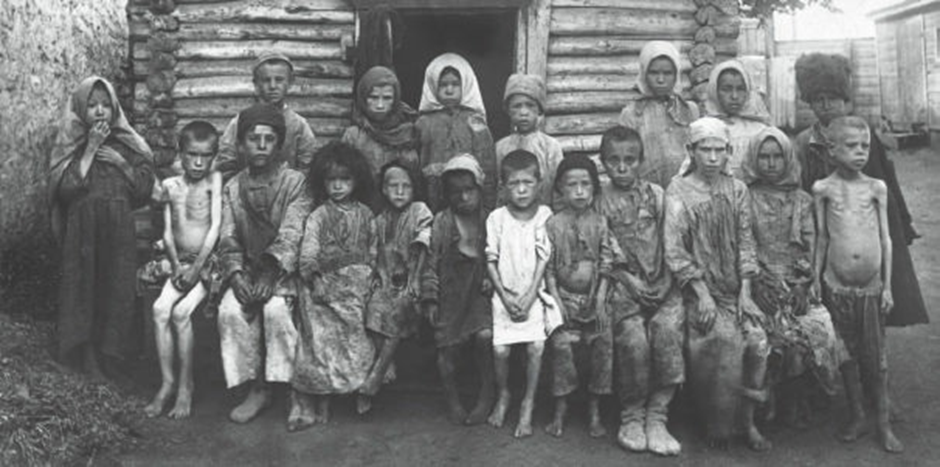
Why do you think this photograph was taken and published in 1921?
government
show peasants what the result on newspaper
raise awareness; scale of suffering
put pressure on government or international community for aid.
Kronstadt Rising
Kronstadt sailors were strong Bolshevik supporters during the revolution and Civil War.
By 1921, concerned about harsh Bolshevik policies affecting ordinary Russians.
Passed a resolution with 15 demands:
New elections
Freedom of speech
Equal rations
End militia units taking peasant grain
Lenin claimed it was a White plot and demanded surrender.
Trotsky’s forces attacked in early March; thousands killed, executed, or imprisoned.
Showed Lenin that even his strongest supporters could rebel, prompting consideration of concessions.
The Kronstadt sailors, once loyal Bolsheviks, rebelled in 1921 over harsh policies, demanding reforms like new elections, free speech, equal rations, and an end to grain seizures. Lenin labelled it a White plot, and Trotsky’s forces crushed the uprising, killing or imprisoning thousands. The revolt alarmed Lenin because it showed even his most loyal supporters could turn against him, highlighting the need for concessions.
→ Why do you think Lenin was more worried about the revolt of the sailors than about starvation among the peasants?
Lenin was more worried about the sailors than peasants because the sailors had been key supporters during the revolution. Their rebellion could inspire others, including workers and soldiers, to turn against the Bolsheviks, posing a direct threat to his power. Starving peasants were harder to organise into an immediate threat.
The New Economic Policy (NEP)
Introduced by Lenin in March 1921 at the Party Congress.
Reintroduced limited capitalism in Russia.
Peasants could sell surplus grain for profit.
Tax replaced compulsory grain seizure by the government.
In March 1921, Lenin introduced the NEP, allowing limited capitalism. Peasants could sell surplus grain for profit and pay a tax instead of handing it over to the government, easing tensions after War Communism.
SOURCE 2:
Our poverty and ruin are so great that we cannot at one stroke restore large-scale socialist production … we must try to satisfy the demands of the
peasants who are dissatisfied, discontented and cannot be otherwise … there must be a certain amount of freedom to trade, freedom for the small
private owner. We are now retreating, but we are doing this so as to then run and leap forward more vigorously.
Lenin, introducing the NEP at the Party Congress, 1921.
FIGURE 1:
SOURCE 3:
Poor, starving old Russia, Russia of primitive lighting and the meal of a crust of black bread, is going to be covered by a network of electric power
stations. The NEP will transform the Russian economy and rebuild a broken nation. The future is endless and beautiful.
Bukharin, speaking in 1922. He was a leading Bolshevik and a strong supporter of the NEP.
Continuation - The New Economic Policy (NEP)
Small factories returned to private ownership; small-scale trade allowed.
Beneficiaries of NEP called NEPmen.
Heavy industries (coal, oil, iron, steel) remained under state control.
Many Bolsheviks opposed it as a betrayal of communism, but Lenin pushed it through.
Implemented from 1921; by 1925, food production had risen significantly.
Industrial workers did not necessarily benefit from production increases.
Under the NEP, small factories and trade returned to private hands, benefiting the NEP men, while heavy industries stayed state controlled. Many Bolsheviks opposed it, but Lenin insisted. From 1921, it improved food production by 1925, though industrial workers saw limited benefits.
FIGURE 2:
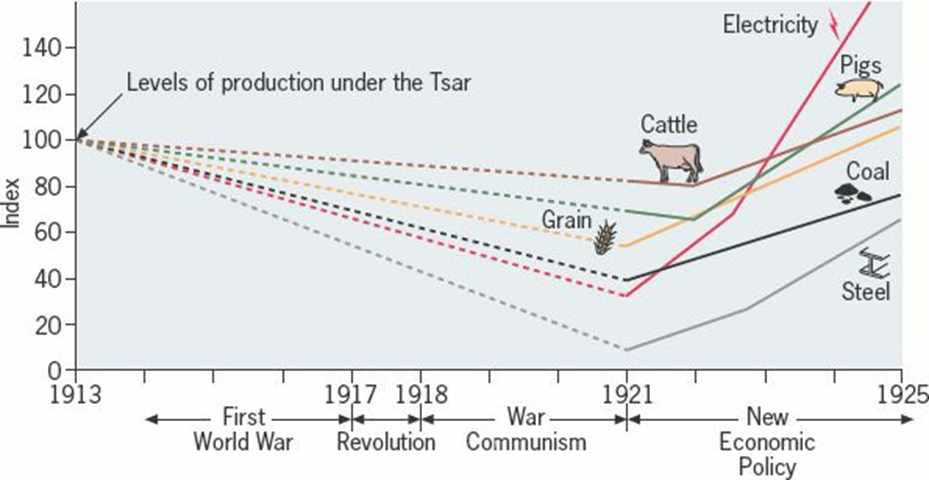
Do the above sources and figures indicate that the NEP was a success?