Love
Love evolves, bends, adapts and grows to meet the changes in our lives and relationships
Its important to consider whether we actually were in love or if you evolve to realise you thought you were but you actually weren’t
Why should we care about close relationships:
Greater physical and mental health
Greater resilience
Greater wealth
Faster recovery from illness
Greater longevity
Hatfield’s passionate vs compassionate love:
Elaine Hatfield, two types, passionate and compassionate love
Passionate love:
“A state of intense longing for union with another person, accompanied by physical arousal” (Hatfield,1988)
Includes the tendency to think obsessively and to idealize the object of love
Reciprocated love is associated with fulfillment and ecstasy
Unrequited love is associated with anxiety, emptiness and despair
Transient form of love- not permanent or lasting
Companionate love:
“The affection and tenderness we feel for those with whom our lives are deeply entwined” (Hatfield & Rapson, 1993)
Combines feelings of attachment, trust, commitment and intimacy
Can be present within nonsexual relationships- close friendships
Also present within sexual relationships- psychological intimacy without ‘heat’ and passion
Passionate and companionate love are not mutually exclusive
Passionate love may evolve into companionate love over time
Passionate love scale (PLS), Hatfield and Sprecher, 1986):
Cognitive components: intrusive thinking, preoccupation with partner, idealization of the other or the relationship
Emotional components: attraction, positive/negative feelings, longing for reciprocity, physiological (sexual arousal)
Behavioral components: actions aimed at determining the other’s feelings, service to the other, maintaining physical closeness
Good psychometric properties
Studies using PLS:
Cross cultural differences in passionate love (Hatfield and Rapson, 2005)
Neural bases of passionate love (Aron et al, 2005)
Changes in passionate love over the family life cycle (Tucker and Aron, 1993)
Degree of bonding with an abusive partner (Graham et al, 1995)
Effects of having married couples engage in novel activities (Aron et al, 2000)
Over the period of time, passionate love may turn into componiate love
Three factor theory of love, (Hatfield and Walster, 1981):
Suggests for love to occur, 3 components must be present:
Cultural exposure- how love is experienced, how your culture influences your perception of love
Physiological arousal- sweaty palms, heart racing, how you feel
Appropriate love object- having someone you find very attractive and fits your concept of an ideal partner.
These all lead to romantic love and this framework has helped to understand the dynamics of love and attraction
Arousal and attraction on a shaky bridge,(Dutton and Aron, 1974):
Misattribution of arousal effect, based on Dutton and Aron (1974) ‘shaky bridge’ study in social psychology
People sometimes misinterpret physiological arousal eg fear, anxiety as romantic or sexual attraction
If someone is already aroused, you may attribute that arousal to a person you encounter rather than to the true cause
Shaky bridge study highlights how attraction can be influenced by context induced arousal and not just the person themselves
Culture and love:
Love is a universal emotion (emotion thought to exist in all cultures and all in historical eras)
Cultural differences can vary within love eg passionate love is viewed as more crucial in individualistic cultures compared to collectivist
However companionate love is more preferred in collectivist (Gao, 1993, Jankowiak, 1995)
In some cultures, passionate love is a pre condition and highly valued and prioritized when selecting a partner
Or in other cultures, arranged marriages are the norm and love might develop after the union rather than before
Expressions of love:
Individualistic cultures- Priority of personal goals and autonomy, commonly in western societies
Personal expression of love such as kissing and holding hands in public is normal/expected, especially in young romantic relationships.
Collectivist cultures- emphasis of group goals and interdependence, commonly seen in Asian and African cultures
Taking care of family needs or maintaining harmony in the family rather than openly discussing feelings of love
Public displays of affection may be considered inappropriate or disrespectful in some cultures, might be restricted to private spaces especially for unmarried couples
Passion and intimacy:
Some cultures have stricter views on relationships, sexual intimacy may be reserved for marriage (guided by religious rules and societal norms)
In other cultures there is a greater emphasis on immediate romantic chemistry and physical attraction as central components of a relationship
Commitment:
In some cultures commitment is a lifelong duty, with strong social and familial expectations around staying together
In other cultures, there is a more flexible approach to relationships where commitment is contingent on personal happiness, fulfillment or compatibility over time
Sternbeg’s triangular theory of love 1986,1988:
Suggests all loving relationships can be described according to 3 components
Love relationships vary depending on the presence/absence of each of these components
Components can interact with eachother
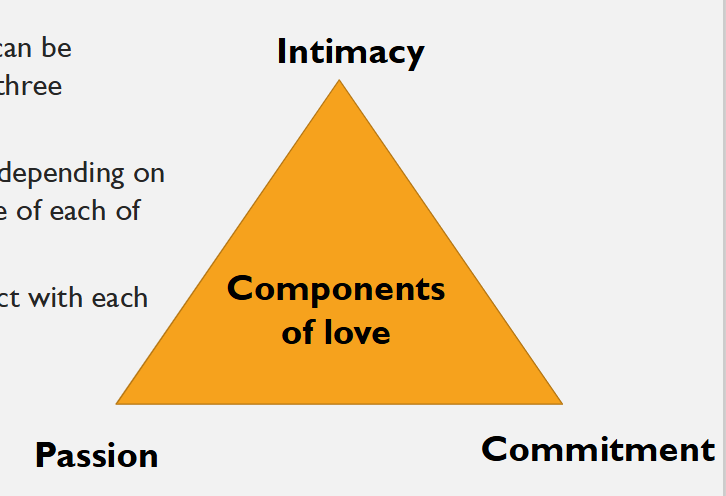
Intimacy:
Emotional component
Feelings of closeness, warmth and sharing (self disclosure)
Passion:
Motivational component
Physical attraction, excitement, sexual desires and extreme longing
Commitment:
Cognitive component
Our resolve to stay in a relationship
Types of love:
Liking, intimacy without passion or commitment, typical in friendships
Infatuation, passion without intimacy or commitment, happens between people with purely lustful desires for one another and no emotional ties
Empty love, there is commitment without passion or intimacy, this can happen to a couple who are only with eachother for a common purpose like children and financial security
Romantic love, passionate and intimacy without commitment, partners care and desire each other without having commitment at the moment
Companionate love, intimacy and commitment without passion, strong friendships or a successful long term marriage in which the passion has faded away
Fatuous love, passion and commitment without intimacy, the people concerned develop passion for one another form commited relationships
Consummate love, combination of all components, type of relationship most people strive for
Studies using STLS:
Levels of 3 components varies as a function of relationship duration (Wojcizke, 2002)
Levels vary across the life span (Sumter et al, 2013)
Confirmation of Sternbergs theoretical construct of love across 45 countries (Sorokowski, et al, 2020)
Geometry of the love triangle:
Amount of love (size of triangle), a large triangle means strong overall love
Balance of love (shape of triangle), the balance between intimacy, passion and commitment determines the type of relationship
Sternbeg argued that love isn’t just one triangle and that people can have several at once:
Real and ideal triangles, what the relationship is actually like vs what you want it to be
Self and other perceived triangles, how you think the relationship looks vs how your partner thinks it looks
Feeling and action triangles, what you feel internally vs how you behave and commitment shown in actions
What happens when love goes awry?
Insufficient love, too small to sustain a relationship
Mismatch between actual and ideal triangle
Mismatching actual triangles between self and others
Mismatching between feeling triangle and action triangle
Changing triangles
Strengths of Sternbergs theory:
Sternbergs theory does allow for the description of a variety of relationships
This is realistic as many different combinations of relationships do exist
The theory allows for the existence of different types of love and does recognise that relationships may change over time, this is also a realistic point
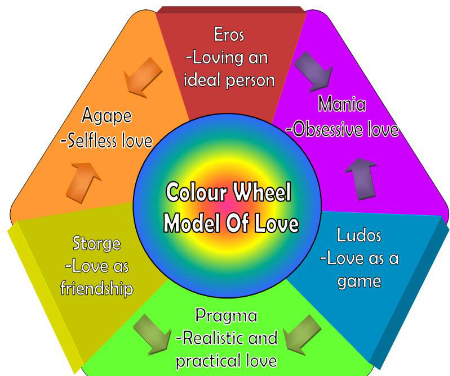
Lee’s theory of 6 basic love styles:
John Alan Lee identified 6 love styles or colours of love (Lee, 1973,1977)
Primary colours or styles of loving:
Eros, erotic passionate, based off physical attraction, love at first sight
Ludus, love is a game to be played with many romantic partners, it is about conquest and not commitments, just to have a good time
Storge, slow developing friendships which grow over time through shared interests and matures into a committed love
Secondary colours or styles:
Mania (eros + ludus), obsessive and intense love, typical of roller coaster relationship, driven by passion and often characterized by jealously or possessiveness
Pragma (Ludus + storge), practical love, love is a ‘shopping list’ of desired attributes, love guided by logic
Agape (Eros + storge), sacrificial and altruistic love, placing the loved persons welfare above ones own
Measuring the 6 love styles:
The 6 love styles are relatively independent attitude/belief systems
This typology was expanded by Susan and Clyde Hendrick, love attitude scale (LAS), Hendrick and Hendrick, 1986
42 or 24 short version item scale with good psychometric quality
Used in many psychological and social psychological studies
Studies using LAS:
Gender differences, (Hendrick and Hendrick, 1988, 1995), Males typically displayed ludus and agape whereas females storage and pragma
Sexual orientation, (Zamora, Winterowd, Koch and Roring, 2013), gay men displayed mania and pragma whereas heterosexual men showed eros
Self esteem, (Hendrick and Hendrick,2002), positive correlation with eros and ludus but negative correlation with mania
Biological theories of love:
Love is grounded in evolution, neural systems and chemistry
Evolutionary perspective suggests that love involves a set of psychological adaption to assist humans in resolving centuries-old problems related to survival and reproduction
Different kinds of love are associated with different types of problems
Passionate love- solves the attraction problem, identifying and selecting suitable mates for procreation
Companionate love- solves the commitment problem, increases likelihood that infants will survive and reproduce
Neurobiology of love:
When in love, it activates the basic system of the brain, the ‘reward’ pathway.
The same areas that are active when humans feel rush from cocaine
Research has compared the brain activity (fMRI) of people who were deeply in love (Bartels and Zeki, 2000, Fisher, Aron and Brown, 2006)
Recruitment of participants who described themselves ‘deeply in love’ (Aron et al, 2005)
Participants brought in two pictures, beloved and acquaintance
Completed the passionate love scale
Slid into fMRI alternated projecting of pictures and a mathematical test
Participants who reported higher levels of passionate love while looking at photo of beloved showed:
Greater activation in the brain’s ventral tegmental area and caudate nucleas, the brains reward and motivation system
Areas of brain involved in production of dopamine, same system involved in pleasure and addictions eg cocaine and gambling
Love is a reward based process
Findings replicated cross culturally and across sexual orientation (Acevedo, 2015)
Other key areas of our brains decrease activation (Zeki, 2007)
The amygdala (implicated in fear and anger)
Frontal cortex (centre of critical thinking, executive function and logic)
Love is illogical and makes us blind
Three brain systems for love, Fisher et al, 2002:
Proposes that love is not one single process, however 3 partly independent biological systems that evolved for different functions
Lust, motivate sexual reproduction with any partner, testosterone and estrogen
Attraction, to focus attention and energy on one preffered partner dopamine, norepinephrine, serotonin
Attachment, to maintain long term pair bonds for co-operation and child rearing, oxytocin, vasopression
Lust or sex drive:
Characterized by the craving for sexual gratification
Not necessarily focused on a particular person, can be directed at a number of potential partners
fMRI studies of human sexual arousal show an activation of hypothalamus, stimulating the production of sex hormones testosterone.
Romantic attraction:
Corresponds to passionate love
Characterized by focused energy and attention on a specific individual
fMRI studies show it involves reward pathways of the brain and the production of dopamine and noradrenalin
Attraction leads to a reduction in serotonin
Serotonin levels of new lovers were equivalent to the low serotonin levels of patients with OCD (Marazziti et al, 1999)
Attachment:
Found in long term relationships (companionate love)
Brain system associated with the production of oxytocin (bonding hormone) and vasopressin
Evolved to enable us to stick together and sustain an afilitiave connection when the dopaminergic thrill is gone
3 brain systems:
Can work together in tandem or work separately
Love can start with any these three feelings
Feel strong sexual attraction, have sex first and then fall in love
Fall head over heels in love, then have sex
Slowly grow deeply attached to someone they have known for months or years and then feel drawn to have
Romantic breakups:
>80% of people have experienced at least one breakup of a romantic relationship (Battaglia et al, 1998)
One of the most stressful events in a persons life (Simpson, 1987)
Romantic dissolution is associated with negative outcomes:
Decreased self esteem (Patrick, Knee, Canevello and Lonsbary, 2007)
Increased depression symptoms (Sbarra, 2006)
Increased suicide attempts (Donald et al, 2006)
Increased risk for a range of illnesses (Bjorkenstam et al, 2013)
Increased risk for early death, relative risk size is comparable to obesity, lack of regular exercise and excessive alcohol intake (Sbarra et al, 2011, Shor et al, 2012)
The process of breaking up:
Based on Duck’s phase model:
This model proposes that relationship breakdown occurs through a sequence of cognitive, interpersonal and social stages from private dissatisfaction to post breakup recovery
Intrapersonal, focusing on dissatisfaction
Dyadic, revealing these to the partner
Social, announcing the breakup to others
Intrapersonal, devising accounts of the breakup as we recover from it
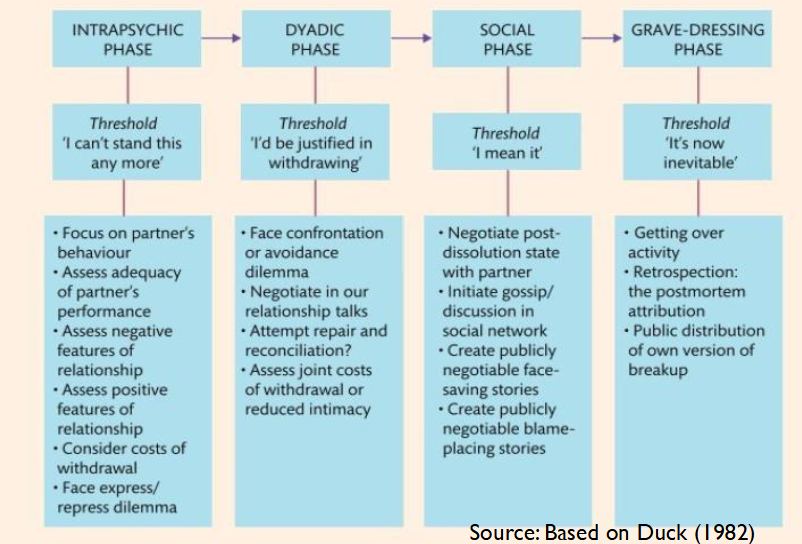
Intrapsychic stage:
Reflection on dissatisfaction
Focuses on a persons internal thought process
I am not happy
Threshold, i cant stand this any more
Dyadic stage:
Revealing dissatisfaction to the partner
Threshold: “I would be justified in withdrawing”
Social Stage:
Distress is made public
This phase normally leads to the dissolution of the relationship
Threshold: “I mean it”
Grave dressing stage:
Recover by thinking why and how it happened – what went wrong
Closure of the previous relationship and readiness to start a new one
Threshold: “It's time to start a new life”