Precambrian Earth and Life History Notes
Precambrian Earth and Life History
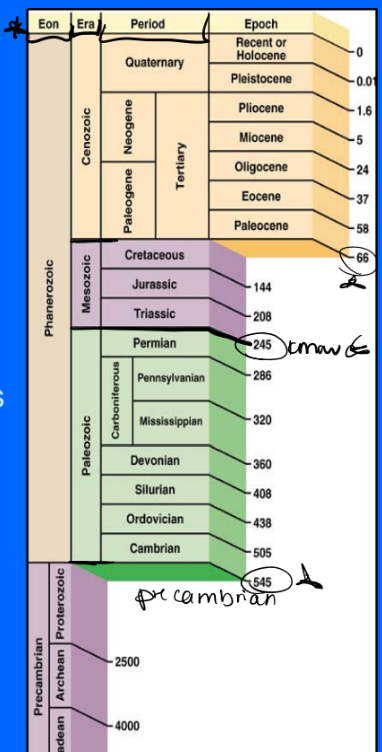
Hadean eon
What Happened During the Hadean?
Zircon = oldest mineral = 4.4 byo - may confirm oldest continental crust, after the Earth-moon system was formed
Evidence of crust during the Hadean includes:
Metamorphic rocks = 4.28 billion years old
3.96 billion years old rocks from Northwest Territories, Canada, reported earlier.
Shields, Platforms, and Cratons
Shields: Large areas of exposed Precambrian rock (Canadian shield)
Platforms: Precambrian rocks covered with younger rocks.
Craton: shield + platform combo = forms stable continental core
Hadean - Very Young Earth
Shortly after Earth formed, it was very hot due to:
Colliding particles during Earth's accretion (coming together by gravity)
Gravitational compression.
Decay of short-lived radioactive isotopes.
The young Earth in the Hadean was very different compared to later Precambrian Earth:
A relatively high frequency of meteorite and comet impacts.
Lethal doses of ultraviolet radiation due to the absence of an ozone layer.
The Moon was much closer to Earth, resulting in a day length of only 10 hours.
Formation of Continents
magma sea cooled = crust
continents formed from chemical differences in magma
Archean eon
Archean - Growth of Early Continents
Island arcs added to the continent crust - subducting ocean crust
Sediments extend continental materials seaward.
Continent-Continent collisions resulted in larger continents.
Magmatism from subduction zones causes thickening.
Proterozoic eon
Proterozoic Earth History
Major difference in crustal evolution style:
Passive margin sediments were common.
Crust accreted around continental nuclei to create large cratons like Laurentia.
Proterozoic Supercontinent
supercontinent Columbia = 2.1 to 1.8 bya (started fragmenting around 1.5 to 1.35 billion years ago) - also known as Nuna and Hudsonland - had parts (proto-cratons) making up the core of other supercontinents
Rodinia: 1.1 byo, Laurentia/Australia/Antarctica collided
Proterozoic Deposits
Thick sedimentary packages of sand, shale, and carbonates formed on passive margins during the Proterozoic.
Ophiolite sequences: stack of ocean floor crust that got pushed onto land - was the first observed difference of oceanic and continental crust
Proterozoic Glaciations & Snowball Earth
Major glaciations occurred in the Proterozoic:
👉 Huronian = early/longest ice age - linked to great oxygenation event (GOE) - increased oxygen, decreased methane = cold - south of Hudson Bay
👉 Cryogenian = extreme global ice (Snowball Earth):
→ 5 stages: oceans start freezing, “snowball earth” - lowered reflectivity, CO2 outgassed by volcano, greenhouse effect melts “hothouse earth”, CO2 pulls back into oceans - back to normal
Origin and Evolution of Atmosphere and Oceans
Early atmosphere formed from volcanic outgassing, primarily water vapour and CO2
Early atmospheric conditions were not suitable for modern oxygen-breathing organisms until photosynthetic organisms (Eubacteria) evolved, approximately 3.5 billion years ago.
most oxygen = cyanobacteria in stromatolites - 2.3 bya
Great Oxidation Event (GOE)
significant increase in atmospheric oxygen approximately 2.5 to 2.1 billion years ago.
Led to the formation of banded iron formations (BIF)
Life - Its Origin
Earliest sign of life = 3.5 billion years ago, primarily fossil evidence of microorganisms (cyanobacteria)
Archean: biologically impoverished compared to present - no oxygen
living organism: must reproduce and have metabolism
two requirements for origin of life = elements that make up organic molecules, and energy sources
Organic Chemical Evolution on Earth
A. Z. Oparin hypothesized that chemical evolution preceded cellular life formation, suggesting spontaneous generation of organic molecules like amino acids under early Earth conditions.
Stanley Miller's experiments confirmed that diverse organic compounds could arise through realistic primordial conditions.- gases used = H2, H2O, ammonia and methane
Origin of Life
required spontaneous organization of self-replicating organic molecules, the requirements:
membrane-enclosed capsule
energy-capturing chemical reactions
chemical system for replication (RNA-DNA)
Fossil Evidence of the Origin of life
trace of life: stromatolites (organic structure) - 3.5 bya - cyanobacteria - Archean
sexually reproducing cells appeared mid Proterozoic - new organisms developed
gunflint microfossils: 2 bya
euk. cells = early/middle Proterozoic
oldest eukaryotes = grypania (photosynthetic algae)
Ediacara Fauna
impressions of multicellular, soft-bodied animals in rocks - 600 mya
Late Proterozoic Shelly Fossils
shells/shell-like material in rocks → Cloudina = oldest shelly animal fossil
—> 60% of Manitoba = underlain by Precambrian rocks