Grieneisen_DynamicalCell_Lecture2024
Biology Notes
Page 1
Speaker: Verônica A. Grieneisen from Cardiff University, UK
Topic: Systems Biology of the Cell
Page 3
Cells need to:
Divide and know when to stop
Move to other places and stay put
Differentiate into the appropriate cell type
Function physiologically and biophysically
To achieve the above, cells need to communicate, stick together, and become polar.
auto-organisation and regeneration
the hydra species can regeneration
it is very simple as well as it has an outer and inner cell layer.
auto-organisation
page 6???
how can we understand the auto-organisation and cell sorting
cell have adhesion they can exhibit differential adhesion.
Page 9
Differential Adhesion Hypothesis:
Proposed by Steinberg in 1963 that cell sorting could be explained as driven by differential adhesion cell type within tissue.
Cell sorting is driven by differential adhesion between cell types in a tissue
Cells with higher adhesion form tissues with higher surface tension
bekijk de bladzijde tien nog een keer want je begrijpt het niet
Page 11
In silico Cell Modelling:
Using computer models to test hypotheses
Cellular Potts Model invented by Graner & Glaziar in 1992
Page 12
green arrow represents the adhesion drive
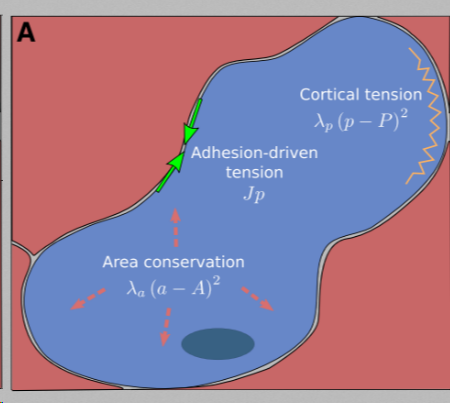
Page 13
In Silico Cells:
Non-polar with small membrane fluctuations
Cells round up alone but form honey-comb lattice shapes when in contact with others
Page 15
Adhesion Mechanisms:
Mediated by cadherins expressed on cell membranes
Two-tiered mechanism for stabilization and immobilization of E-cadherin
Page 16
Key Messages:
adhesion differences between different cell types will lead to tissue seperating or “auto-organising“
Computer models can test hypotheses
Auto-organisation follows simple rules driven by adhesion differences
complex plant morphology
gene regulatory
plant-soil interaction
environmental condition
ecological interaction
Page 22
Auxin:
Indole-3-acetic acid
Regulates cell division, differentiation, and elongation
auxin move through specialised membrane transporter
Page 25
Auxin Gradients:
Instructive for development
Stable growth due to dynamic auxin flows
Page 27
Learnings:
Coordinated transporter direction organizes roots
Dynamic auxin flows lead to stable growth and provide instructions
Page 29
Complexity of Cells:
Cells are more complex than simple rules suggest
Page 30
Keratocyte:
A single moving cell discussed
Conclusion
The study of cell dynamics, adhesion, and modeling plays a crucial role in understanding cell behavior and organization.
Biology Notes
Page 31
Main Ideas:
Actin cytoskeleton in animal cells plays a role in cell deformation and motility.
Involvement of G-actin, F-actin, and sidebranching by Arp2/3.
Page 32
Main Ideas:
Core internal cell dynamics in animal cells involve Cdc42, Rac, Rho, WASp, WAVE, PIP2, ROCK, Arp2/3, capping, and contraction protein.
Page 33
Main Ideas:
Continuation of core internal cell dynamics in animal cells with a focus on front and back dynamics involving Cdc42, Rac, Rho, WASp, WAVE, PIP2, ROCK, Arp2/3, capping, and contraction protein.
Page 34
Main Ideas:
Small G-proteins act as molecular switches with GTP and GDP.
Involvement of GEF, Rho, Rho GDP, GTP, GDI, GAP, and effectors in G-protein signalling.
Page 35
Main Ideas:
Polarity in animal cells with Rac and Cdc42 at the front and Rho at the back.
Page 36
Main Ideas:
Systems biology approach to understanding cell dynamics.
Crosstalk between G-proteins through GEFs and the role of GTP and GDP in signaling pathways.
Page 37
Main Ideas:
Small G-protein interactions contribute to polarity in cells.
Importance of fast cytosolic diffusion and slow membrane diffusion.
Page 38
Main Ideas:
Cells exhibit movement due to reactions between proteins and differential diffusion.
Patterns can emerge without external cues based on protein interactions.
Page 39
Main Ideas:
Steering of the cytoskeleton by small G-proteins like Rho, Rac, and Cdc42.
Page 40
Main Ideas:
Dynamic spatial settings in cell biology research.
Page 41
Main Ideas:
Integration of systems biology in understanding cell dynamics in a dynamic spatial setting.
Page 42
Main Ideas:
Evaluation of the effectiveness of biological models in learning new insights.
Page 43
Main Ideas:
Learning from cellular processes that deviate from the norm, such as interactions when cells encounter obstacles.
Page 44
Main Ideas:
Exploration of conflicts and resolutions involving small G-proteins like Cdc42, Rac, and Rho.
Involvement of cytoskeleton components like Arp2/3, capping, and contraction in cell dynamics.
Page 45
Main Ideas:
Utilizing cell biochemistry to understand cell shape, movement, sensitivity, and conflict resolution.
Page 46
Main Ideas:
Individual cell behavior in the context of cellular models.
Page 47
Main Ideas:
Collective behavior of multiple model cells influenced by spatial constraints rather than signaling pathways.
Page 48
Main Ideas:
Cells organize through properties like adhesion, polarity, and communication.
Use of models to explore interactions between different levels in biology.
Examples of cell sorting, plant morphogenesis, and shared mechanisms in animal and plant cells.
Importance of imaging and systems biology thinking in understanding cellular processes.
Page 49
Main Ideas:
Plant cells also exhibit polarity and steering mechanisms similar to animal cells.
Studies