ALL of Topic 1 Flashcards
1.1:
Environmental Value Systems: A worldview that shapes the way people percieve and evaluate environmental issues. EVS’s can be influenced by cultural, economic, and/or socio-political factors.
3 main categories:
Ecocentric
Anthropocentric
Technocentric
Ecocentric: Emphasizes ecology and nature as central to humanity. Encompasses a less materialistic approach to life but rather one with a greater self sufficiency of societies. The ecocentric perspective advocates for the protection of natural environments and biodiversity, prioritizing ecological balance and sustainability over economic growth.
Anthropocentric: Heavily believes in humans as “managers” of the global systems. Humans must use taxes, regulations, and legislation to exert control over the globe to maintain stability.
Technocentric: Believes that technological advancements can provide solutions to environmental problems. Even if humans are pushing natural systems beyond their typical boundaries, technology can cause this boundary to adapt and extend further. This perspective often emphasizes the role of innovation and engineering in addressing issues such as pollution, resource depletion, and climate change, showcasing the potential for human ingenuity to create a more sustainable future.
Big Idea: Be able to distinguish between the three different EVS’s and say which is the most applicable in a scenario.
1.2:
System: A set of interconnected parts that work together to form a complex whole, often defined by specific boundaries and interactions with their environment.
Parts of a System:
Input: energy or matter that enters a system
Output: something produced at the end of the system
Storage: Areas where energy or matter is accumulated inside a system
Flow: Movement of energy or matter within a system
Boundaries: Outside/edge of a system
Transfers are processes that involve a change in location within the system. For example, water runoff seeping into ground water. Transformations are the formation of new products or a change in state. There is a chemical or structural change within the product, causing it to be an entirely new product. A great example of transfer and transformations is the water cycle.
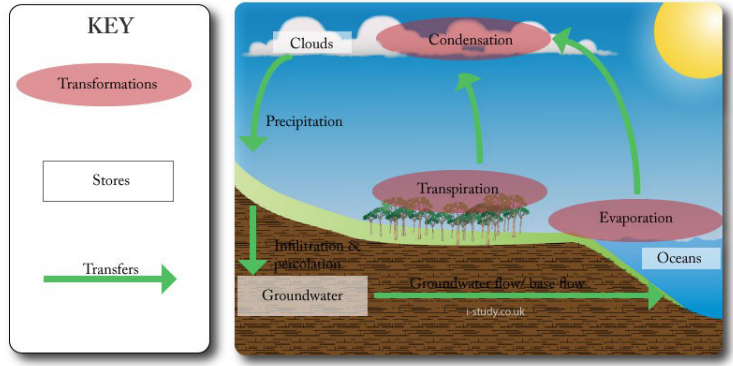
There are three different types of systems: open, closed, and isolated.
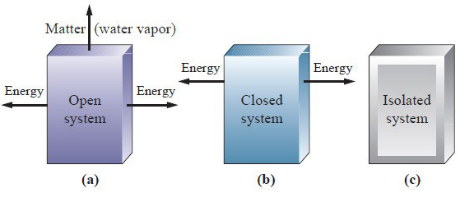
Open Systems: Most systems are open systems, including all ecosystems. Open systems are defined by their ability to exchange matter and energy with their environment.
Closed Systems: Closed systems are defined by their ebility to exchange energy, but not matter. These do not occur naturally on earth, but earth is the ultimate example of one. However, a manmade example is a sealed terrarium. However, these usually do not survive as the system eventually becomes off balanced. Example: Biosphere 2
Isolated System: Isolated systems do not exchange either matter not energy with its surroundings. The only real example of an isolated system is the Universe.
Model: Models are simplified versions of systems. It shows the flows and storages as well as the structure and the workings.
Strengths:
Easier to work with (less complex)
Can be used to predict the effect of a chane of output
Can be applied to other similar situations
Can help visualize patterns
Can be used to visualize really small things and relaly large things
Limitations:
Less accuracy with the simplification
If the assumptions made to create the model are wrong, then the entire model is inaccurate
Predictions are not certain, they may be inaccurate
Different people can interpret the model in different ways
Models may be used politically out of context
1.3:
Energy in systems: Laws of Thermodynamics
1st Law of Thermodynamics is often called “The Principle of Conservation of Energy”. This principle states that energy is neither created nor destroyed.
2nd law of thermodynamics states that the entropy (the measure of the disorder of a system) of an isolated system will tend to increase over time. Think about an isolated system, that cannot exchange energy nor matter, with a problem with its equilibrium of transfers and transformations of matter and energy. THese problems will only increase as there are no other systems to support it.
Thus, an implication of the 2nd law of thermodynamics is that no ecosystemic process can be 100% efficient. Think of cellular respiration—lower-entropy chemical energy is turned into high-entropy mechanical energy. When this happens, heat energy is lost. With this energy loss, no natural ecosystemic process will ever be entirely energy efficient. This energy loss can be reflected in an energy pyramid and calculated.
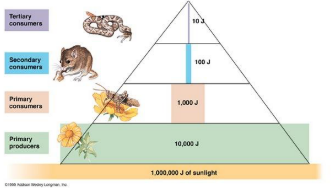
Energy Loss (percentage) = (Initial input - energy taken in)/initial input * 100
—> Know how to apply this formula!!
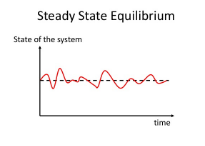
Equilibrium: The tendency of the system to return to an original state following disturbance.
Steady State Equilibrium: In an open system, even though inputs and outputs of energy and matter are continuous, the system as a whole remains more or less constant. It follows an average line, with some highs and lows.
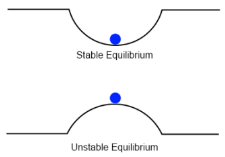
After a disturbance:
Stable returns to the same equilibrium.
Unstable returns to a new equilibrium.
Negative Feedback Loops: Helps organisms and systems return to their original state. They stabilize as they reduce change within the system/organisms. Some examples are body temperature regulation and predator prey relationships.
Positive Feedback Loops: (The viscious cycle) Changes the system to a new state. They destabilize as they increase change. Examples include blood clotting, ocean warming, and melting of polar ice (albedo effect).
Tipping Point: A critical threshold when even a small change can have dramatic effects and cause a disproprotionately large response in the overall system. Think of carrying capacity, where one small change can send the entire system spiraling. Examples:
Lake eutrophication
extinction of keystone species
coral reef bleaching
Resilience: The tendency of a system to avid tipping points and maintain stability through steady-state equilibrium. The ability of a system to avoid tipping points and be able to stay constant despite small changes, restore back to original state.
Examples:
Eucalyptus trees in Australia
Resilient to wildfires: able to grow in ash filled soil, have very thick bark to prevent fire damage, and have fire activated seeds to ensure new growth.
1.4:
This is the unit that we did the macroscale sustainability project on!! Also what we did the tragedy of the commons activity for!
Tragedy of the Commons: Tragedy of the Commons is a philisophical idea of shared resource consumption. It involves a scenario where there is a shared resource, with just enough to sustain all who rely on it. However, some will take more than they need and overconsume the resource. This will deplete it beyond its rate or replenishment and this elimiate the resource entirely. This idea can be applied to international scenarios, non-renewable resources, and more.
Macroscale sustainability: Macroscale sustainability is a focus on sustainability at a regional, national, or global scale. Basically, evaluating the sustainability of a large system or group of individuals. It evaluates their sustainability based on factors like resource depletion, trade, and their ecological footprints. These evaluations are extremely important because they can influence policy and legislation decisions. They help identify rooms for improvement in large areas and can be used to draw comparisons and contrasts.
Be able to look at a system and evaluate if it is sustainable or not!
Ecological Footprints: Ecological footprints are the environmental impact that a person or community of individuals has on the environment, but expressed as the amount of land required to sustain their consumption of resources. Its a visual to display how fast an individual or group uses up how many resources their consumption requires. Some examples include water footprints, carbon footprints, energy, and more. Overshoot day is an example of an ecological footprint.
Be able to draw conclusions and analogies based off of ecological footprint diagrams (Like the one below)

Big Ideas: Macroscale sustainability, footprints, understanding human and carbon footprints, water usage, evaluate if an entire system is sustainable or not, tragedy of the commons
1.5:
Pollution is classified through 3 different aspects:
Matter: pollution can be gases, solids, or liquids
energy: pollution can be in the form of sound, light, or heat energy
living: pollution can be living, like invasive species or biological agents
Types of Pollution
Primary Pollutants: Primary pollutants are active as soon as they are emitted. In their raw (by raw form, I mean their form directly emmitted from the source with no changes made to it) form, they are dangerous and cause harm to the environment.
Example:
Carbon Monoxide
Secondary Pollutants: Formed after a primary pollutant has been physically or chemically changed. The primary pollutant will have been released, and then interact with something else to create a different form that is dangerous to the environment.
Example:
Acid rain—> when sulphur trioxide mixes with water to form sulfuric acid
Point Source:
released froma single, identifiable source
easy to determine where pollution is coming from
easier to manage since you know what is causing the pollution
Non-Point Source:
Pollutants are coming from multiple sources
Polutants may be transported over distances (runoff, blown by wind)
Difficult to determine where polutants are coming from, making their management challenging
Persistent Organic Pollutants (POP’s):
toxic chemicals that affect human health and the environment
transported by wind and water and do not break down easily, do not biodegrade
bioaccumulate as passed through a food chain
Many POP’s were made as pesticides
Examples:
DDT, Dioxins, PCB’s
Biodegradable Pollutants:
Break down quickly in the environment by decomposers, light, and heat
Still have damage, but not nearly as much as POP’s
Less of a long term presence
Examples:
Sewage, compost, starches, soap
Acute Pollution:
Large amounts released at one time
Results in a lot of harm to humans and environment
Examples:
Bhopal Disaster and Chernobyl
Chronic Pollution:
long term release of small amounts of pollutant
often goes undetected
difficult to clean up
wide spread
Example:
Air Pollution, car emmissions
Measuring Pollution
Direct Measurements of pollution can be made using differen tools. Alwyas are specific quantities.
acidity of rainwater (pH probe)
amoutn of gases in atmosphere (CO2 probe)
Particulates emitted by engines (light or turbidity sensor)
Soil nitrate and phosphate levels
Indirect measurements of pollution involve measuring changes in the abiotic or biotic factors as a result of exposure to a pollutant.
Abiotic: Measuring the amount of dissolved oxygen in a water source
Biotic: Measuring population of indicator species (organisms that are only found in conditions that are polluted or unpolluted
Monitoring of Pollution
Level 1: Preventing Pollution before it even happens. Changing human activity that creates pollution to prevent it from even being emmitted. Providing alternatives to pollution based engrained habits, like solar power or electric cars. Educating on how exactly to prevent pollution, like education on recycling. Legislation can be made to prevent pollution habits, like charging more for gas or electricity. Additionally, they can provide economic incentives, like tax breaks if emmision regulations are met.
Level 2: controlling the release of the pollutant. This does not stop the release of it entirely, but rather manages the release of it to try and minimize it. Legislation and regulation are the best ways to manage the release of pollutants, like emmision standards for cars. Additionally, developing technology for extracting pollutants, like filters, help limit the amount of pollution released, but does not completely take out all pollutants being emmitted.
Level 3: Clean up and restoration of the natural environment. This is a last resort to managing pollution, as it does nto control the release of it but rather deal with just its effects. It involves the extraction and removal of the pollutant from the ecosystem and the the replanting/restocking of lost or depleted populations from the pollution damage.