Homo.. recent invitation?
Is Homosexuality a recent invention?=
“Homosexual” as a Term by Who
By Karl Maria Kentbeny
created in 1869 or 1870
Kertbeny introduced the term in a letter written in 1869. He used the word "homosexual" to describe same-sex attraction, and "heterosexual" for opposite-sex attraction
idea that homosexuality didn’t exist before this word came out (not true)
Michel Foucault on Homosexuality
Michel Foucault, a French philosopher and social theorist, is expressing a historical shift in the perception and categorization of homosexuality
A rupture from one way to another way of thinking of sexuality orientation and sexuality in 1870
idea that homosexuality didn’t exist before this word came out (not true)
Originally, it was associated with the act of sodomy (a term historically used to refer to certain sexual practices, often same-sex acts).
The shift occurred when homosexuality was no longer merely seen as a specific sexual act but was instead linked to a broader concept of androgyny (not an act now but an identity)
Not just a sexual act but part of ones identity, part of them (type of individual)
Transformation from Temporary Sinner to a Species:
With the emergence of the term "homosexual," there is a shift from viewing homosexuality as a temporary sin to recognizing it as a distinct and enduring aspect of an individual's identity. It becomes a recognized "species" or category of people.
Social Constructionist Claims
The concept of sexual orientation was invented in the West in 1869, primarily by medical practitioners who created the idea of heterosexual and homosexual individuals through their research on the topic
shared through medical discourse
Prior to this, same-sex sexual acts existed (sodomy, tribadism), but homosexuals were not recognized by others as a distinct category of human beings (prior to 1870)
Personal or group identities based on same-sex sexuality did not exist and thus, neither did sub-cultures of same-sex attracted individuals
continuity is then not expected for identities, subcultures, customs and traditions before 1870
Idea that Homosexuality didnt exist before the 18th Century, and because sexual orientation categories did not exist, everyone was bisexual until the Rupture
How we can research these Social Constructionist claims
1) Archeological Evidence (material culture)
2) Historical Evidence (written record)
1) Archeological Evidence (material culture)
Evidence Shows….
Evidence of homosexual behaviour within material culture can be seen in sexual terms or seen as more ritualistic
Difficulty in interpretations (not all experts can agree)
so any evidence within archeology for homosexuality is too ambiguous to really tell
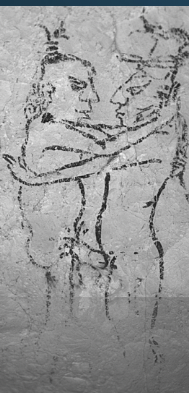
So…Unambiguous archaeological evidence of homosexual behavior that predates historical records is rare
Example: NajTunich cave, Guatemala, ~1320 years old »»»»»» (too ambiguous to tell)
2) Historical Evidence (written record)
Portuguese Fanchonos
Research by Who?
Luiz Mott
brazilian researcher
When was this?
Late 16th and 17th century records of the Portuguese Inquisition in the National Archives in Lisbon
Define Fanchonos
Portuguese fanchonos – same-sex attracted males, many of whom were effeminate
Evidence will show how we see both group and personal identity with Fanchono
fanchonos = translated to "sissy, fairy, faggot"
can be used as a term of endearment or torment
Example: Priest Barreto
1652: “There is also the priest Barreto, 44 years old. When he arrived in a place, the young people were warned: “Take care with this cleric because he is a fanchono and a somitigo [sodomite].”
shows how they are recognizing a distinction between sodomy (the act) and fanchono (types of individual) — goes against social constructionist claims
Group Identity?
1645: People referred to ”assemblies of fanchonos”
shows how they are categorizing them as a distinct group — goes against social constructionist claims
Use of the word assembly = thinking of these Fanchonos as a group (group identity)
Personal Identity.?
They employed nicknames such as Rafeal Fanchono (1570)
adopting label of Fanchono as personal identity — goes against social constructionist claims
(some even put it in their name) — Ex: Rafeal Fanchono
Fanchono Subculture
Wore distinctive clothing and hairstyles
Often employed overtly feminine nicknames
Employed specialized slang
Allowed them to talk about sexual things around people not part of culture
would say they are "on the job" -- means “Im a fanchono”
Fanchonos spoke about themselves as a “jurisdiction” while outsiders were referred to as “ugly”
"jurisdiction" = part of subculture, "ugly" = people out of culture
Frequented certain taverns, inns, and cruising grounds
cruising grounds = to find sexual partners
no places strictly for Fanchonos, just went to places that would accept them (mixed places)
grace cathedral (example)
Shared houses where they would have noisy, campy parties
would do drag, singing, dance, sex, social talk, camp behaviour
had Fanchonos dance troupes
"campiness" = associated with homosexual culture, exaggerated (theatrical) way of behaving, intended to amuse (artificiality)
English Mollies
Research by who?
Rictor Norton
When
Found in 18th century documents including records from London’s central criminal court
From “The Old Bailey”
Define English Mollies
English mollies = same-sex attracted males who lived in 18th century London
Group Identity?
”…the vile Practices of Sodomy, and the effeminate Actions of our modern Mollies,…” (Philogynus, 1726)
shows how they are categorizing them as a distinct group — goes against social constructionist claims
recognized them as a type of group
Personal Identity?
Individuals employed nicknames for themselves like Black Molly, Green Pea Molly or Flying Horse Molly
adopting label of Mollie as personal identity — goes against social constructionist claims
Molly Subculture
Mollies organized themselves in physical and social space in the manner of a subculture
molly culture thought to be more extensive than homosexual culture today
Often employed overtly feminine nicknames
nicknames = to have fun, endearment, joke around,
They have specialized slang and gestures
They patronized “molly houses”
People who patronized molly houses = identified with or engaged in homosexual activities (seeking a space where they could express their sexuality more openly and find a sense of community)
Mother Clap’s = A popular molly house. A coffeehouse, where men from outside London also attended
Sunday most popular in Mothers clap
molly houses = quasi sex clubs
no police around = so bad behaviour/acts in these places
Camp was an important part of the subculture
Important to note that these Mollies weren’t effeminate outside the Molly Houses, only inside the Molly houses did they act such a way
just working class men outside of molly houses
Part of this behaviour seen in within the Molly Houses, was not done for feminine purposes, but for camp purposes
not trying to imitate ladies but whores, for camp.
Part of Camp: Teasing, part of having fun, bitch fights, calling eachother “whore”
Festival nights, mock weddings, mock births, and christenings
within these Molly Houses
Cruising grounds
molly had shared knowledge of cruising jobs
17th Century Japan
Define Onna Girai
Onna girai: Ihara Saikaku’s, The Great Mirror of Male Love (1687)
Identity based on sexual orientation
men that never want to marry women, reject women as sexual partners
Attracted to same sex
translates to women hater
Shows more evidence, specifically from a place out of Europe (unlike English Mollies and Fanchono)
Nascent subcultures?
”We’re such a couple of onna girai!”
shows how these people adopted this as part of a group identity, as well as a personal Identity
"Nascent subcultures" refers to emerging or developing subcultures that are in their early stages of formation
Indonesian Ludruk
Define Waria
Evidence for a subculture of ludruk performers dates back to 1822 (still before 1870)
Waria = feminine males (same as fafafine)
Within Bali, preformed acting troupes
comedy performance in drag
emphasize camp humor — Performance important (embellishment/to decorate seen clearly here
troupes = good evidence for subculture
Looking at the Evidence from the Mollies and Fanchonos, what general conclusion can we make? Who made these labels for these group?
Overall Connection = invariance that keeps on emerging (same things but different places)
Both the Mollies and Fanchonos, themselves were driving this process (they came up with these terms). This direction of influence is opposite than what social constructionist believe.
Social constructionists have this notion that heterosexuals were the dominant and were the ones coming up with these terms, labelling them. In reality, it was the homosexuals labeling themselves and not the other way around.
Homosexuality was here WAY before 1870, we just didn’t have a term for it yet
Same sex attracted women as a distinct category before 1870 (Evidence for Women)
Not alot of research on Women on this topic
Tribads - Bourdeille (1514?-1614)
Pierre de Bourdeille, Abbé Brantôme (154?-1614), Lives of Gallant Ladies
Was the first person to use word "lesbian"
“…such is the character of the Lesbian women, which will not suffer men at all. Now such women as love this practice will not suffer men, but devote themselves to other women and are called tribads…”
Lesbians were recognized as Tribads in 1614
shows how they are recognized as a distinct class of individuals (opposite of what social constructionist said)
Ancient Indian Medical Texts
“On the exhaustively debated….question of the essentiality versus the social construction of homosexuality … the classical Indian literature clearly opts for a congenital, organic etiology” --Sweet & Zwilling (1993)
“Man haters
These texts discussed women homosexuality in terms of pathology
shows how same sex attraction has a biological basis — where something went wrong with development (during embryonic and fetal stages)
Evidence of how thousands of years before 1869, and in a not European culture, there is evidence of recognition and labeling of same-sex attracted females as distinct “types”, as well as being called "man haters”
Example: Personal Identity — Anna Lister (1790-1840)
Anne Lister — 1790 to 1840
most well studied same sex attracted female prior to 1869
identified as sexually different (didn’t use the word lesbian, was not a word widely used at the time)
recognized her feeling as not normative
In her diary, its clear of her same sex attraction (exclusive same sex attraction)
This showcases how she rejected social construction interpretation (instead reflecting biological interpretation)
ex: saying “instinctive” “natural to me”
So… is there Lesbian Subcultures prior to 1869? — Anna Lister
Polari
The use of specialized slang by marginalized groups, particularly within LGBTQ+ communities, has a long history and serves multiple purposes.
This slang allows individuals to communicate freely while maintaining a degree of secrecy or protection.
Polari emerged in England in the mid-20th century and was primarily used by gay men, especially in urban areas like London.
Polari incorporated elements of various languages, including English, Italian, Yiddish, and Romani, and it was characterized by its playful and cryptic nature.