4 - Microbial Growth
🦠 BIO3124 — MICROBIAL GROWTH
🌱 1. What Does “Microbial Growth” Mean?
Microorganisms, like all living organisms, need:
Carbon → to build cellular structures
Energy → to power cellular processes
Other nutrients → to make proteins, DNA, membranes, etc.
Bacteria have evolved many different ways to find, acquire, and use nutrients.
Why are bacteria so adaptable?
Bacteria have highly plastic genomes.
👉 Genome plasticity = bacteria can adapt their genetic information and develop different strategies for obtaining and using nutrients.
Understanding microbial growth is important because it allows us to:
Understand how bacteria increase ⇧ cell mass
Understand how they increase ⇧ cell number
Control bacterial growth
Use microorganisms to produce useful products = antibiotics
🍎 2. MICROBIAL NUTRITION
Nutrient Requirements
Microbes require different nutrients to grow.
These nutrients can generally be divided into:
🥑 Macronutrients
Required in large amounts.
They are used to build major cellular components and support metabolism.
🧂 Micronutrients
Required in small amounts.
They are often needed as cofactors or components of enzymes.
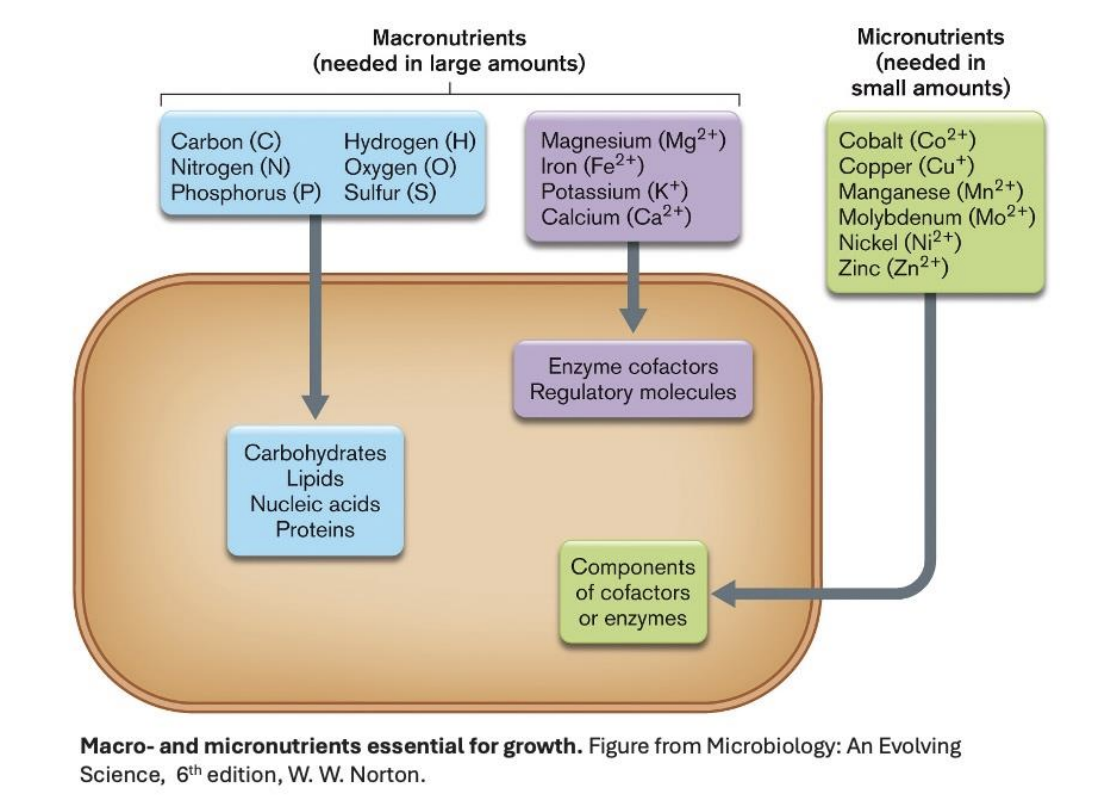
Big picture:
Nutrients → cellular building blocks + energy → increased cell mass → cell division → increased cell number
🚪 3. HOW BACTERIA ACQUIRE NUTRIENTS
Bacteria have to get nutrients from their environment and bring them into the cell.
Major strategies include:
Extracellular digestion
Through transport systems:
Passive transport
Active transport
ABC transporters
Group translocation
Siderophores
🧱 4. GETTING THROUGH THE PLASMA MEMBRANE
The plasma membrane separates:
Outside of cell ↔ Inside of cell
The membrane is selectively permeable, meaning some substances can cross more easily than others.
Bacteria use several mechanisms to control what enters and leaves.
1⃣ Lipid bilayer exclusion
The chemical properties of the plasma membrane determine what can cross.
Small, nonpolar molecules can cross the lipid bilayer relatively easily.
Examples:
O₂
CO₂
Small lipids
2⃣ Cell wall
The cell wall can act somewhat like a filter.
Its structure, particularly the peptidoglycan, affects movement of substances.
3⃣ Permeases / carrier proteins
Permeases are substrate-specific transport proteins.
👉 They recognize particular substances and help move them across the membrane.
4⃣ Nutrient-binding proteins
Some bacteria have specialized nutrient-binding proteins in the periplasmic space.
These proteins help capture nutrients and deliver them to transport systems.
5⃣ Protein channels / pores
Membrane-spanning proteins can form channels or pores through which specific substances can move.
6⃣ Secretion systems
Bacteria also have specialized systems that transport substances out of the cell.
🍽 5. HOW DO BACTERIA “EAT”?
Bacteria are tiny, but their food sources can be relatively large.
Therefore, bacteria often cannot simply engulf large pieces of food.
Instead, they:
Break food down outside the cell → transport the smaller products into the cell
This is called:
⭐ EXTRACELLULAR DIGESTION
How does it work?
Bacteria secrete hydrolytic enzymes.
These enzymes break down large molecules outside the cell.
The smaller molecules can then be transported into the cell.
For example:
Large nutrient → hydrolytic enzyme → smaller molecules → transport into cell
Why is this important?
Extracellular digestion is important for nutrient acquisition in many environments, including:
🌱 Soil
🧍 Host tissues
Other ecological environments
🚇 6. GENERAL MEMBRANE TRANSPORT
There are several ways substances can move across bacterial membranes.
A. Passive / Simple Diffusion
Substances move:
HIGH concentration → LOW concentration
Therefore, they move along the concentration gradient.
Does it require energy?
❌ No ATP required.
Examples of molecules that can diffuse through the membrane:
CO₂
O₂
Small lipids
Other small/nonpolar molecules
Easy way to remember:
Passive = no energy
⚡ 7. ACTIVE TRANSPORT
Active transport moves substances:
LOW concentration → HIGH concentration
Therefore, substances are transported against the concentration gradient.
Does it require energy?
✅ Yes.
Possible energy sources include:
ATP
PMF (proton motive force)
High-energy molecules such as PEP
Easy comparison:
Passive transport | Active transport |
|---|---|
Along gradient | Against gradient |
High → low | Low → high |
No direct energy required | Requires energy |
Example: diffusion | Example: ABC transport |
🔄 8. GROUP TRANSLOCATION
Group translocation is a transport mechanism in which the substance is chemically modified while it is transported into the cell.
A major example is the:
⭐ Phosphotransferase System (PTS)
The transported molecule is modified during transport.
👉 Think:
Transport + chemical modification happen together.
🧲 9. SIDEROPHORES — HOW BACTERIA GET IRON
Iron is extremely important for bacterial growth.
However, bacteria have a problem:
❗ Iron in nature is often difficult to obtain.
Ferric iron:
Fe³⁺
is often present in an insoluble form.
Therefore, bacteria cannot simply transport it directly.
Siderophores
Siderophores are molecules secreted by bacteria that bind iron.
Process:
Fe³⁺ in environment
⬇
Siderophore binds Fe³⁺
⬇
Siderophore–Fe³⁺ complex
⬇
Complex is transported into cell
⬇
Fe³⁺ is reduced to Fe²⁺
⬇
Fe²⁺ can be used by the cell
Why is this important medically?
Some pathogenic bacteria have specialized mechanisms for taking iron from their host.
Therefore, targeting bacterial iron-acquisition systems can potentially be used to kill pathogenic bacteria.
🔋 10. ABC TRANSPORTERS
ABC = ATP-Binding Cassette
ABC transporters are one of the largest families of energy-driven transport systems.
They are found in:
🦠 Bacteria
Archaea
Eukaryotes
There are 200+ different systems identified in prokaryotes for transporting organic and inorganic compounds.
Energy source:
⭐ ATP
The ATP provides the energy needed for transport.
Gram-negative vs Gram-positive/Archaea
🟦 Gram-negative bacteria
Use periplasmic binding proteins to help capture substrates.
🟩 Gram-positive bacteria + Archaea
Use substrate-binding proteins on the external surface of the cytoplasmic membrane.
Two Major Types of ABC Transporters
1⃣ Uptake ABC transporters
Move substances:
Outside → Inside
They are particularly important for nutrient uptake.
2⃣ Efflux ABC transporters
Move substances:
Inside → Outside
They can function as multidrug efflux pumps.
💊 Why does this matter?
Efflux pumps can pump antibiotics out of bacterial cells.
Therefore:
Efflux pump → antibiotic removed → increased antibiotic resistance
🧬 11. BACTERIAL CELL DIVISION
Bacterial cell division is called:
⭐ Binary Fission
Bacteria do not undergo:
❌ Mitosis
❌ Meiosis
Instead, they divide through a process involving:
DNA replication → chromosome separation → septum formation → daughter-cell separation
🧬 12. DNA REPLICATION AND CELL DIVISION ARE COORDINATED
Bacterial cell division requires coordinated:
Cell growth
DNA replication
Cell-wall synthesis
Membrane synthesis
Separation of cellular components
Unlike eukaryotic cells, bacteria can continuously synthesize:
RNA
Proteins
while their DNA is being replicated.
Important idea:
DNA replication + cell growth + cell-wall expansion must be coordinated.
This prevents the cell from dividing before each daughter cell receives the necessary genetic material.
🧬 13. BACTERIAL DNA REPLICATION
Most bacterial chromosomes are:
Circular
Located in the nucleoid
Replication begins at:
⭐ Origin of replication (ori)
From the ori:
Two replication forks are created.
The forks move:
⬅ in one direction
➡ in the other direction
This is called bidirectional replication.
Replisome
DNA replication is carried out by a protein complex called the:
⭐ Replisome
The replisome contains:
DNA polymerase
Accessory proteins
Other proteins necessary for replication
The replisomes move around the chromosome until replication is completed.
🧠 14. THE BACTERIAL NUCLEOID
Bacterial DNA is not simply floating around randomly.
The circular chromosome is highly organized.
DNA-binding proteins help create:
supercoiled loops → dense nucleoid structure
The chromosome can therefore be packed into the cell in a structure resembling a bottlebrush.
Important difference from eukaryotes:
Bacteria generally do not condense their chromosomes into visible chromosomes before cell division.
🔗 15. TRANSCRIPTION + TRANSLATION IN BACTERIA
In prokaryotes:
Transcription and translation are tightly coupled.
This means:
DNA → mRNA → protein
can happen almost simultaneously.
Ribosomes can begin translating the mRNA before transcription of the entire mRNA molecule is finished.
This is possible because bacteria do not have a nucleus separating DNA from ribosomes.
✂ 16. SEPTATION — HOW THE BACTERIAL CELL ACTUALLY DIVIDES
As DNA replication approaches completion, the cell prepares to divide.
The process is called:
⭐ Septation
A septum forms between the two future daughter cells.
Septum
The septum is a partition that:
Grows inward from the sides of the cell
Constricts the cell
Eventually seals the two daughter cells apart
⭕ 17. FtsZ AND THE Z-RING
A very important protein in bacterial cell division is:
⭐ FtsZ
FtsZ proteins assemble into a:
Z-ring
The Z-ring forms around the middle of the cell and is anchored to the plasma membrane.
It helps organize the machinery responsible for cell division.
Treadmilling
FtsZ assembles and disassembles in a treadmilling pattern around the cell.
This helps direct septum formation.
Think of it as:
FtsZ → Z-ring → septum formation → cell division
🏗 18. THE DIVISOME
The divisome is a protein complex responsible for managing bacterial cell division.
One important component of the divisome is:
⭐ FtsZ
FtsZ:
polymerizes → forms Z-ring → organizes septal growth
Septation also requires rapid synthesis of:
Cell membrane
Peptidoglycan
Other cell-wall components
🧬 19. WHY MUST DNA REPLICATION BE COORDINATED WITH DIVISION?
Imagine cutting a cell in half while its chromosome is still trapped in the middle.
One daughter cell could end up without a complete chromosome.
Therefore:
DNA replication must be sufficiently advanced/completed before septation separates the cells.
The slides describe this as avoiding the “guillotine” effect.
Simplified sequence:
DNA replication
⬇
Chromosomes move apart
⬇
FtsZ forms Z-ring
⬇
Septum develops
⬇
Cell wall forms
⬇
Two daughter cells separate
⏱ 20. GENERATION TIME
Definition:
Generation time = the time required for a microbial population to double in number.
It depends on:
🥗 Nutritional conditions
🧬 Genetic factors
🌡 Temperature
Example:
Escherichia coli ≈ 20 minutes
So, under suitable conditions:
1 cell
→ 2
→ 4
→ 8
→ 16
→ ...
🧩 21. WHAT DOES EACH DAUGHTER CELL RECEIVE?
During division, each daughter cell receives:
One chromosome
Enough cellular components to survive independently
This includes sufficient amounts of the machinery/components necessary for life.
🌱 22. ASYMMETRIC GROWTH AND CELL DIVISION
Not every bacterium divides into two identical-looking cells.
Some bacteria undergo:
⭐ Budding division
This involves unequal cell growth.
A new daughter cell develops as a bud or extension from the parent cell.
Examples include bacteria that form:
Stalks → Caulobacter
Hyphae → Hyphomicrobium
Appendages → Ancalomicrobium
Key idea:
Binary fission = relatively equal division
Budding = asymmetric/unequal division
🧫 23. GROWING BACTERIA IN THE LAB
To study bacterial growth, scientists grow bacteria in:
Culture media
There are two major forms:
🥣 Liquid / broth
Useful for studying:
Growth characteristics
A pure bacterial culture
🧫 Solid media
Usually made solid using:
⭐ Agar
Useful for:
Separating mixed cultures
Isolating bacteria
Studying bacteria from clinical specimens or natural environments
📈 24. BACTERIAL GROWTH CURVE
A bacterial growth curve shows:
log(number of live cells) vs. time
A typical closed culture has limited nutrients.
It is also called:
⭐ Batch culture
The growth curve has four major phases:
Lag phase
Log/exponential phase
Stationary phase
Death phase
🟡 25. LAG PHASE
What happens?
Bacteria have recently been introduced into a new environment.
They are adapting to their new conditions.
The cells are metabolically active and preparing for growth, but the population does not yet increase rapidly.
Think:
“Getting ready.”
🟢 26. LOG / EXPONENTIAL PHASE
Bacteria begin dividing rapidly.
The population increases exponentially.
Think:
“Rapid multiplication.”
Cells are generally highly metabolically active during this phase.
🟠 27. STATIONARY PHASE
Eventually, nutrients become limited and waste products accumulate.
As a result:
Rate of cell division ≈ rate of cell death
Therefore, the total number of viable cells remains relatively stable.
Think:
“Growth slows/stops because resources become limiting.”
🔴 28. DEATH PHASE
Eventually:
Cell death > cell division
The number of viable cells decreases.
This happens because of factors such as:
Nutrient depletion
Waste accumulation
Unfavourable environmental conditions
The four phases:
Lag → Log → Stationary → Death
🟡 → 🟢 → 🟠 → 🔴
🔄 29. CONTINUOUS CULTURE
A continuous culture is different from a closed/batch culture.
Instead of allowing nutrients to run out, fresh medium is continuously added while an equal amount of culture is removed.
This can allow the population to reach a:
⭐ Steady state
A steady state allows scientists to study bacterial physiology under controlled conditions.
⚙ 30. CHEMOSTAT
A chemostat is a system used for continuous culture.
It:
continuously adds fresh culture medium
+
continuously removes culture
This allows bacteria to maintain controlled growth conditions.
The slides indicate that the chemostat can maintain logarithmic growth.
Interesting comparison:
The human gastrointestinal tract can be thought of as functioning somewhat like a chemostat because material continuously enters and leaves the system.
🦠 31. BIOFILMS
Many bacteria do not live as isolated, free-floating cells.
Instead, they can form specialized communities attached to surfaces called:
⭐ BIOFILMS
Definition:
A biofilm is a surface-attached microbial community embedded in a protective matrix.
Biofilms can contain:
One bacterial species
Multiple species
Other types of microorganisms
They can form on:
🧍 Animal tissues
🌱 Plants
🌊 Aquatic environments
🪨 Soil
🏥 Medical devices
⛽ Industrial equipment
🚢 Boats
🛡 32. WHY ARE BIOFILMS IMPORTANT?
Biofilms are often:
Very hardy
They can be difficult to remove.
They protect bacteria from:
💊 Antibiotics
🧪 Harmful chemicals
🦠 Predation by protists
🛡 Host immune responses
This makes biofilm-associated bacteria much harder to eliminate.
🌱 33. HOW DO BIOFILMS FORM?
Biofilm formation generally involves several stages.
Step 1 — Attachment
Bacterial cells attach to a surface.
⬇
Step 2 — Microcolony formation
Attached cells multiply and form small communities.
⬇
Step 3 — Mature biofilm
The bacteria produce a complex structure with channels.
⬇
Step 4 — Dispersal
Some bacteria leave the biofilm and become:
Planktonic cells
These are free-floating cells that can colonize new locations.
Simplified:
Free cells → attachment → microcolonies → mature biofilm → dispersal
💧 34. BIOFILM STRUCTURE
Biofilms are not simply solid masses of bacteria.
They contain channels that allow water and nutrients to move through the structure.
This organized structure helps bacteria survive and communicate.
Biofilms can make bacterial populations approximately:
10–1000× more resistant to antimicrobials
according to the slide material.
🧬 35. WHAT ARE BIOFILMS MADE OF?
Biofilms contain an extracellular matrix.
One important component can be:
⭐ Extracellular DNA (eDNA)
Some bacteria actively release DNA outside the cell.
Other bacteria release DNA when they die.
Why is extracellular DNA useful?
DNA is:
Negatively charged
Sticky
Structurally important
It can:
🛡 Protect bacteria
Because DNA is negatively charged, it may interact with positively charged (cationic) antimicrobial molecules.
🧱 Strengthen the biofilm
DNA can help maintain the structure and coherence of the biofilm.
🛡 Block immune cells and competitors
Its presence can make penetration into the biofilm more difficult.
🧬 Promote genetic exchange
Close proximity between bacteria can facilitate exchange of genetic material.
🍽 Serve as a nutrient source
Under oligotrophic conditions (low nutrient availability), extracellular DNA can potentially provide nutrients.
🔀 36. BIOFILMS CAN DIFFER BETWEEN SPECIES
There is no single universal biofilm composition.
Even bacteria from the same species can produce biofilms with different compositions.
The slides use Staphylococci as an example.
📡 37. HOW DO BACTERIA DECIDE TO FORM A BIOFILM?
Biofilm formation is highly coordinated.
Two important concepts are:
⭐ c-di-GMP
and
⭐ Quorum sensing
🔵 38. c-di-GMP
Cyclic di-guanosine monophosphate (c-di-GMP) is an important intracellular second messenger.
It acts as a major regulator or “master switch” for biofilm production.
It can activate or repress genes involved in:
Surface attachment
Matrix production
Physiological changes
High-level idea:
Environmental/population signals
⬇
c-di-GMP changes
⬇
Gene regulation
⬇
Biofilm-related behaviours
📢 39. QUORUM SENSING
⭐ Definition
Quorum sensing (QS) is a bacterial cell-to-cell communication system.
Bacteria use chemical signals called autoinducers to communicate.
The bacteria can detect changes in:
Population density
and adjust gene expression accordingly.
In simple terms:
Bacteria are essentially asking:
“How many of us are around?”
Then they change their behaviour depending on the answer.
📡 40. WHAT CAN QUORUM SENSING CONTROL?
Quorum sensing can regulate:
🦠 Biofilm formation
☠ Virulence
💊 Antibiotic resistance
🧬 Sporulation
💡 Bioluminescence
🏃 Motility
Other cellular behaviours
🧪 41. AUTOINDUCERS
Different bacteria use different chemical signaling molecules.
Important examples:
Gram-negative bacteria
⭐ AHLs
N-acyl homoserine lactones
Also called Autoinducer-1 (AI-1).
Gram-positive bacteria
⭐ AIPs
Autoinducing peptides
Many Gram-positive + Gram-negative bacteria
⭐ AI-2
Autoinducer-2
AI-2 can function as a more universal/inter-species signal.
🟦 42. QUORUM SENSING IN GRAM-NEGATIVE BACTERIA
Gram-negative bacteria commonly use:
AHLs — N-acyl homoserine lactones
AHL molecules can freely cross the bacterial membranes because of their chemical properties.
Step-by-step:
1. AHL is continuously produced
⬇
2. AHL is released outside the cell
⬇
3. Bacterial population increases
⬇
4. AHL concentration outside the cells increases
⬇
5. More AHL diffuses back into cells
⬇
6. AHL binds its receptor
⬇
7. The receptor affects transcription
⬇
8. QS-regulated genes are activated/repressed
Possible target genes include genes involved in:
Biofilms
Virulence
Bioluminescence
Other behaviours
Key idea:
More bacteria → more AHL → stronger signal → coordinated gene expression
🟩 43. QUORUM SENSING IN GRAM-POSITIVE BACTERIA
Gram-positive bacteria commonly use:
AIPs — Autoinducing peptides
Unlike AHLs, peptides cannot freely cross the membrane.
Therefore, AIPs require:
Transport systems
Cell-surface receptors
AIP process
Step 1 — Produce precursor
The bacterium produces a:
pro-AIP
⬇
Step 2 — Processing
A protease clips the precursor.
pro-AIP → mature AIP
⬇
Step 3 — Secretion
The mature AIP is transported out of the cell.
ABC transport systems can be involved.
⬇
Step 4 — Detection
AIP binds to a:
Membrane-bound histidine kinase receptor
⬇
Step 5 — Phosphorylation
The histidine kinase activates a two-component signaling system.
⬇
Step 6 — Response regulator
The response regulator becomes phosphorylated.
⬇
Step 7 — Gene regulation
The response regulator acts as a transcription factor and changes expression of QS-controlled genes.
These can include genes involved in:
Virulence
Sporulation
Biofilm formation
Antimicrobial production
Other bacterial behaviours
🔄 44. GRAM-NEGATIVE VS GRAM-POSITIVE QUORUM SENSING
Feature | Gram-negative | Gram-positive |
|---|---|---|
Main signal | AHL | AIP |
Signal type | Small chemical molecule | Peptide |
Crosses membrane freely? | Yes | ❌ No |
Receptor | Intracellular receptor | Membrane-bound receptor |
Major signaling mechanism | Receptor regulates transcription | Histidine kinase → response regulator |
Example function | Biofilm, virulence, bioluminescence | Biofilm, virulence, sporulation |
🌎 45. AI-2 — UNIVERSAL / INTERSPECIES SIGNAL
Autoinducer-2 (AI-2) is produced by many:
Gram-positive bacteria
Gram-negative bacteria
Because it is found across many bacterial groups, AI-2 can participate in:
Broad microbial community interactions
Different bacteria can therefore use chemical signals to communicate within mixed microbial communities.
🛑 46. QUORUM QUENCHING
If:
Quorum sensing = bacterial communication
then:
Quorum quenching = interfering with bacterial communication
Quorum Quenching (QQ) refers to strategies that disrupt quorum sensing.
This can potentially interfere with bacterial behaviours such as:
Biofilm formation
Virulence
Other coordinated behaviours
The slides also refer to:
Quorum Sensing Inhibition (QSI)
as strategies for interfering with QS signaling.
🧠 47. THE BIG PICTURE
All of these topics are connected.
🍎 Nutrient acquisition
Bacteria need nutrients.
⬇
🚪 Transport
Nutrients must enter the cell through specialized transport systems.
⬇
⚡ Energy + metabolism
Nutrients provide materials and energy for cellular processes.
⬇
🧬 Growth
The cell increases its mass and replicates its DNA.
⬇
✂ Cell division
FtsZ forms the Z-ring → septum forms → daughter cells separate.
⬇
📈 Population growth
Repeated cell division produces a growing bacterial population.
⬇
🏘 Biofilm formation
Bacteria may attach to surfaces and form organized communities.
⬇
📡 Quorum sensing
Bacteria communicate using chemical signals and coordinate their behaviour.
⬇
🛡 Increased survival
Biofilms can provide protection from:
Antibiotics
Immune responses
Environmental stress
⭐ HIGH-YIELD EXAM CONNECTIONS
🔑 Nutrient acquisition
Extracellular digestion → breakdown outside cell → nutrients transported inside
🔑 Passive transport
High → low concentration + no energy
🔑 Active transport
Low → high concentration + energy
🔑 ABC transporter
ATP-powered transport
🔑 Siderophore
Secreted molecule that captures Fe³⁺
🔑 Binary fission
Main bacterial cell division process
🔑 FtsZ
Forms the Z-ring and helps organize septation
🔑 Divisome
Protein complex managing bacterial cell division
🔑 Generation time
Time required for microbial population to double
🔑 Growth curve
Lag → Log → Stationary → Death
🔑 Chemostat
Continuous addition of fresh medium + removal of culture
🔑 Biofilm
Surface-attached microbial community protected by an extracellular matrix
🔑 c-di-GMP
Important intracellular second messenger regulating biofilm formation
🔑 Quorum sensing
Cell-to-cell communication based on population density
🔑 AHL
Major quorum-sensing signal in Gram-negative bacteria
🔑 AIP
Major quorum-sensing signal in Gram-positive bacteria
🔑 AI-2
Signal used by many Gram-positive and Gram-negative bacteria
🔑 Quorum quenching
Interfering with quorum sensing
🧠 ONE-MINUTE REVIEW
How do bacteria grow?
🍎 Obtain nutrients
→ 🚪 Transport nutrients into cell
→ ⚡ Generate/use energy
→ 🧬 Replicate DNA
→ 🏗 Make cellular components
→ ⭕ FtsZ forms Z-ring
→ ✂ Septum forms
→ 🦠 Two daughter cells
→ 📈 Population increases
How do bacteria cooperate?
📡 Quorum sensing
→ chemical signals/autoinducers
→ detect population/community conditions
→ coordinate gene expression
→ biofilm/virulence/motility/etc.
Why are biofilms difficult to treat?
🦠 Cells attach to a surface
→ 🧱 extracellular matrix develops
→ 🛡 physical/chemical protection
→ 😴 some cells become metabolically inactive/persister-like
→ 💊 antimicrobials and immune cells have greater difficulty reaching/eliminating them.
A particularly important chain to memorize for this lecture is nutrient acquisition → growth → DNA replication → FtsZ/Z-ring → septation → population growth, and then quorum sensing → coordinated behaviour → biofilm formation.