Lecture 11: Soundness & completeness, Subproofs, rules for disjucntion
We can show connections btwn symantic and syntactic notions
These meta-theoretical connections are relative, i. e., they depend on the particular notion of entailment and formal systems us
They have to be proved and do not automatically hold for all systems
Tautologies
Whatever sentence you can prove from no premises will be a tautology
Any tautology whatsoever can be proved in the Fitch system from no premises
Symbolically
P1 , ... , Pn ` Q
to express that there is a proof of Q from the assumptions (premises) P1 , ... , Pn .
Note, that this mirrors our use of the entailment sign ‘ ✏ ’.
We also saw earlier that tautologies are entailed by any sentence or sentences at all.
Thus, in the case that Q is a tautology, we can reflect this by writing:
✏ Q.
Analogously, in the case where Q can be proved from no premises, we write:
` Q, which we might read this as reflecting ‘we don’t need anything to prove P’
the statement (A) can be expressed as:
If ` Q , then ✏ Q.
This is a particular case of the soundness of TFL, which we have encountered in Sec. 8.3.6:
If P1 , ... , Pn ` Q , then P1 , ... , Pn ✏ Q.
Completeness
Statement (B) is the converse of (A), namely:
If ✏ Q , then ` Q.
This is a particular case of what is sometimes called
the completeness of the Fitch system with respect to validity:
If P1 , ... , Pn ✏ Q , then P1 , ... , Pn ` Q.
What completeness expresses, is that the Fitch system fully captures our notion of validity.
If you think of entailment as being the standard here, then
a) soundness says that proof does not violate the standard, whereas
b) completeness tells us that the proof system fully lives up to the standard.
These results (which in fact can be proved! — more on this later) are results about the
Fitch deduction system and our notion of entailment and are known together as
the Soundness and Completeness of the Fitch system:
P1 , ... , Pn ✏ Q if and only if P1 , ... , Pn ` Q.
For the particular case of a tautology, combining the claims (A) and (B), we get:
✏ Q if and only if ` Q.
© Dirk Schlimm, McGill University, PHIL 210, 2025. • Do not distribute this document. • 10–4
More of this later.
10.3 More on subproofs
Before going back to new rules for the missing connectives, let me say a few words on the
use of subproofs again, since there are some subtle points that can easily be overlooked.
This is an example we’ve seen before (Section 9.4):
1 A Assumption
2 B Assumption
3 A R 1
4 B ! A !I 2–3
5 A ! (B ! A) !I 1–4
Important things to note:
• Subproofs can be nested, so we can have subproofs within subproofs, etc.
• In the above example we have two subproofs:
1. A proof of A from the assumption B , in lines 2–3.
2. A proof of (B ! A) from the assumption A , in lines 1–4.
and one main proof of (A ! (B ! A)) with no premises, in lines 1–5.
• When a rule calls for a subproof, we cite it as n – m ,
with n the first and m the last line numbers of the subproof.
• After a subproof is finished (marked by the end of the vertical line),
– you can only cite the whole thing (from first to last line),
and not any individual line in it,
– in particular, you cannot refer to the assumption again, and
– you also cannot cite any subproof entirely contained inside it
Rules for ‘V’
Introducing ‘V’
To justify P V Q , all we need to know is either P or Q , or both.
Since we have
P ✏ P Q and Q ✏ P Q,
we can craft two corresponding rules for V I
m | P
n | (P Q) I m
m | Q
n | (P Q) I m
Two remarks:
1. This rule only cites one line, and there are no other conditions for using it.
2. This rule might seem odd at first, but based on our notion of validity, it is certainly a
valid rule of inference.
It is sometimes called ‘Addition’ to express that you can add anything you want (or
anything you need) to another sentence, as long as it is in the form of a disjunction
Proof strategy (6): If a conclusion is a disjunction,
it can be enough to prove one disjunct and then use _ I.
Eliminating V
To motivate elimination of V,
f you know (P _ Q) , what can you conclude about P or Q ?
More concretely: If you know that your friend likes tea or coffee, what do you know?
Scene 1:
You: Would you like tea or coffee?
Friend: Yes!
You: . . . ?!?
Not much, really, other that they cannot both be false
(and perhaps that your friend has taken PHIL 210).
But, at least one of them has to be true.
Now, this means that if each of P and Q separately entails some third sentence R ,
then that R must follow from the disjunction,
because at least one of the disjuncts must be true!
Scene 2:
You: If you like tea, do you like a cookie with it?
Friend: Yes.
You: And, if you like coffee, do you also like a cookie with it?
Friend: Yes.
You: Ok, here’s your cookie!
Put formally:
P ! R, Q ! R ✏ (P _ Q) ! R.
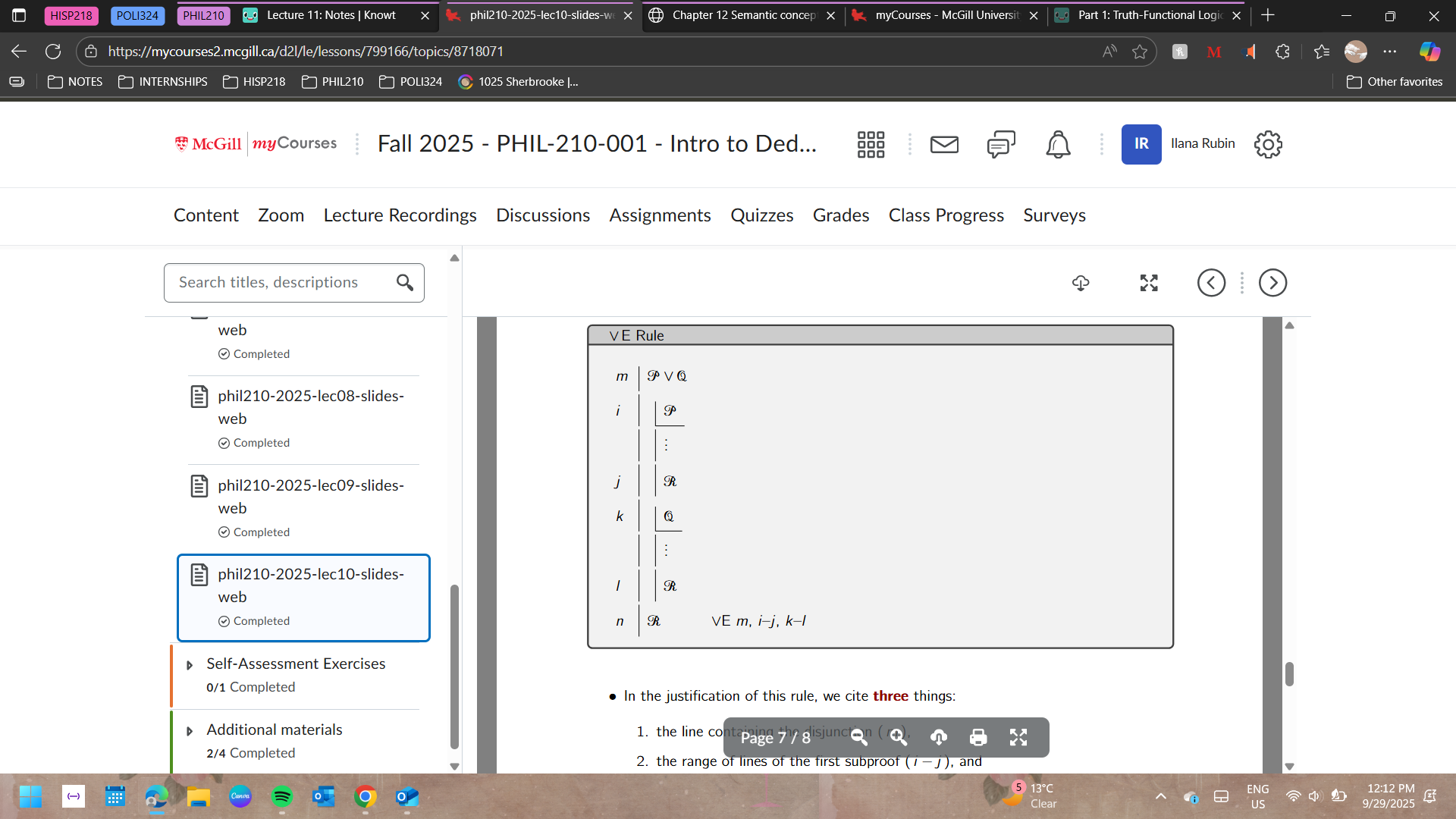
The then justification, cite:
1. the line containing disjunction (m)
2. Range of lines of first subproof (i-j)
3. Range of lines of second subproof (k-l)
Argument based on V E rule is also referred to as proof by cases
Proof strategy (7): If you have a disjunction as a premise, you need to find a sentence R
that is implied by both disjuncts, in order to apply _ E. This can be tricky, although other parts of the proof might give you a clue