Midterm Study Guide
Geography Basics
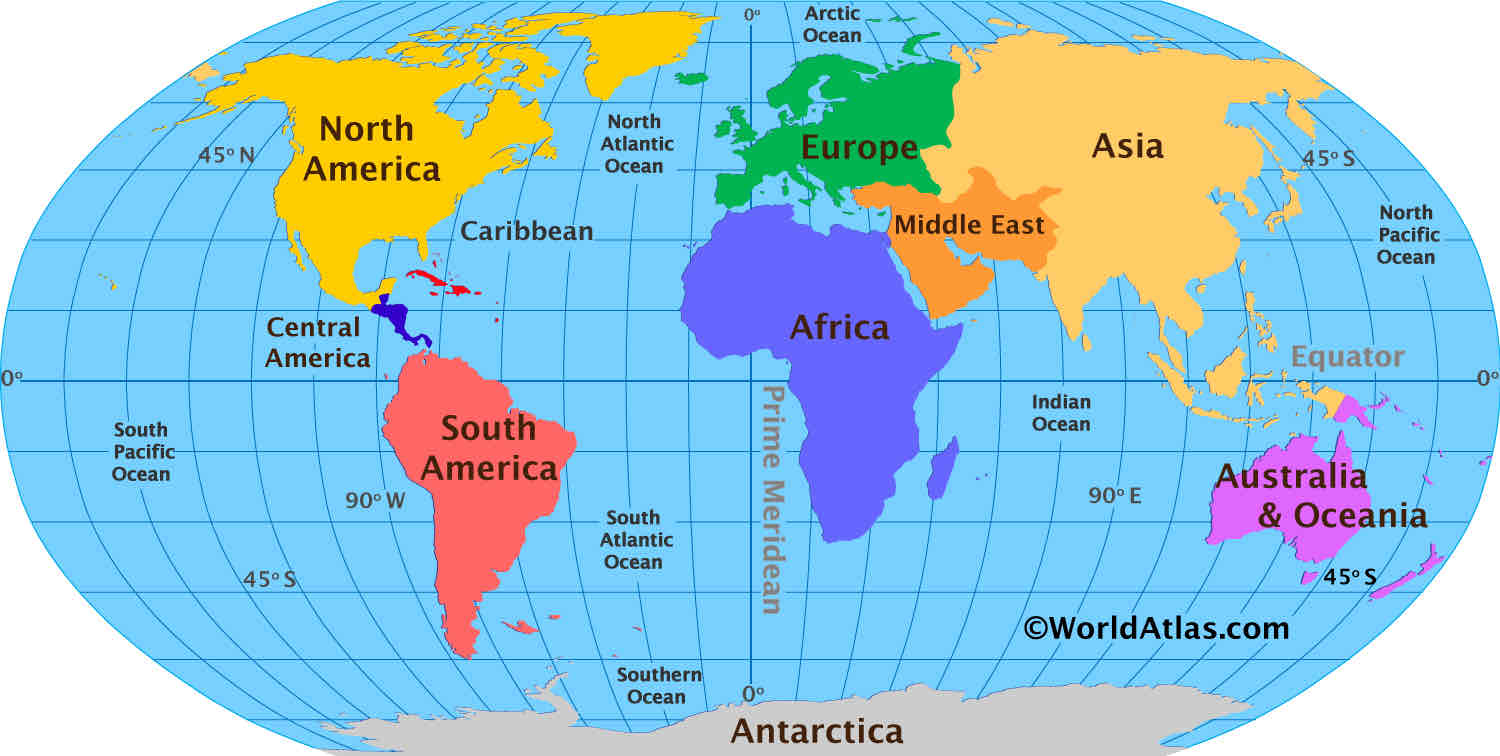
Continents: Africa, Antarctica, Asia, Europe, North America, South America, Australia.
Oceans: Atlantic, Pacific, Indian, Southern, and Arctic.
Absolute Location: Exact position on Earth using coordinates (latitude & longitude).
Relative Location: Position in relation to other places (e.g., "north of the equator").
Key Concepts:
Physical vs. Human Geography: Physical geography includes natural features (mountains, rivers), while human geography covers human-made features (cities, roads).
Impact of Geography on Civilizations: People settle where resources like water and fertile land are available. Mountains and deserts often protect areas from invasion but can isolate
Review Questions:
• Why did early civilizations develop near rivers?
Because they were ways together water and farm
• How does relative location differ from absolute?
Relative location is the location in relation to other places, but absolute location is exact coordinates
2. Paleolithic and Neolithic Eras
Key Terms:
Paleolithic Era: Old Stone Age, when people lived as hunter-gatherers. ( they had to keep moving around)
Neolithic Revolution: The shift to farming and permanent settlements.
Domestication: The taming of animals and cultivation of plants
Key Concepts:
Paleolitic Lifestyle: Nomadic, reliant on hunting and gathering, used fire and basic stone tools.
Neolithic Revolution Impact: Farming and domestication led to stable food sources, population growth, social classes, and specialized jobs.
Benefits of Agriculture: Allowed people to live in one place, led to new technologies, and established trade routes.
Review Questions:
What was the main change during the Neolithic Revolution! They were farming
How did domestication help early humans establish communities? It gives them an away to get food without going so far .
3. River Valley Civilizations
Key Civilizations:
Mesopotamia (Tigris and Euphrates): Known for cuneiform writing and the Code of Hammurabi, one of the earliest written laws.
Egypt (Nile River): Used the Nile's flooding for agriculture, built pyramids, and was led by Pharaohs,
Indus Valley (Indus River): Known for advanced city planning (grid layouts) and sanitation systems in cities like Harappa,
China (Yellow River): Early development along the Yellow River, influenced by philosophies like Confucianism and the Mandate of Heaven.
Key Concepts:
Importance of Rivers: Provided water for crops, transportation, and fertile soil due to flooding .
Cultural Contributions: Writing systems, organized laws, religious beliefs, and social hierarchies developed in these regions.
Review Questions:
• Why were rivers so important to early civilizations?
4. Roots of Judaism and Christianity
Key Figures:
• Abraham: Considered the founder of Judaism.
• Moses: Led the Hebrews out of Egypt and received the Ten Commandments.
•Jesus of Nazareth: Central figure in Christianity, believed by followers to be the Messiah
Core Beliefs:
Judaism: First major monotheistic religion, based on a covenant with God. Sacred texts include the Torah (first five books of the Hebrew Bible).
Christianity: Grew out of Judaism; followers believe Jesus was sent to bring salvation. Sacred texts include the Old Testament (shared with Judaism) and the New Testament.
Historical Influence:
Spread of Judaism: Despite being a minority, it has influenced Western law,ethics, and religious thought.
Spread of Christianity: Expanded rapidly in the Roman Empire and became a major influence on
European culture and government.
Review Questions:
What are the main differences between monotheism and polytheism?
Monotheism is the belief of one god, and Polytheism is the belief of more than one gods.
Practice Questions
How does geography influence where civilizations are established? By short or longer how they live and it was easy to live.
Describe the lifestyle changes from the Paleolithic to the Neolithic Era. In the Paleolithic they would hunter and gather, and Neolithic Era was farming.
What was the significance of the Code of Hammurabi in Mesopotamia? It was laws, that were give them so they could follow something.
Compare and contrast the core beliefs of Judaism and Christianity. They share the same book.
Explain why rivers were essential to the survival and growth of early civilizations. It was give them water so farm and fertile soil.
A government where people had where people choose their representatives through elections limited democracy republic
A time period known as the new stone age when farming a settlements began Neolithic Revolution
Area known as the land between two rivers or the Fertile-Crescent Mesopotamia
Empire in India that brought a golden age in art literature and science Gupta Empire
Major city in the Indus Valley known for its grid like organized pattern Mohenjo Dare
A territory made up of many islands for example Greece Archipelago
A form of government where elections and choosing the government is done by everyone democracy
Set of laws made by the king of Babylonia that included harsh punishments for breaking the law code of Hammurabi
The idea that the soul is reborn reincarnation
City state in Greece that valued democracy, art, poetry and education Athens
Respect for parents Filial piety
City state in Greece where preparing for the military was more important and boys were trained since the age of seven Sparta
Law or rules created by the Romans and an example for modern day Twelve tables
A fusion of Greek, Indian, Egyptian and Persian culture Hellenistic culture
The concept of taking an exam based on specific teaching sin order to obtain a government position civil service
The time period of Roman Peace and a Golden Pax Romana
A Macedonian leader who conquered land from Europe to Asia Alexander the Great
A series of trade routes used in order to transport products from Asia, the Middle East and Europe Silk Road
Roman members of the upper class patricians
Roman members of the lower class Plebeians
A state in which supreme power is held by the people and their elected representatives Republic
Why was the river a valuable source for te early civilizations? It was valuable because it provided water for crops, bathing and a form of transportation and trade
Why are Mohenjo Daro and Harappa examples of urban planning ? BOTH cities near the Indus River Valley developed cities of mud bricks that were organized and even had sewer systems
Why were hieroglyphics and cuneiform important? Both systems of writing provided a way to keep track of trade and they were form of language.
How did the Shang adapt to living near mountains? In order to grow crops, farmers set up a terrace farming system with steps
How did the people in Egypt adapt to their environment? In Oder to obtain water to nearby cities from the Nile, shadoofs were used to carry water to fields.
Why was it difficult for Greece to be united as an empire? This area was made up of many mountains and islands. As a result, they developed different city-states that had different rules but the same language and culture
How did emperor Shi Huangdi maintain control in China? The emperor unified his people and territory by bringing together several pieces of the Great Wall. In addition he used the system of legalism with strict rules and punishment to control.
Why is interconnectedness through trade important? Trade routes like the Silk Road provided products for places in Asia and Europe. They helped spread cultural (cultural diffusion)
1. The Four Noble Truths are to Buddhism as the Ten Commandments are to
(1) Judaism
(2) Hinduism
(3) Shinto
(4) Islam
2. Hammurabi's code of laws and Oin dynasty legalism are similar in that both promoted the idea that
(1) worship of leaders will maintain the power of an empire
(2) an informed citizenry will help maintain peace and prosperity
(3) equality of the people is the most important goal of government
(4) harsh punishments for crimes will lead to a more orderly society
3. The terms Brahma, dharma, and moksha are most closely associated with which religion?
(1) Judaism
(2) Hinduism
(3) Islam
(4) animism
4. In a comparison of the ancient cities of Athens and Sparta, Sparta placed more emphasis on
(1) education
(2) military service
(3) family order
(4) human rights
5. Which Neolithic Revolution development led to the other three?
(1) complex civilizations
(2) domestication of plants and animal
(3) division of labor
(4)surplus of food
6. The river valleys of the Tigris-Euphrates, Huang. Ho (Yellow River), and Indus were centers of early civilization because they
(1) had rich deposits of iron ore and coal
(2) were isolated from other cultural influences
(3) contained rich soils from annual floods
(4) were easy to defend from invasion
7. Which event or events led up to the outbreak of the Peloponnesian War?
(1) Territorial disputes
(2) Economic tensions
(3)Athens allying itself with traditional enemies of Sparta
(4) all of the above
Base your answers to the following two questions on the illustration below and on your knowledge of social studies.
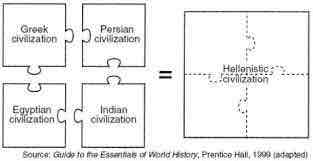
8. Which concept is most closely related to the main idea of the illustration?
(1) isolated
(2) cultural diffusion
(3) armed conflict
(4) urbanization
9. Which leader is most closely associated with the accomplishment shown by the illustration?
(1) Charlemagne
(2) Mansa Musa
(3) Alexander the Great
(4) Suleiman the Magnificent
10. What is the government structure in which the people hold the power by voting for representatives in government to make choices on behalf of the people?
(1) direct democracy
(2) Monarchy
(3) Filial Piety
(4) Republic
11. In which region did China’s earliest civilizations develop?
(1) Gobi Desert Valley
(2) Himalaya Mountains Plateau
(3) Yellow River
(4) Tibetan
12. An artificial waterway constructed to allow the passage of boats or ships inland or to convey water for irrigation is known as a
(1) Canal
(2) Levee
(3) Dam
(4) Aqueduct
Geographic Feature
Definition
Advantage/ Disadvantage H
1. Plain
A broad area of flat land
A: Ease of Transportation
D:Lack of protection
2. Mountain
A large landform that stretches above the surrounding land
A: Protection
D: Difficult access to other places
3. Desert
A hot dry area of land with little rain and plants
A: Protection
D: Lack of water
4. River
A large natural flow of fresh water that crosses an area of land and goes to an ocean, lake, sea etc.
A: Water supply
D: Flood risks
5. Sea
A large body of saltwater that is surrounded in or in part by land.
A: Trade
D: Flood Risks
6. Oceans | A large body of saltwater that covers nearly ¾ of the Earth’s surface | A: Food supply D: Flood Risk |
7. Peninsula | A place of land almost entirely surrounded by the sea . | A: Transportation D: isolation |
8. Archipelagos | A group of islands | A: Food supply D: isolation |