Electrochemistry
The study of chemical reactions that produce electricity or use electricity to drive a desired product (the interchange of chemical and electrical energy).
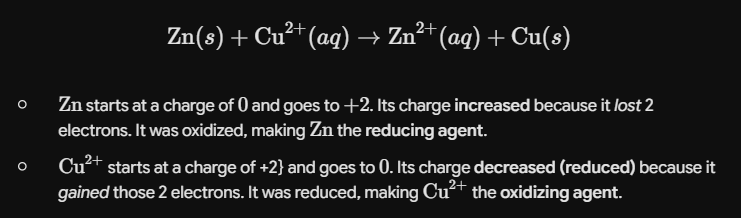
Electrochemical reactions oftren result in electron transfer, often called redox reactions:
Oxidation: electrons are loss from reactant (reducing agent)
Reduction: electrons are gained from reactant (Oxidizing agent)
Redox reactions only occur in reactants and it always happens at the same time
Galvanic Cell
controlled environment for spontaneous redox reactions to occur
produces electricity spontaneously
basically it harnesses the electron transfer to create actual electricity
examples: Battery chargers
Salt bridge acts as a way to balance the build up of charge between cells, thus it also completes the circuit.
There are 2 ways for charges to be conducted
Metallic conduction, the charge travels through metal such as the wires connected in a galvanic cell
Electrolytic conduction, the charge travels through the ions in liquid ie the salt bridge
Half Cell (we focus on the metal)
Reduction (Cathode): Occurs when a dissolved metal ion collides with the electrode, gains electrons, and deposits onto the surface. [RED CAT]
Oxidation (Anode): Occurs when a neutral metal atom on the electrode surface loses electrons and enters the solution as an ion. [AN OX]
Equilibrium: Isolated half-cells quickly establish a dynamic equilibrium between the solid metal and its dissolved ions:
Standard Cell Notation
Anode Electrode | Anode Solution || Cathode Solution | Cathode Electrode
Cells are represented using a shorthand format following specific rules:
A single vertical line (|) or slash (/) represents a phase boundary (e.g., when the reactant to product partnership has different states solid-liquid etc)
A double vertical line (||) represents the salt bridge.
A semi-colon (;) represents a boundary when the reactant to product partnership are same states of matter
Cell Potential and half cell potential
is the energy or force needed for the electron to move from one place to to another ie from anode to cathode within a cell
measured in volts as 1v = 1Jule/coulomb
Voltage is the driving force of the reactions
Cell potential disregards coefficient of equation since its intensive
Higher Charge= reduction
Lower Charge= oxidation
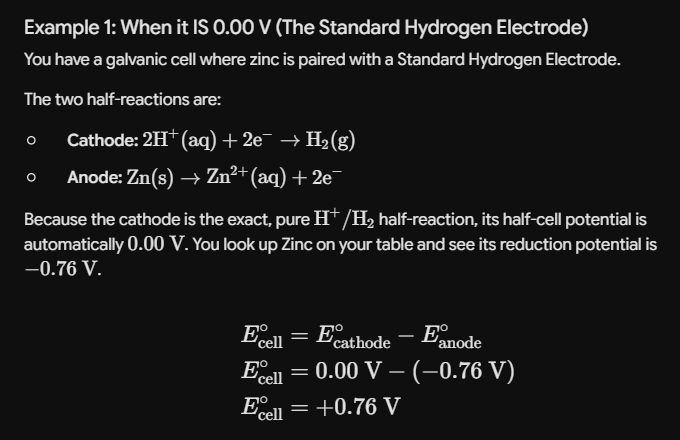
Cell potential is the difference in the potential for cathode and anode, half-cell potential are the individual cell potentials of both
To determine which one is the anode and cathode we can look at the half-cell potential as the lesser one will always be the anode (oxidized)
If half-cell potential is negative then it is easily oxidized, if half-cell potential is positive then it is easily reduced
Special cases
If both sides of your half reaction are lone Hydrogen then its half-cell potential is 0V
Spontaneousness
Predicting Spontaneity using E cell: Given any redox reaction, we can calculate spontaneity based on signs
Spontaneous Reaction: A reaction is spontaneous if E cell (positive value).
Non-spontaneous Reaction: A reaction is non-spontaneous if E cell (negative value). This means the reaction is spontaneous in the reverse direction.
Galvanic Cell Spontaneity: A galvanic cell is always spontaneous because it is inherently designed and set up so that its E cell is positive.