Intro to Factor Markets
Factors = Resources
Firms demand resources (need resources)
land, labor, and capital
land’s payment is rent
Labor’s payment is wages
Capital’s payment is interest
The decision is employ a factor is based on
productivity of the factor
cost of the factor
price of the good/service
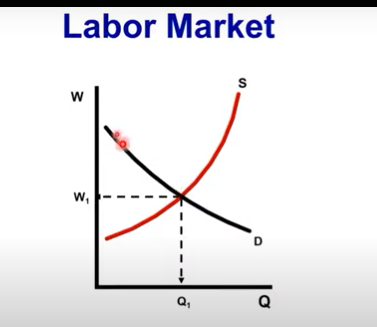
Labor Market
Market demand
many firms with jobs
Market supply
many willing and able workers
Graph:
Wage differentials
Human capital
ability
education
training
Networking
Discrimination
Luck
Minimum Wage: Unskilled labor
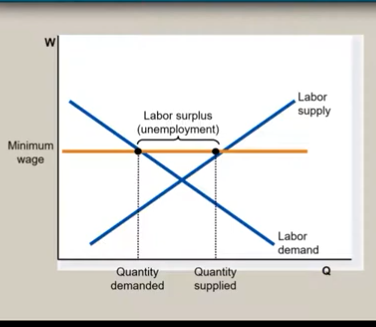
Case Against minimum wage
Unemployment
some small businesses shutdown
Benefits those who don’t need it
Case For Minimum Wage
Fights poverty
fights monopsony (single hirer)
increases productivity
reduces turnover (staying at one job)
Evidence and Conclusions
Creases unemployment
Labor welfare increases
stops monopsonists
Changes in Factor Demand and Supply
Determinants of Factor Demand
Productivity of resource (MP)
better resources
education/training
technology
Price of the product (P)
derived demand - factor demand is derived from (driven by) product demand
Related Factors:
Changes in the price of complementary resources
don’t worry about the price of substitute resources
Determinants of Factor Supply
Immigration/emigration
age distribution
working conditions (better=more people willing to work and vice versa)
Education/Training (inc. in supply)
preferences for leisure (dec. in supply when people do not value work as much)
availability of substitute resources
Profit Maximizing Behavior in Perfectly Competitive Factor Markets:
Marginal Revenue Product (MRP)
MRP= change in Total Revenue/change in Resource Quantity
Marginal Resource Cost (MRC)
Change in Total Resource cost/change in resource quantity
Hire as long as MRP is greater than/= to MRC
The optimal amount of a factor is the last unit where MRP>/= MRC
In perfect competition ONLY:
MP x P=MRP
Imperfect Competition:
Imperfect markets have more inelastic Demand than Perfect
Optimal Combination of Resources
All resources are variable
Last dollar spent on each resource yields the same marginal product
MPL/PL = MPC/PC
Monopolistic Markets
Monopsony Model
single buyer for a type of laobr
“wage maker” behavior
pay all workers the same wage
have to increase wages to attract more workers