Exam revision
Diatoms
what are the characteristics of the chloroplast with respect to chlorophylls and ultrastrucutre?
answer: the chloroplast has 4 membranes. the pigments within the chlorplasts are chl a, chl c, and fucoxanthin. The chloroplasts are connected to the nuclear membrane. the membrane o the chlorplasts have three thylakoids per lamella. the girlde lamella consists of all of this.
explain the cell wall of diatoms
answer: the cell wall is made up of silica. the frustule of the diatom is made up of the epitheca and the hypotheca, kind of like a closed petri dish. the upper view shows the epivalve (the flat top), and the lower view shows the hypovalve (the flat bottom). The girlde band conssits of the epi cingulum and the hypo cingulum, which rim the theca’s. Has narrow pores on the frustule known as aeroeolae.
diatoms get smaller for each cell division. why?
answer: teh epitheca and the hypotheca of hte mother cell splits and a new hypothecated is fromed for each, with the motehr cell’s hypothecated acting as the new epitheca for the duaghter cell. as teh hypotheca in the mother cell is smaller than th eepitheca, one of the daughter cells will be slightly smaller than the mother cell.
how do diatoms restore their original cell size?
asnwer: when they are critically small, they go through meiosis and produce gametes. The gametes then fertilise each other, producing an auxospore (2n). a new silica cell wall is produced inside the auxospore, which is able to produce the largest possible size for the diatom.
flagella, explain their morphology and occurence in diatoms
answer: the gametes have the flagella, and only occurs in centric diatoms. teh flagella is atypical because they lack the central microtubule in the axoneme.
how do pennate diatoms reproduce?
answer: they dont have flagellated gametes. they have an isogamous reproduction, where the gametes cannot be differentiated. first they go through the regular mitotic division
Explain the life cycle of a centric diatom
answer: it is the same as the pennate, excpet that there are the falgellate gametes (the male gametes - sperm) and a non motile female gamete (egg). the auxospore is also circular, and they dont have a perizonium
what are the four groups of convenience and how are they related to each other?
asnwer: raphid pennates, araphid pennates, radial centric, biopolar and multipolar centric diatoms.
green micro algae
what features are characteristics of the green algae?
answer: they are green due to to chl a and b and caretenoids, the chloroplast has 2 membranes, they normally have two flagella and may have more, they are itty bitty or very large, their storage product is starch
they have chl a and b and beta carotene and lutein.
they have light harvesting complexes similar to land plants, which are not found in other algal groups
small rubisco subunit
starch storage
cell walls are made of celluose
two or more flagella ( in multiples of 2) in equal lenght
what are the main differences between the flagellates of teh chlorphyceae (UTC clade) and the pyramimonadophyceae?
asnwer: pyramimonadophyceae has organic scales and chlorphyceae doesnt.
look at notebook lm
what characterises teh trebouxiophyceae?
asnwer: they are symbionts (phycobionts - photosynthetic symbiont) with lichens. unicellular and spherical in shape. they have a semi close mitosis.
describe some characteristic features of the flagellar transition regions of the green alage:
answer: its a stellar construct. its astar shaped pattern. the micortubular stucuture within teh flagella.
describe the green algal chloroplast with respect to ultrastruutre, pigments and type and location of the storage product and eyespot.
Answer: the eyespot and the starch is inside the chloroplast/plastid
green macro algae
what i meant by the terms coenocytic and siphonal?
answer: idk
what do you understand by teh process called conjugation? In what algal group does this take place?
Answer:
haptophytes
what is the typical morphology of haptophytes?
answer: haptonema, 2 flagella, chloroplasts, pyrenoid, cell membrane, they cna have scale, like coccolithophores, pigment: chl a, c, fucoxanthin
describe the morphology and function of teh flagella and how many they have. describe the morphology of the haptonema. Descrbie the occurence of flagella and haptonema among haptophyte taxonomic groups.
answer: the flagella are used fro locomotion. thye have two flagella. the morphology of the flagella: smooth flagella of equal length. Haptonema is used for sensing the environment, prey capture, attachment onto substrates. They are thin and long, can be 10x the body length, can also be shorter than the flagella. the haptonema may be long, coiled or short.
coccoliths: describe how and where different types of coccoliths are produced in the cell of coccolithophores.
answer: heterococcoliths → they produce the coccolith inside the cell body, and then they push it out onto their surface, adding it to their current scales. holococcoliths → they produce the coccoliths outside the cell body, so directly on where they have their current scales. they contain small equally sized cells that are crystals of calcites.
describe the position of haptophyta in the eukaryotic phylogenetic tree:
answer: haptophyta stands alone in the phylogenetic tree. its “closest” relative is teh SAR group.
what type of life cycle is found in haptophyta? describe the life cycle in two genera. What is the advantage or role of such a life cycle?
answer: it has a haploid-diploid life cycle. the rest we skip. advatages: they can escape lethal viral infections by trasnitionig from its diploid, coccolith-bearing phase to virus-resistant haploid phase. They also are able to defend against grazing.
which are teh two main described classes? what are their morphological characterisitcs? a new class was recently described. whats it called?
answer: rappephyceae is the new calss recently described. the two main described classes is pavlovophyceae and coccolithophyceae (prymnesiophyceae).
coccolithophyceae | pavlovophyceae |
two equal flagella or no flagella | unequal flagella |
dont have eyespot | has an eyespot in the chloroplast |
can have coccoliths (scales) | they dont have body scales, but can have knob scsales |
complex cytoskeleton | simple cytoskeleton |
long haptonema or none | more likely to have short haptonema |
which are teh four main orders of class prymnesiophycea (one coccolithophore order can be divided into three orders)? what are their morphological characterisitcs?
asnwer: prymnesiales (genus: prymnesium, chrysochromulina (killed a lot of fish casue of a bloom)), phaeocystales (phaeocystis), coccolithales (coccolithus pelagicus), isochrysithales (genus: gephyrocapsa).
give some examples of genera or species in the four orders above and describe their ecology.
asnwer: LOOK ABOVE
phaecosystis → gelatinous colonies, provided defense agaisnt herbivory, blooms are associated with foams along shores that attach to fish nets and gill, give a foul smell, live as symbionts.
coccolithales → found in deep ocean, and significantly contribute to carbonate deposits
prymnesiales → very widespread, can be mixotrophs, inhabit low light environemnts
gephyrocapsa → quite ubiquitous, forms massive blooms from polar to tropical waters.
what nutritional modes can we find among haptophytes? what can they eat and how? when and where is this nutrition an advantage?
answer: autotrophy and mixotrophy. they eat bacteria and POM. they feed using their haptonema, bringind the food onto the other end of the cell where their “mouth” is. this feeding is advantageous when there is low light.
some haptophytes can form toxic blooms. Mention three species and secribe what sort of problem they may causes and where they ahve formed toxic blooms in norway. Under which environmental conditions have they formed toxic blooms?
asnwer: chrysochromulina leadbesteri → the formed blooms and killed a lot of fish, tons of them, up in lofoten in the aquacuclture pens.
prymnesium parvum → formed blooms in fjords in stavanger since they prefer waters that are low in salinity. it affected the fish farming in that area.
prymnesium polylepis → started in the south coast and moved up north by currents, killing farmed salmon, and benthic animals.
members of phaeocystis may form large blooms that may cause problems too. mention two species and describe problems they may cause.
asnwer: phaeocystis puchetii and phaeocystis globosa. they form blooms that can be seen as big foamy blooms, and can clog teh gills of fishes and block the fishing nets because of how sticky they are in colonies.
haptophytes produce DMSP. what effect can this have on the climate?
answer: DMSP → dimethylsulfoniopropionate. when the haptophyte cells are lysed, enzymes are released to convert DMSP to DMS gas. this gets released intot eh atmosphere, and is transformed by free radiacls into sulfur dioxide and methane sulfonic acid. these materials contribute eto cloud formation in the atmosphere, therefore increasing the albedo. this gives an overall cooling effect. on the downside tho, the sulfur comounds mix with the rain causing acid rain.
coccolithophores have an important role in the biogeochemical cycle in the ocean and thus for the climate. what are the processes that can influence the climate?
asnwer: calcification, where they convert cabronate and calcium to calcium carbonate, which releases CO2 into the atmosphere.
carbon sequestration → coccoliths dont easily defgrade but sink, and create carbon sinks, for example the white cliffs of dover.
albedo influence → the blooms cause a milky green colour which refelcts a lot of light, therefore contributes to global cooling.
dinoflagellates
the dinoflagellates have many types of chloroplasts, describe them and how they are believed to have evolved?
answer: the chloroplasts have evolved from secondary and tertiary endosymbiosis. They are able to retain the plastids from prey they have consumed, a process known as kleptoplastidy. while nearly half teh species are photosynthetic, their plastids have multiple evolutionary origins through tertiary and secondary endosymbiosis.
the most common type of chloroplast in dinoflagellates is the peridinin plastid, which are golden brown and contain teh pigments chl a and c. they are typically bound by an envelope of three membranes and have thylakoids that’s stacked in threes.
the secondary green plastids have originated from a secondary endosymbitic event involving a green alga. a diatom showing this is Lepidodinium.
then there are teritiary plastids, that have evolved from tertiary endosymbiosis. There is the cryptomonad derived, so genera like dinohysis have these plastids, which have the accessory pigments alloxanthin and phycobiliproteins. there are the diatom derived ones, where they have plastids derived from a pennate diatom. then there is teh haptophyte derived, so some dinoflagellates have aquired stbale plastids from teh haptophyte endosymbionts
there are kleptoplastids, which are temporary plastids within the dinoflagellates obtained from stealing them from other engulfed prey for example like cryptomonads.
describe the ultrastrucuture of dinoflagellates
alveoli is a synapomorphy of alveolates, which is why dinofalgellates are placed in the clade Alveolata.
answer: the cell covering of the dinoflagellate is called teh amphiesma. it consists of an external cell membrane underlain by a single layer of membranous sacs called alveoli (they are the sacs behind the plates. There are armoured and unarmoured species. teh armoured species have thecal plates composed of cellulose. The plates fit closely together, overlapping at regions known as sutures. Growth occurs by adding material to the margins of these plates, creating intercalary growth bands. teh unarmoured species have mroe alveoli that are empty or nearly devoid of cellulose contents.
they have a transverse flagella and a longitudinal flagella.t he cingulum is where the trasnverse flagellum is placed and the sulcus is where the longitudinal flagellum is placed.
the nucleus of the dinoflagellate is called a dinokaryon, where they have condensed chromosomes. the mitochondria have tubular cristae. teh plastids are enveloped by three membranes. they contain thylakoids that are stacked in threes.
they have extrusomes which are defensive strucutres: trichocysts are glgi derived protein rods that can elongate eigth times upon discharge, and then there are nematocysts, which are harpoon like ejectile strucutres.
finally there is the ocellus, which is an eye like strucutre with a clear lens, an ocular chamber, and a cup shaped retinoid. it may be used for vision. dinoflagellates also use starch granules as storage products
the eyespot in dinoflagellates may be very simple to quite ellaborate, what kind of eyespots are common in the class?
answer: there are plastid associated eyespots, which has one or two layers of carotenoid lipid containing droplets located between teh three memebrane plastid envelope and the outermost thylakoids.
there is the simple cytoplasmic eyespot which is found in some colorless species
there is the membrane bound remnant eyespots, which is surrounded by three membranes
then there is the ocellus which is light sensing and the strucutre f teh ocellus is very simimlar to that of an animal eye.
what ploidy does teh vegetative state have?
answer: it is haploid (n) except for noctiluca which have a diploid (2n) vegetative state
explain the life cycle of a dinoflagellate. what are resting spores? what are temporary cysts?
answer: look at notebook lm
dinoflagellate may be toxic, mention a few toxic species. who are they toxic for?
answer: alexandrium katanella, alexandrium pseudogonyaulax, dinophysis (tripos, acuta, acuminata, norvegica). everybody and everything
how do dinoflagellates feed?
answer: they are phototrophs, mixotrophs, they use a peduncle (the tentacle thing in noctiluca) and palium (eject their cytoplasm to produce the cape)
why is noctiluca in its own class and instead of dinophycea?
answer: because of genetic analysis that showed that they diverged and evovled earlier than the others within teh group, making them less closely related and giving them their own class.
what are the main orders of class dinophyceae?
answer: gonyaulacales, dinophysiales, peridiniales, gymnodiniales, prorocentrales
we may divide the dinoflagellates into groups. which are the groups that free living dinoflagellates may be grouped into and what features characterise them? how do they relate to taxonomic orders?
answer: they can be caracterised into thecate or a thecate, either with plates or no plates, making them naked.
euglenoids
what are the characteristics of the chloroplast with respect to chlorophylls and ultrastrucutre?
answer: very diverse in morphologies, ring shaped, disc shaped, star shaped. has chlorophyll a and b, carotenoids, xanthophils. there can be multiple chloroplasts and there is no specific number. three membranes. most of them contain a pyrenoid. the eyespot is outside the chloroplast.
explain the strucutre of the pellicula
answer: the pellicula is a part of the cell mmeebrane of euglenoids, which isvery flexible, allowing the eugelonoid movement called metaboly. It acts as a strucutural skeleton. it is basically strips of protein across he memebrnae, which can sometimes be seen as stripes when looked at under a microscope. the strips slide against each other allowing the euglenoid to change their shape, and move and bend.
what are euglenoid movements?
answer: metaboly. they go swish swish and move around like an amoeba
describe the flagella and their location on the cell
answer: they are on the apical end of teh cell. the flagella is long and fine. it comes out of a pocket, which is a depression in the top.
how is the light sensing organelle built?
answer: 2 structures, photoreceptor around or beside the flagella, it senses where teh light is an dit moves towards the light using the flavoprotein. teh eyespot moderates how much light is taken in for processing. it its too briht, it cna cover the photorecptor so it doesnt get damaged. the photoreceptor senses where the light is.
what is the storage product and where is the cell is it located?
answer: storage product is paramylon, located int eh cytoplasm as granules, also outside hte chloroplast.
cryptophytes
what are the characterisitcs of the chloroplast with respect to chlorophylls, accessory pigments and ultrastructure?
answer: chl a + c and phycocyanin and phycoerythrin whoch dont occur in phycobilisomes but the thylakoid, 4 membranes. it is connected to the periplastidial ER. has starch granules. has two thylakoids.
explain the structure of the periplast
answer: the plasma membrane is sandwished between protein layers called the periplast
why do teh cryptomnads have a nucleomorph?
answer: remnant of previous red algae during engulfement
describe the flagella and their location on the cell
answer: two unequal falgella emerging from a pocket called the vestibulum.. they hairs or tiny scale.
explain the furrow/gullet system
answer: think of the cup holder and soda
what are ejectosomes and what do they look like?
answer: it is a dfensive strucutre, coiled up ribbon. they are lying within the furrow gullet system.
what is hte storage product and where in the cell is it located?
answer: the storage product is starch. located inthe periplastidal ER
phytoplankton ecology
what are the size range and size groups of phytoplankton?
answer: phytoplankton can range among a variety of sizes, from a tiny single cell to alrge cololnial forms. the groups: picoplankton from 0.2 to 2.0 µm, nanoplankton form 2.0 to 20 µm, microplankton from 20 to 200 µm, mesoplankton form 0.2 to 20 mm, and macroplankton from 20 to 200 mm.
what characters of phytoplankton are dependent on cell size? how and why?
answer: growth rate and metabolic efficiency are dependent on cell size. smaller phytoplankton have a higher growth and reproduction rate than larger ones. as a cell increases its size, its volume increases as the cube of its radius, whereas teh SA increases only as the square of radius. Consequently the SA to V ratio decreases as size increases. becasue the exchange of nutrients and waste occurs across teh cell surface, a high SA/V ratio makes small cells much more efficient at processing material to support growth. Smaller cells are better at rapid nutrient uptake than larger cells, but larger cells are better at long term storage. Due to teh SA/V ration being higher in a smaller phyoplankton compared to a big one, there is a better ability for them to uptake nutrients during eutrophication than for bigger phyotplankton. however, the smaller ones cant store these, due to less space internally. larger phytoplankton can have more internal space for taking up and storing excess nutrients, such as phosphate, which can be used during periods of scarcity. larger cells have a tendency to sink faster than smaller cells due to the larger volume. the larger animals are less susceptible to grazing than smaller aniamsl. The smaller ones like rotifers and protozoa are easily consumed by small grazers. on the other hand small aniamls that can form colonies are generally immune to predation by most crustaceans.
what are the main abiotic factors influencing primary productino?
answer: the main abiotic factors that influence primary production are light, temperature, and the availability of mineral nutrients. Light is important for photosynthesis, and this factor declines exponentially with depth, with red lght being absorbeed near the surface and blue light penetrating deeper. So the optimum amount of light is within the upper layer in the euphotic zone. However at extreme light levels, phytoplankton at hte very surface of the water are photoinhibited, where photosynthesis is inhibited due to damage of the photosynthetic apparatus. With temperature, higher temperatures usually increase metabolic rate and growth rates until the optimal temperature is reached. Rising temperatures though can cause thermal stratification, which can trap nutrients int he deep water, limiting surface productivity. There is also the avialbnility of nutrients such as phosphorous, nitroge, and iron, which are essential for phytoplankton to bloom. Finally, the physical water motions can influence the distribution of nutrrients and the algae themselves through mixing and upwelling, trubulence, and large scale wind driven eddies.
which are the main macronutrients and micronutrients that phytoplankton need for growth?
answer: the macronutrients they need are carbon (synthesis of all organic compounds), oxygen, hydrogen, nitrogen (for building proteins and chlorophyll), phosphorous (for ATP, DNA, and phosopholipids) , and sulfur. some phytoplankton need silicon, like diatoms, as their bodies/exoskeleton/cell walls are made of silica. The micronutrients they need are as follows: iron, zonc, manganese, copper, cobalt. Most of the micronutrients they require are found in trace amounts, but are essential for the growth of phytoplankton. the most important one out of all mentioned is iron, which is the prmiary limiting factor in HNLC areas of the open ocean.
what is the P-I curve? describe it.
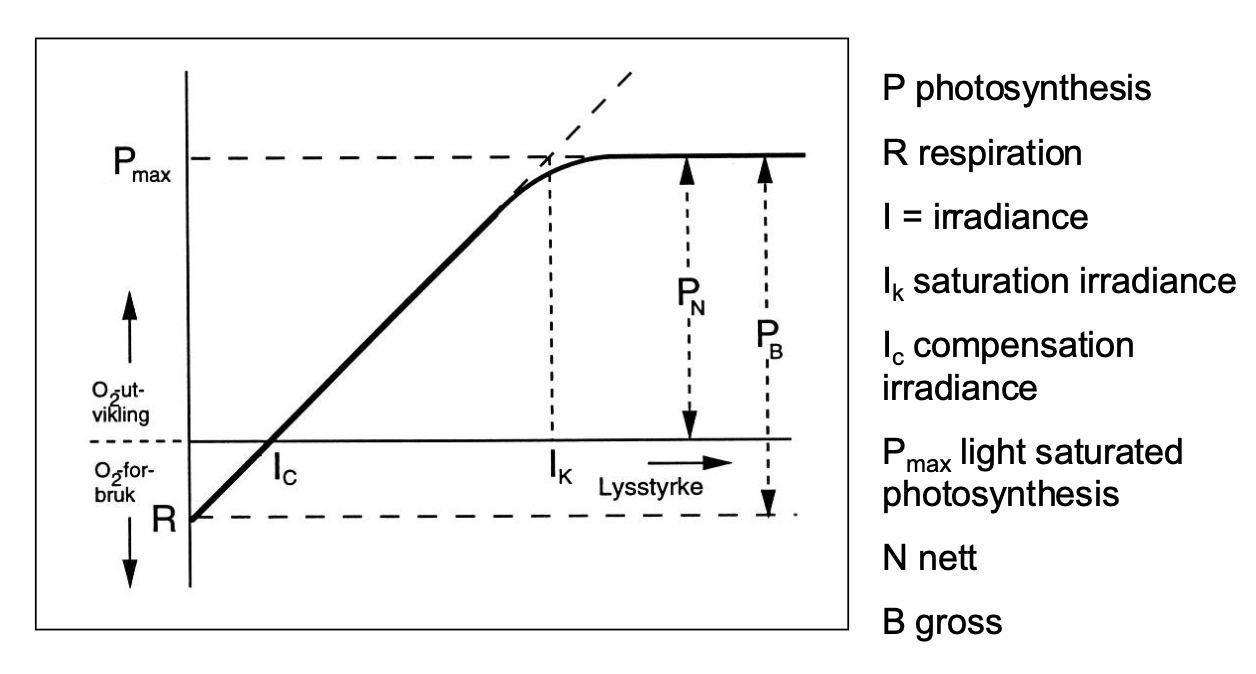
answer: the P-I curve (photosynthesis versus light curve) is a grpahic representation of the characteristic response of planktonic algae to increasing light intensity. it illustrates how the rate of photosynthesis changes as a function of irradiance (E). At very low light levels, the rate of net photosynthesis balances the rate of respiration. THis specific irradiance level is known as the compensation point, where there is zero net oxygen exchange. but when the light intensity increases, teh photosynthesis rate also increases linearly. however there comes apoint whent he photosynthesis rate plateus cause if photoinhibition.
what are the main loss processes or phytoplankton?
answer: loss process are factors that remove or displace phytoplankton from the active population in aquatic environments. some factors are grazong, where predators feed on the phytoplankton. this is dependent on the size of the algae, so the small ones are more easily consumed than the larger ones. the next factor that matter is sedimentation,where its the process of the algal cells sinking out of the euphotic zone. larger animals have faster sedimentation rates than smaller cells. but some cells are able to minimize these losses through gas vacoules in the cell, or increasing theri surface area with apendages on their body. competition, where they compete with other species for space, and one species is then displaced by another. the other one is mortality and lysis, where a viral infection can destroy the cell and cause them to lyse. another loss process is when parasitism occurs.
what factors influence the sinking rate and how?
answer: cell size, density, and turbulence within the water.
the sinking velocity is proportional to the square of the cell’s radius. so larger cells or colonies should sink faster than smaller ones, as they have a larger surface area compared to larger individuals. denisty can also come into play here. Phytoplankton are already denser than seawater, causeing them to sink. if they have cell walls amde of dense material like silica for diatoms, they have a tendency to sink faster than the others.. the denser an animal is, the faaster they sink. one way they can counter the rate of sinking is having lipid or oil droplet within their bodies, giving them a form of bouyacy, as oil is less dense than water. FInally, there are physical motions within the ocean that can infleunce the arate of sinking of an animal. Non motile aniamls like diatoms, depend on turbulent mixing and the vertical water motions to remain suspended in the euphotic zone.
what adaptations cna they have to reduce sinking?
answer: cell appendages, form large wide colonies using mucilage, have gas vesicles or lipid vesicles, or actively swim using flagella, vertical migration, cell size (SA/V)
cell appendages → having horns or spines to increase theri surface area relative to their volume, for example ceratium. they have more elongated flat shapes, therfore maximising drag. They have chitonous fibersthat also increase drag. and light structures, where the cell walls are perforated with pores or slits, which serves to lighten the heavy mineral weight of the cell covering.
bouyancy mechanisms → gas vesicles in the body to keep them afloat. acumulation of lipids in teh body in the form of droplets. mucilagenous sheaths, where many algae are embedded into. because the mucilage has a close density to water, it can reduce the overall density of a alrge colony. however, adding mucilage decreases teh sinking only up to a point, after which the increased diameter of the colony causes the sinking rate to rise again.
active movement → phytoplankton tha are flagellates are abl to propel themselves towards the surface allowing them to maintain their position or perform vertical migration, moving to surface waters by day for photosyntheis and deeper waters at night to aquaire nutrients.
size and physiological state → smaller cells have a reduced sinking velocity in gnenral compared to larger cells. also actively growing and healthy sink more slowly than dead or dying/aging cells of the same species.
explain the microbial food web in relation to the classical food chain.
answer: the basic food web is depicted as a linear food chain supported by larger primary producers. the microbial food in context to this is where energy that is usually unvaialble to the classic food chain is processed. The consumption of DOC excluded by living algae or released from decaying cells. bacteria take up this DOC, effectivly reclaiming it for the food web. the microbial foodweb is teh dominant pathway in nutrient poor waters, such as subtropical ocean gyres, where small cells have a competitive advantage in nutrient uptake. so basically. phytoplankton eat the bacteria. but the bacteria are also able to fix DOC and nitrogen and carbon or consume them, so the released energy from teh bigger animals is recycled back uo into the regular food chain.
describe the different food webs dependent on the nutrient levels and ratio.
answer:
phytoplankton have patchy distribution. explain.
answer:
describe typical stratification paterns in frent climate zones. what consequences do the stratification have for primary production?
answer:
what is top-down and bottom-up control of phytoplankton? give examples for both
answer:
what is Hutchinson’s plankton paradox? how can this be explained?
answer:
what environmental factors related to climate change will infleunce primary production in the ocean? how may these factors influence primary production?
answer:
what changes can we see and also expect more of in the phytoplankton production due to climate change?
answer:
mid term questions
you are looking at a sample from the top green layer of a colorful microbial mat on mud flats. Using phase contrast and floursence microscopy, you see evenly spaced cells in teh middle of a filament that are slightly smaller than the others. The smaller cells are not flourescent, indicating they lack chlorophyll, but the rest of the filament is flourescent. what are these specialised cells int eh filamentous cyanobacteria you are most likely looking at? what is their function and why do they not contain chlorophyll?
answer:
phycobilisomes contain three different pigment. what are they called? what colour does each pigment have? what is their main funciton?
answer:
most of the floridophyceae present a unique sexual life cycle. describe an example and explain the importnace of it.
answer:
describe and discuss the evidences that support the theory of primary and secondary origin of the chloroplast. which taxonomic groups are examples of organisms with primary and secondary chloroplast origins?
answer:
a recent agal bloom off the coast of norway has killed millions of salmon. you’ve recieved a pure, monospecific sample or culture of the suspected algae. what steps and methods would you use to identify the species responsible for the bloom?
answer:
what is the phylogenetic species concept?
answer:
describe the morphological synapomorphy found among teh members of the stramenopile lineage.
answer:
describe the ecological and economic importance of brown algae?
answer:
what are the different growth modes in brown algae, and which one is present in kelp?
answer:
compare the three types of cytokinesis (furrowing, phycoplast, and phragmoplast) in chloroplastida and explain how they relate to evolutionary groups.
answer:
what are two key features of chloroplasts in chloroplastida?
answer: