Anatomy and Physiology
Anatomy and Physiology
Form and Function
Vocab
- Physiology
- The study of biological systems (body-organ function)
- Anatomy is divided into several branches
- Gross anatomy- study of structures that can be viewed by the naked eye
- Histology- the study of tissues with the use of a microscope
- Comparative anatomy- compares body structure of different species
- Embryology- the study of in-utero development
Anatomical Locations
- Dorsal
- Top of the animal
- Ventral
- Belly or underside
- Cranial (Anterior)
- Towards the front or head of the animal
- Caudal (Posterior)
- Towards the rear
- Medial
- To the inside; extending toward the middle
- Lateral
- To the outside; away from the inside
- Anatomy
- Focus on external parts of livestock species
- Physiology- how systems work together
- Integumentary
- Skeleton
- Muscular
- Circulatory
- Respiratory
- Digestive
- Nervous
- Reproduction
Integumentary System
- Exterior covering of the body
- Skin
- Modified appendages of skin
- Hair
- Woll
- Horns
- Feathers
- Hooves
- Function
- Physical protection
- Protection against infection
- Temp regulation - sweat
- Environment response – sensory nerves
- Glands for secretion
- Two primary layers
- Epidermis- outer layer
- Dermis- inner layer
- Hair
- Coat covering of cattle, horse, pig, goat
- Wool
- Coat covering of sheep- finer texture, soft
- Feathers
- Covering of poultry
- Chickens molt in late summer- shed old feathers- and grow new in time for winter
Skeletal System
- In farm animals, the skeleton is internal (endoskeleton)
- Skeletons of farm animals are very similar
- Qhave mostly the same bones - the size of bones may vary
- 5 major functions
- Support: the body is kept in position by the muscles that attach to the skeleton
- Protection: the flat bones that protect internal organs
- Movement: provided by the joints
- Blood Production: blood cells are produced in the bone marrow
- Storage: Minerals are stored in the bone, mostly calcium and phosphorus
- Outside of the bones are hard
- Minerals are stores- mainly calcium
- Inside of bones are soft tissue
- Bone marrow
- Red marrow- blood cell formation
- Bone marrow
- Skeleton grows as an animal grows
- Bone growth ceases as an animal matures
- Bone calcifies = physical maturity
- Bone growth can be affected by
- Nutrition- vitamins and minerals
- Hormones
- Exercise
- Bones may break
- The animal body can mend or repair a break
- Bones are joined - at the joint
- Held together by ligaments
- Joins are lubricated with synovial fluid
- Movement - made possible by joints powered by muscles
- Ball and socket
- Rotation all directions
- Hips
- Rotation all directions
- Hinge joints
- Two directions
- Pasturn, knee, shoulder
- Two directions
- Pivot joints
- Neck- work together for directional movement
- Gliding joints
- Vertebrae - flex
- Ball and socket
Bone Classification
- Long Bones- Limbs, support the weight
- Short Bones- Knee and Hock, dissipate concussion
- Flat Bones- ex. Ribs, Scapula, and Some bones of the skull and enclose cavities containing vital organs
- Irregular Bones- unpaired bones, ex. Vertebrae and some skull bones
Muscular System
- Muscle fibers made up primarily of protein
- Actin
- Myosin
- Tropomyosin
- Troponin
- Groups-
- Involuntary
- Voluntary
- Three types:
- Skeletal
- Cardiac
- Smooth
- Three types:
Involuntary Muscles
- It can be smooth or striated
- Most are smooth (the 🫀heart is an exception)
- Involuntary smooth muscles
- Found in the walls of many body organs
- Digestive
- Move ingesta (🥨🥖🥩food) along the tract
- Reproductive 🍑🍆
- Parturition, ova (🥚egg), movement
- Respiratory🫁
- Digestive
- These muscles are controlled by the autonomic nervous system - hormones - contract or relax 🧘🏼♀️
- Found in the walls of many body organs
- Autonomic nervous system muscular control
- Sympathetic is when an animal needs to get the hell out of town- speeds up muscles, heart rate, and eyes, and slows down digestion
- Fight or flight
- Parasympathetic slows muscles but speeds up digestion
- Rest and digest- After a big Thanksgiving meal you need a nap
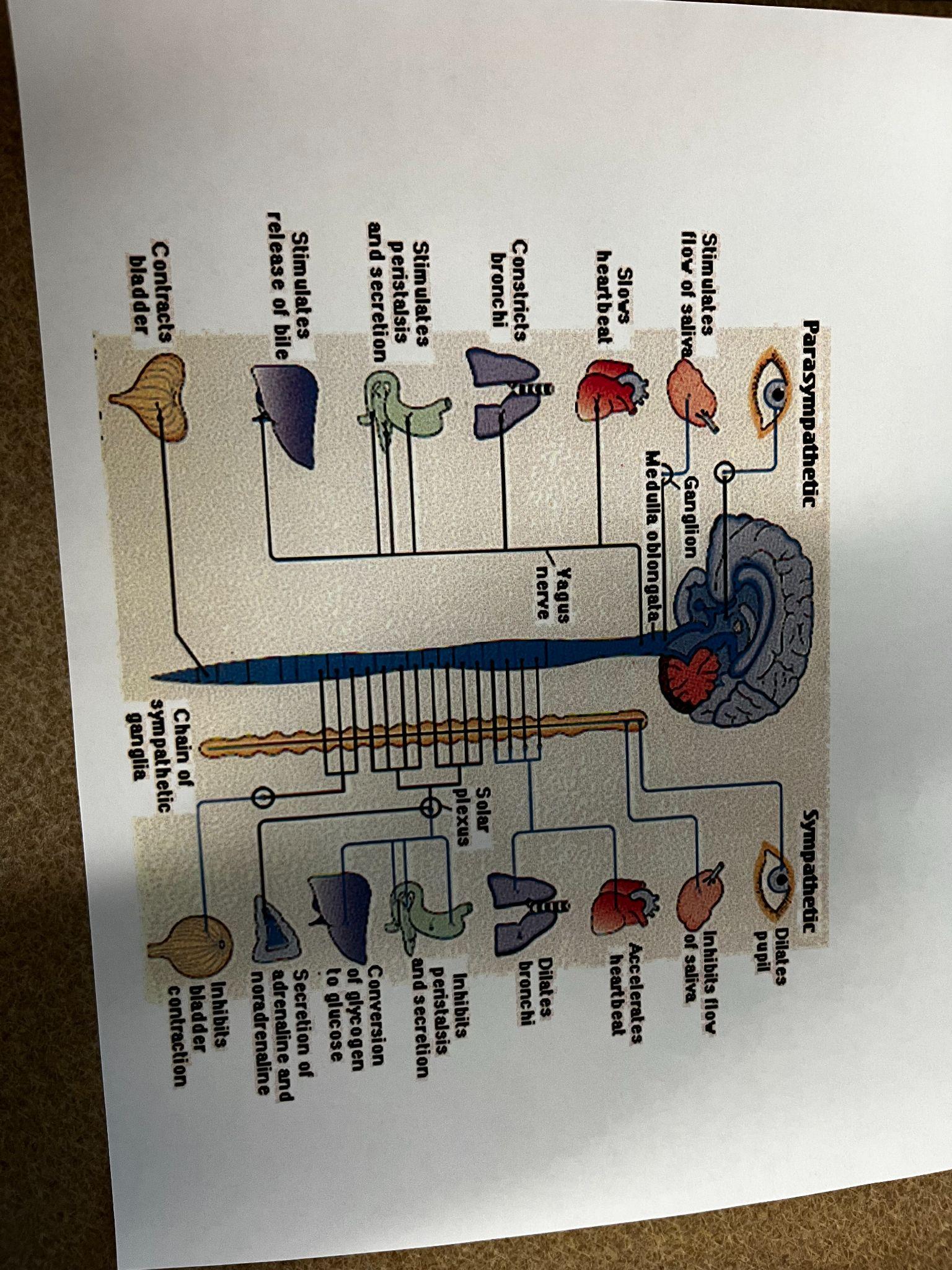
- Rest and digest- After a big Thanksgiving meal you need a nap
- Sympathetic is when an animal needs to get the hell out of town- speeds up muscles, heart rate, and eyes, and slows down digestion
Voluntary Muscles
- Striated muscles
- Function when the animal calls on them
- Skeletal muscles
- Movement
- The heart is a working muscle that is involuntary
Muscular Contraction
- The actual contraction
- Muscles made up of fibers and bundles of these fibers
- Contraction shortens these fibers and bundles
- Sliding or ratcheting along each other
- Relaxation allows them to lengthen back out
- Contraction shortens these fibers and bundles
- Muscle contraction is a very complex biochemical process that uses energy
- ATP (ADENOSINE TRIPHOSPHATE)
- The main source of energy
- When muscle is stimulated - ATP is broken down to form energy
- ATP is formed by:
- Using blood glucose to make ATP
- Breaking down glycogen (fat) to glucose to make ATP
- Dieting
- Breaking down fat and protein molecules (muscles💪🏻) to make ATP
- Starving- Last Options
- Good dairy cattle- can’t consume enough energy because lactation takes so much energy
- Muscle contraction can happen with or without oxygen
- With oxygen = much more efficient and by-products are being eliminated
- Aerobic process
- Without oxygen = a build-up of lactic acid (can be only for a short time)
- Anaerobic process
- With oxygen = much more efficient and by-products are being eliminated
- Fatigue = can’t make this reaction happen fast enough
- Might be low on glycogen
- Most likely low on oxygen
- Go to no oxygen path
- This cannot be sustained for a long period of time
Circulatory system
- Composed of:
- Cardiovascular system- blood distribution
- Lymph system- Lymph distribution
- Made up of:
- Heart
- Arteries
- Capillaries
- Veins
- Lymph vessels
- Lymph Nodes
- Functions
- Gas transport
- Oxygen to the tissues/muscles
- CO2 (waste gas) out via lungs - respired
- Nutrient transport to cells
- Glucose- for ATP production
- Vitamins and Minerals for cell function
- Waste transport out of the cells-body
- Ammonia from protein digestion
- Transported to the liver and converted to euro
- Urea transported to the kidney
- Excretion in urine
- Acids from anaerobic contractions
- Ammonia from protein digestion
- Transportation hormones
- Regulate daily functions
- Contain cells that fight infection
- Stabilize the pH of body fluids
- It helps regulate body temp
- Gas transport
- Key contributors to the circulatory system:
- Bone marrow
- Production of blood cells
- Spleen
- Storage of blood cells
- Removes damaged/old blood cells
- Bone marrow
- Blood Flow
- Heart>
- Lungs>
- Heart>
- Arteries>
- Arterioles>
- Capillaries>
- Venules>
- Veins>
- Heart
Vessels
- Heart
- Located in the chest (thoracic) cavity, between lung lobes
- Pump that circulates blood throughout the body
- Actually a double-pump
- The right atrium and right ventricle
- The left atrium and left ventricle
- Valves in the heart prevent backflow
- Actually a double-pump
- Failure=Death
- Arteries
- Blood vessels that carry oxygenated blood from the heart tissues and organs
- One exception- is the pulmonary artery because it has not been to the lungs yet
- Thick-walled to take pressure, and pump blood everywhere
- Arteries branch into Arterioles
- Capillaries
- Smallest diameter blood vessels
- Red blood cells travel single-file
- Run through muscle, fat, and organ tissues
- This is where:
- Nutrients given to tissue cells
- Oxygen given to tissue cells
- CO2 waste taken from tissue cells
- **SITE OF EXCHANGE**
- Smallest diameter blood vessels
- Veins
- Blood vessels that return blood back from tissues to the lungs and to the heart
- Blood in veins going to the heart is low oxygen- high CO2
- Gets oxygenated in the lungs
- One exception to low oxygen blood in veins in the Pulmonary Vein
- Veins are larger in diameter than arteries to make it as easy as possible for blood to return to the heart
- Blood pressure in veins is low
- Veins have valves to prevent backflow
- Blood vessels that return blood back from tissues to the lungs and to the heart
Blood
- Two parts:
- Liquid = Plasma
- Cells
- Plasma
- Water 90%
- Dissolved gases
- Enzymes
- Glucose
- Wastes
- Salts
- Proteins
- Hormones
- Antibodies
- Erythrocytes
- Aka- red blood cells
- Produced in bone marrow
- Life span in people is about 90-120 days(3-4months)
- Filled with hemoglobin
- This is needed for oxygen transport
- Oxygen attaches to hemoglobin
- Dead red blood cells are removed by the spleen
- Leukocytes
- Aka- white blood cells
- Short-lived- days to weeks
- 1 Fight disease by attacking and engulfing bacteria (Neutrophils)
- 2 Or fight disease by producing and releasing antibodies
- (Lymphocytes)
- Antibodies are specific to disease organisms
- Become immune to a disease
- Platelets
- Irregularly shaped and colorless
- Coagulate-
- Form blood clots