AF 1401 - Lecture Week 3
Expenses are recorded when the benefits are received, until then it is a prepayment.
If you buy groceries on a business card, it is a personal expense.
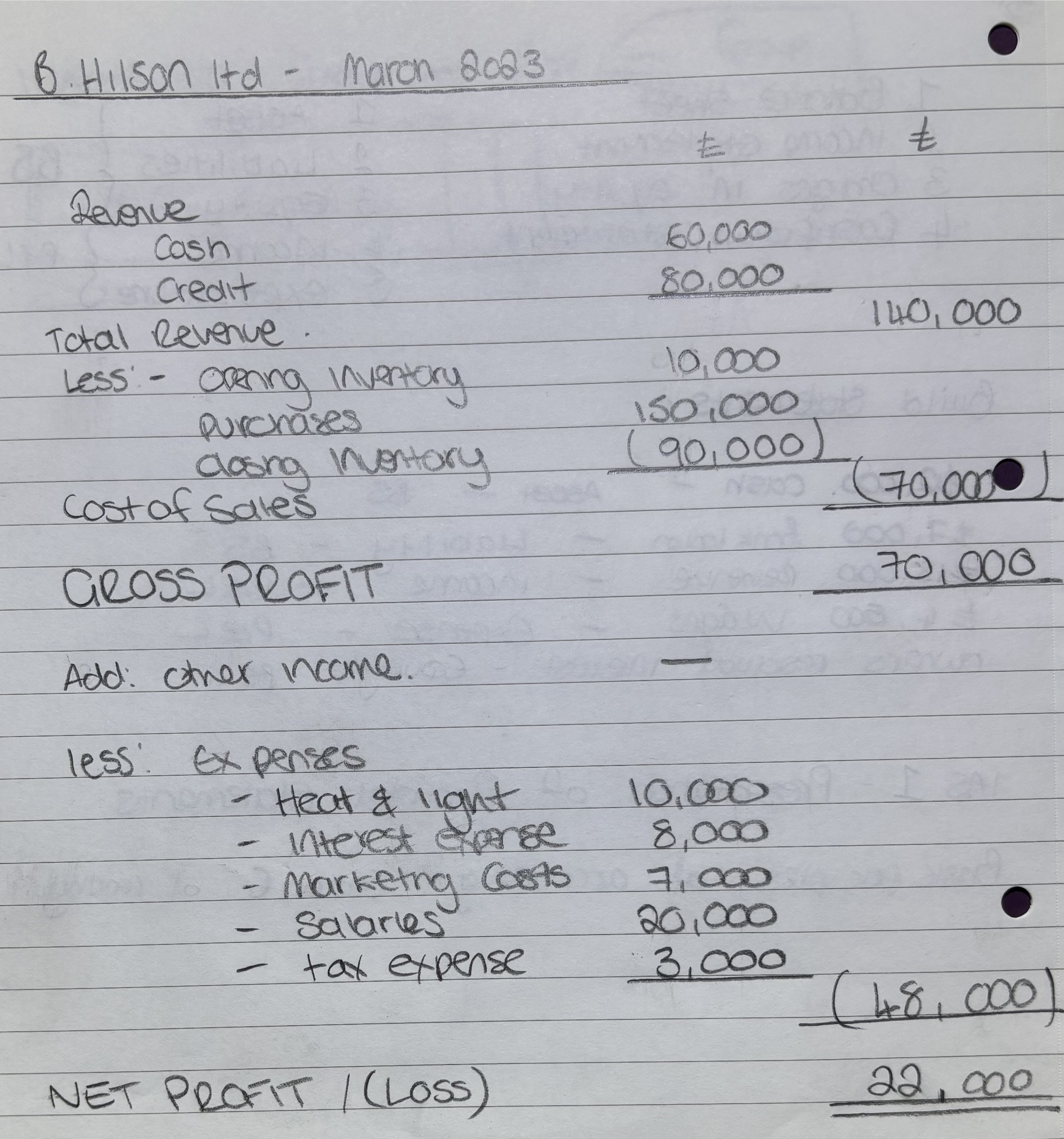
Profit and Loss:
Made of Income and Expenses
Income - Expenses = Profit/Loss
Other incomes also known as sundry

Cost of Goods Sold:
Opening Inventory + Purchases - Closing Inventory = Cost of Sales
50 + 250 - (100) = 200
Balance Sheet:
Made of Assets, Liabilities, and Equity.
Asset: A resource the business owns or controls, resulting from a past event and is expected to generate future economic benefit.
Liability: A present obligation arising from past events and settlement is expected to cause an outflow of economic resources.
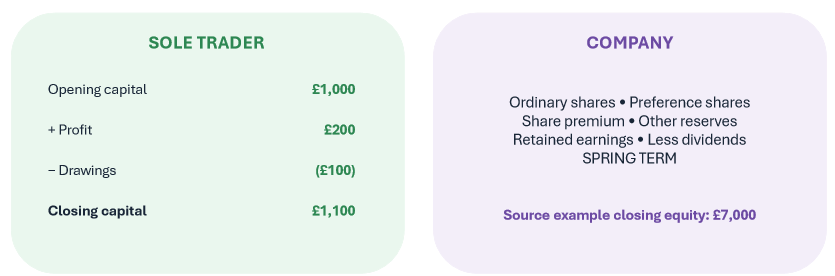
Equity (Capital):
Cost Classification:
Revenue expenditure and Capital expenditure.

Topic 2 has been completed!
ICAEW Reading
Chapter 2: The accounting equation
1 Assets, liabilities and the business entity concept
1.1 Assets
The Conceptual Framework states that an asset is a resource controlled by the entity as a result of past events from which future economic benefits are expected to flow.
Some assets are held and used in operations for a long time. For example, an office building or a machine. These are long-term or non-current assets.
Other assets are held for only a short time. A newsagent, for example, has to sell his newspapers on the same day that he gets them. Short-term assets are called current assets.
1.2 Liabilities
The Conceptual Framework states that a liability is a present obligation arising from past events, the settlement of which is expected to result in an outflow of resources from the business embodying economic benefits.
Liabilities are also categorized as either non-current (payable in more than 12 months) or current (payable in less than 12 months).
1.3 Capital
The Conceptual Framework states that capital (which it calls equity in the context of a company, as we shall see in Chapter 11) is the residual interest in the assets of the entity after deducting all its liabilities. It is effectively what the business owes the owner.
2 The accounting equation
2.1 What is the accounting equation?
Liza opens a flower stall and invests £2,500 into it. The business is a separate entity in accounting terms and so it owes the money to Liza as capital.
Assets | = | Capital | + | Liabilities |
£2,500 (cash) | = | £2,500 | + | £0 |
Liza then purchases a market stall for £1,800 and some flowers for £650.
Assets | = | Capital | + | Liabilities |
£1,800 (stall) | = | £2,500 | + | £0 |
£650 (goods) | ||||
£50 (cash) | ||||
£2,500 |
Liza sells all her flowers for £900 cash, creating a profit on the flowers of £250 (£900 less £650).
Assets | = | Capital | + | Liabilities |
£1,800 (stall) | = | £2,500 (introduced) | + | £0 |
£0 (goods) | £250 (profit) | |||
£950 (cash) | ||||
£2,750 | £2,750 |
Note that:
} profits are added to owner’s capital
} losses are deducted from owner’s capital
2.2 Appropriation of profits: sole trader drawings
A sole trader does not get paid a wage; they 'draw out' or appropriate some of their capital as drawings (money and goods taken out of the business by its owner).
WORKED EXAMPLE: THE ACCOUNTING EQUATION (CONTINUED)
Liza decides to pay herself £180 in “wages” at the end of the week.
Assets | = | Capital | + | Liabilities | |
£1,800 (stall) | = | introduced | £2,500 | + | £0 |
£0 (goods) | plus profit | £250 | |||
£770 (cash) | Less drawings | (£180) | |||
£2,570 | Closing capital | £2,570 |
In the following week, Liza purchases flowers for £740 cash.
Assets | = | Capital | + | Liabilities | |
£1,800 (stall) | = | Opening capital | £2,570 | + | £0 |
£740 (goods) | |||||
£30 (cash) | |||||
£2,570 |
She employs Ethel for the day and pays her £40. They sold all the flowers for £1,100 cash. Liza drew out £200 for herself.
The profit calculation will be:
£ | £ | |
Sales | 1,100 | |
Less cost of goods sold | 740 | |
Less Ethel’s wage | 40 | |
(780) | ||
Profit | 320 |
Assets | = | Capital | + | Liabilities | |
£1,800 (stall) | = | Opening capital | £2,570 | + | £0 |
£0 (goods) | Plus profit | £320 | |||
£890 (cash) | Less drawings | (£200) | |||
£2,690 | Closing capital | £2,690 |
Cash being: £30 brought forward + £1,100 cash sales - £40 Ethel’s wages – £200 drawings = £890
3 Credit transactions
3.1 Trade payables (creditors)
A trade creditor is a person to whom a business owes money for trading debts. The amounts outstanding to these suppliers are called the trade payables (a current liability of a business).
3.2 Trade receivables (debtors)
A debtor is an amount outstanding from a customer. The amounts due are known as trade receivables (a current asset of a business).
WORKED EXAMPLE: THE ACCOUNTING EQUATION (CONTINUED)
Liza invests another £250 and borrows £500 from her Uncle Henry.
Assets | = | Capital | + | Liabilities | |
£1,800 (stall) | = | Opening capital | £2,690 | + | £500 (loan) |
£0 (goods) | Capital introduced | £250 | |||
£1,640 (cash) | |||||
£3,440 | £2,940 |
Liza buys a van for £700 on credit.
Assets | = | Capital | + | Liabilities | |
£1,800 (stall) | = | Opening capital | £2,690 | + | £500 (loan) |
£700 (van) | Capital introduced | £250 | £700 (payable) | ||
£0 (goods) | |||||
£1,640 (cash) | |||||
£4,140 | £2,940 | £1,200 |
Liza buys £800 flowers, paying £750 in cash and £50 on credit.
Assets | = | Capital | + | Liabilities | |
£1,800 (stall) | = | Opening capital | £2,690 | + | £500 (loan) |
£700 (van) | Capital introduced | £250 | £700 (payable - van) | ||
£800 (goods) | £50 (trade payable) | ||||
£890 (cash) | |||||
£4,190 | £2,940 | £1,250 |
The goods are sold for £1,250 in cash. Ethel’s wages were £40 (paid), Uncle Henry’s interest charge is £5 (not paid yet) and Liza took £240 in “wages” (paid).
The profit calculation will be:
£ | £ | ||
Sales | 1,250 | ||
Less cost of goods sold | 800 | ||
Less Ethel’s wage | 40 | ||
Less interest expense | 5 | ||
(845) | |||
Profit | 405 |
Assets | = | Capital | + | Liabilities | |
£1,800 (stall) | = | Opening capital | £2,690 | + | £500 (loan) |
£700 (van) | Capital introduced | £250 | £700 (payable - van) | ||
£0 (goods) | Plus profit | £405 | £50 (trade payable) | ||
£1,860 (cash) | Less drawings | (£240) | £5 (interest due) | ||
£4,360 | £3,105 | £1,255 |
Interactive Question:
How would each of these transactions affect the accounting equation in terms of an increase or decrease in an asset, capital or a liability?
(a) Purchasing £800 worth of goods on credit
(b) Paying the telephone bill £25
(c) Selling £450 worth of goods for £650
(d) Paying £800 to a credit supplier
4 The statement of financial position
The statement of financial position of a business shows its financial position at snapshot in time, highlighting its liabilities, capital and assets. As such it is an extension of the accounting equation.
4.1 Proforma statement of financial position
NAME OF BUSINESS STATEMENT OF FINANCIAL POSITION AS AT (DATE)
£ | £ | |
Non-current assets | X | |
Current assets | X | |
Total assets | x | |
Capital and liabilities | ||
Capital brought forward | X | |
+ capital introduced | X | |
+ profit for period | X | |
- drawings | X | |
Closing capital | x | |
Non-current liabilities | x | |
Current liabilities | x | |
Total capital and liabilities | x |
5 Capital and revenue items
5.1 Capital and revenue expenditure
} Capital expenditure: Expenditure which results in the acquisition of long term assets, or an improvement or enhancement of their earning capacity.
Creates a non-current asset in the Statement of Financial Position (see Chapter 10)
} Revenue expenditure: expenditure incurred either for trade purposes (purchase of raw materials, wages and salaries, administrative expenses) or to maintain the existing earning capacity of long term assets (repairs and maintenance).
Creates an expense in the statement of profit or loss.
5.2 Capital and revenue income
} Capital income: proceeds from the sale of non-current assets. The profit or loss on sale of the assets is included in the statement of profit or loss in the period that the sale takes place.
} Revenue income: Income derived from the sale of trading assets or provision of service (“Revenue”) and interest or dividends received.
Solutions
Chapter 2 The accounting equation
Examples of assets
Examples of assets could be any of: cash, trade receivables, inventories, prepayments, non-current assets (vans, buildings, land, equipment, computers) intangible assets (goodwill, brand names)
Examples of liabilities
Examples of current liabilities could be any of: overdraft, bank loans repayable within a year, trade payables, accruals, tax payable.
Examples of non-current liabilities could be loans repayable in more than a year, provisions.
Interactive question: the accounting equation
(a) Increase assets by £800, increase liabilities by £800
(b) Decrease assets/cash by £25, decrease capital (profits) by £25
(c) Increase assets by £200 overall, increase capital (profits) by £200.
(d) Decrease assets by £800, decrease liabilities by £800
Interactive question: asset classification
(a) Non-current asset
(b) Non-current asset
(c) Current asset (inventories for a car trader)
(d) Non-current or current asset depending on how long the investment is to be held for.